I have heard the same sentence several times in the last week.
"I asked AI, and it said..."
Sometimes the sentence ends with, "you were wrong." Sometimes it ends with a recommendation. Sometimes it is used as proof that the person making the argument must be right.
And I think we need to stop for a moment.
You did not ask an all-knowing authority and receive the truth.
You asked a particular system, using a particular model, with a particular prompt and a particular amount of context. It gave you advice. You then decided what weight to give that advice.
That final decision is still yours.
Why "AI said" feels so powerful
This is not about people being foolish. It is about how human beings handle advice and authority.
Research has found that people can show algorithm appreciation: in some settings, particularly when they are not experts in the task, they give more weight to advice when they believe it came from an algorithm rather than another person.
That makes intuitive sense. A machine can feel detached from ego, politics, mood, or self-interest. Its answer arrives quickly, confidently, and often in beautifully structured language. It can feel less like one opinion and more like a verdict.
But fluency is not authority.
The answer may be excellent. It may also be incomplete, built on weak context, based on an ambiguous question, or simply wrong. The important point is that the answer still needs a person to judge it.
The convenient disappearance of the source
If somebody said, "I read a book and the book says you are wrong," we would immediately ask which book.
Who wrote it?
When?
What evidence did they use?
Did the author know anything about our particular situation?
"I asked AI" quietly removes all of those useful questions.
Which AI?
Which model and version?
Was it using web search, a company knowledge base, an old training cutoff, or no external evidence at all?
What did you ask it?
What did you leave out?
Did you ask it to challenge your position, or only to help you justify it?
Psychologists use the term epistemic vigilance for the mental work involved in judging information and its source. We depend on other people for knowledge, but we also need ways to test their competence, motives, evidence, and plausibility.
When the source is reduced to the single word "AI", that vigilance becomes harder. The system sounds universal just as the details that would let us assess it disappear.
Cognitive offloading is useful. Accountability offloading is not.
We already offload parts of our thinking all the time.
We use calendars to remember appointments, calculators to perform arithmetic, maps to navigate, and documents to preserve knowledge. Psychologists call this cognitive offloading: using the world around us to reduce the mental demand of a task.
That is not laziness. It is one of the ways humans extend what they can do.
AI is an extraordinary cognitive tool. It can help us search, compare, draft, test a line of reasoning, find counterarguments, and explain something at the level we need.
But there is a line between offloading work and offloading judgement.
There is an even clearer line between offloading judgement and offloading accountability.
"AI said" can become a psychological escape hatch. If the answer works, I can use it. If it fails, the machine was wrong. My own choice becomes strangely invisible.
That is not a healthy relationship with advice, whether the advisor is a person, a book, a consultant, or a model.
Automation bias turns review into confirmation
Researchers have studied automation bias for decades. In decision-support settings, people can follow an automated recommendation even when it is wrong, or fail to notice something because the system did not flag it.
The danger is not simply that automation makes mistakes.
The danger is that the presence of automation changes the human task. Instead of independently deciding, the person starts checking whether there is an obvious reason to disagree. Review becomes confirmation.
This is why a human-in-the-loop label is not enough. The UK's Information Commissioner's Office says meaningful human review requires knowledge, authority, independence, and the real ability to challenge or override an automated recommendation. A person who merely clicks approve is not providing meaningful oversight.
Research into AI-assisted decisions has found that small forms of cognitive friction can reduce overreliance. Asking people to make an initial judgement before seeing the AI answer, requiring them to consider an alternative, or making them explain why they agree can force the mind back into the decision.
People do not always enjoy that friction.
That may be the point.
You are the A in AI
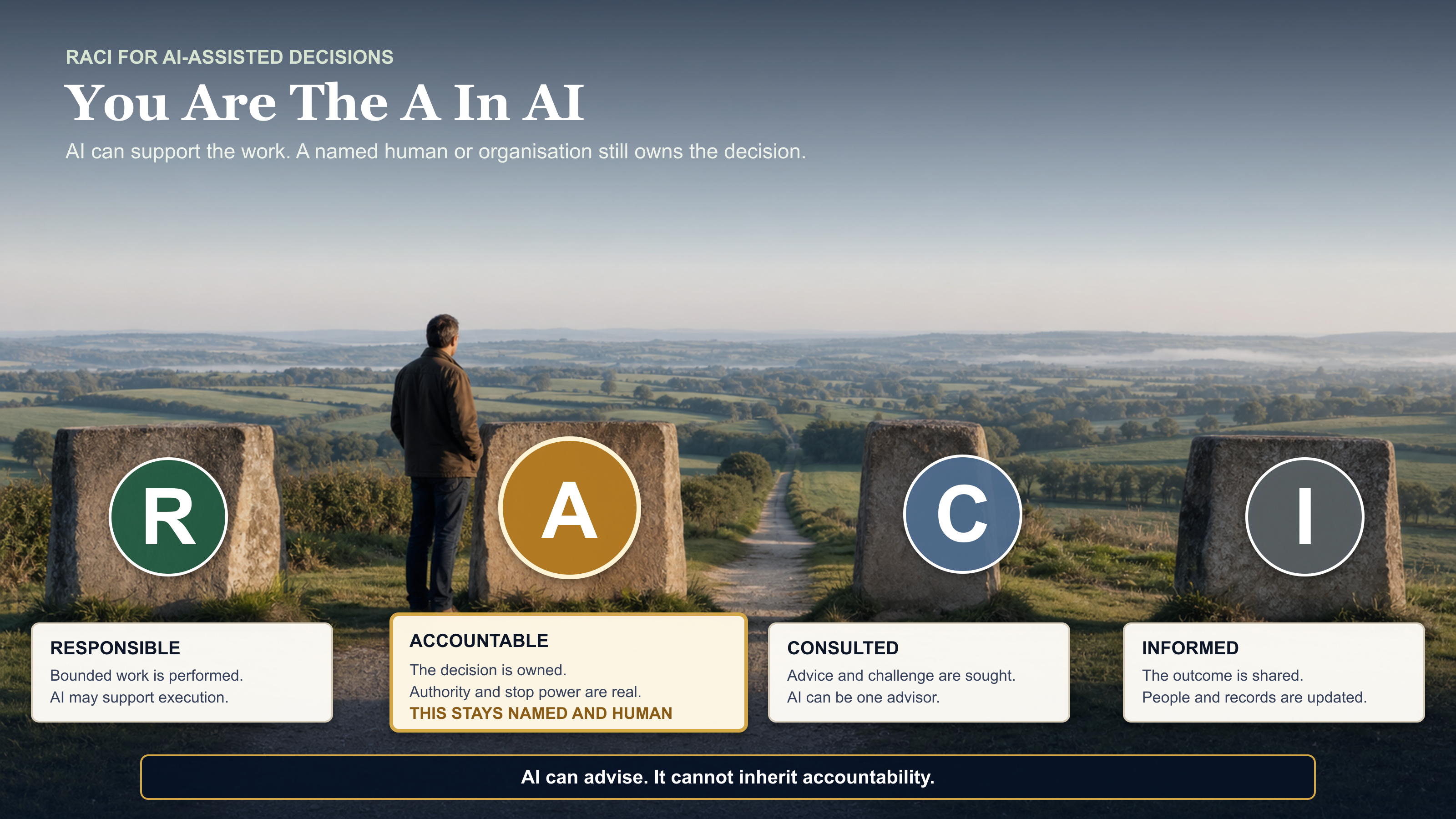
There is a project-management model called RACI: Responsible, Accountable, Consulted, and Informed.
The wording varies a little between organisations, but the useful distinction is simple. Somebody may do the work. Other people or systems may be consulted. Others may be informed. But one named owner remains accountable for the outcome.
That gives us a better way to describe AI-assisted work.
An AI system may perform a bounded piece of work. It may be consulted for analysis. Its output may inform a decision.
But it is not the accountable owner.
You are the A in AI.
This does not mean one individual should become a convenient target whenever a complex system fails. Research on moral crumple zones warns that organisations can place nominal responsibility on a human who has too little knowledge, time, authority, or control to change the outcome.
Accountability must therefore come with real authority, competence, evidence, and the ability to stop.
NIST's AI Risk Management Framework makes the organisational version of this point. It asks companies to define human-AI roles clearly and says executive leadership should take responsibility for decisions about the risks of developing and deploying AI systems.
The human cannot be a rubber stamp.
The company cannot point at the human when the system fails.
And the human cannot point at the model and say, "AI told me to do it."
Say what actually happened
So I am making a personal commitment.
The next time somebody says, "I asked AI and it said...", I am going to ask:
"What do you think?"
They may agree with the answer. That is perfectly reasonable. AI advice can be very good.
But the honest sentence is not:
AI said this, therefore it is true.
It is something closer to:
I used this system to examine this question. I gave it this context. It produced this advice and these sources. I checked the important assumptions and considered the strongest counterargument. My judgement is that we should do this, and I remain accountable for that decision.
That sentence is longer.
It is also far more useful.
A five-question pause
Before using an AI answer to support a decision, ask:
- Source: Which system and model produced this?
- Context: What did it know, and what might it be missing?
- Evidence: Can I inspect the sources, assumptions, and uncertainty?
- Challenge: What would the strongest opposing answer say?
- Accountability: What do I think, and am I prepared to own the decision?
This is not a reason to use AI less.
It is a way to use it with more intellectual honesty.
Ask it difficult questions. Ask it to challenge you. Ask it to find what you have missed. Ask it to explain the evidence. Use it to extend your thinking.
Just do not use it to make your own judgement disappear.
The advice may come from AI.
The accountability does not.
Sources and notes
- Logg, Minson and Moore: Algorithm appreciation
- Buçinca, Malaya and Gajos: To Trust or to Think
- Risko and Gilbert: Cognitive Offloading
- Sperber et al.: Epistemic Vigilance
- Bonaccio and Dalal: Advice taking and decision-making
- Bahner, Hueper and Manzey: Misuse of automated decision aids
- Elish: Moral Crumple Zones
- NIST: AI Risk Management Framework Core
- ICO: Human review of AI decisions
- OECD AI Principle: Accountability