
I was sitting in a restaurant in Stockholm, looking at the menu, and the first thing I did was not heroic.
I took a photo of it.
Then I uploaded it and asked ChatGPT something very ordinary: I wanted something light, nothing too heavy, and water with it. What would it recommend?
It answered.
Simple. Useful. Exactly the sort of thing I needed in that moment.
Then I asked how to order it phonetically in Swedish.
That got a smile from the waiter.
I still had to point at the menu, so we are not quite living in the future. Or, more accurately, I am not quite living in the future. But it was enough to make me wonder why more small businesses are not making this easier.
The missing little layer
Small businesses already have the information people want.
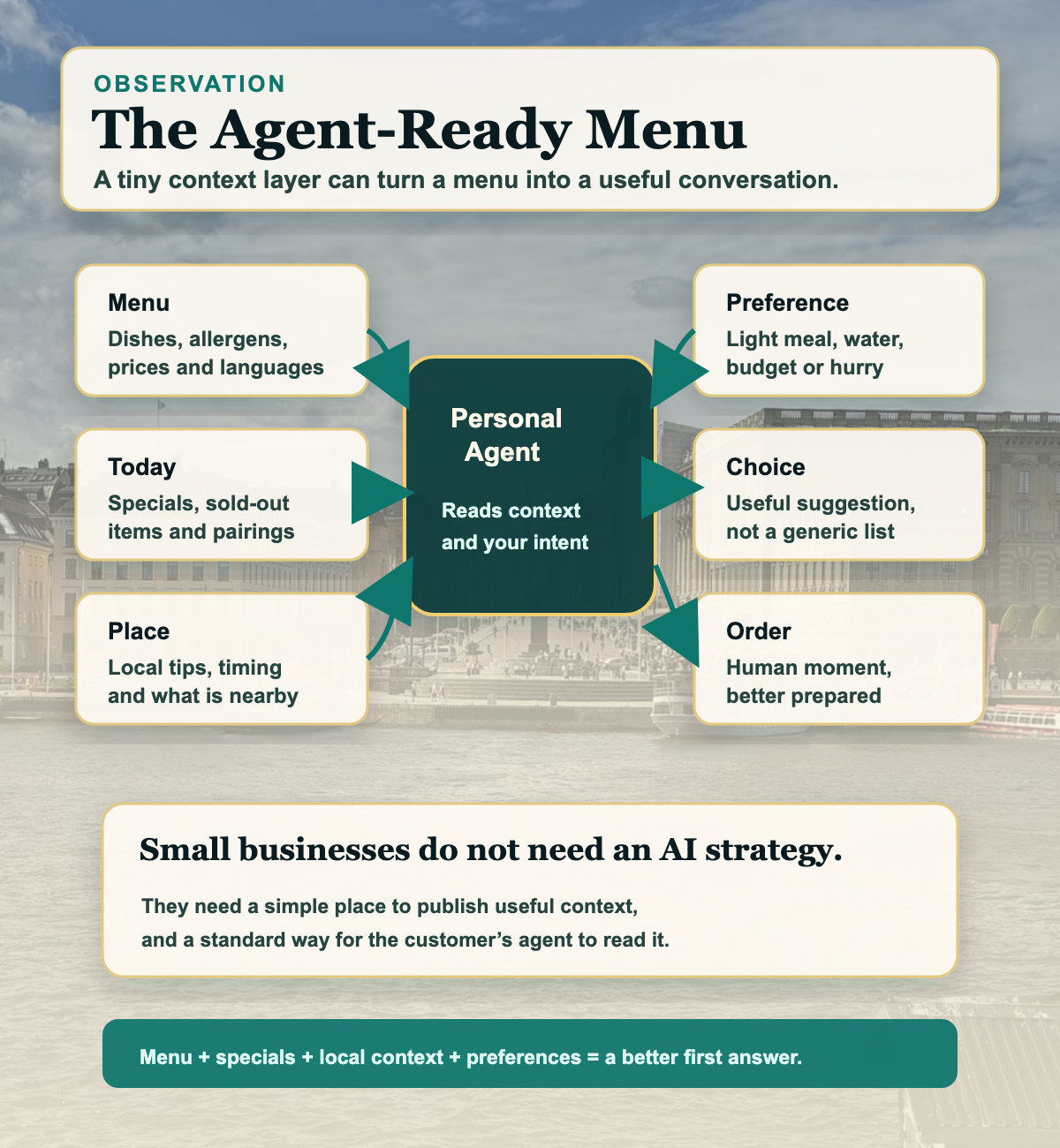
A restaurant knows its menu, its specials, what is light, what is rich, what is vegetarian, what has nuts, what is local, what sells out, what pairs well with a drink, what a nervous tourist might be able to pronounce, and what the staff would recommend if asked nicely.
Most of that context is not in a format an agent can use.
Some of it is printed.
Some of it is on a website.
Some of it is on a chalkboard.
Some of it is only in the heads of the people working there.
So the customer has to do a little workaround. Photograph the menu. Upload it. Ask a question. Hope the image is clear. Hope the translation is right. Hope the answer understands what kind of meal you actually want.
That is fine for me. I like playing with this stuff.
But it should not need to be a small technical ritual.
Why not agent-ready menus?
Imagine the simple version.
There is a small QR code on the menu, on the window, or on the table.
It does not just open a PDF.
It opens a small agent-readable context page.
The page says:
- today's menu;
- specials;
- allergens;
- dietary notes;
- recommended pairings;
- opening times;
- what is nearby;
- how to order politely;
- and what has changed today.
Then your own agent, on your own phone, can read it and help you.
Not the restaurant trying to trap you in an app.
Not a giant reservation system trying to own the relationship.
Just a useful layer of context, made easy for the visitor and easy for the business to update.
The price problem
I suspect one reason this has not happened is fear of cost.
Small businesses have been trained to be suspicious of anything that sounds like technology.
They hear "AI" and they imagine a consultant, an agency, a retainer, a dashboard, a migration, and a bill that starts at a level they simply cannot justify.
That is not irrational.
A small restaurant does not want an AI strategy.
It wants a fixed, understandable price for a useful answer layer.
Something closer to the early internet idea: pay a small predictable amount, put the information somewhere, and let people access it.
For this to work at the small-business level, it cannot feel like enterprise software wearing a hat.
It has to feel like a menu board.
Change the specials. Add the dish. Remove the one that sold out. Add a note about the local area. Done.
The business case is not complicated
This is not only about being clever for tourists.
It could help the business sell better.
A customer asks: what is light?
The agent can answer.
A customer asks: what goes with this wine?
The agent can answer.
A customer asks: I have twenty minutes before the ferry, what should I order?
The agent can answer.
A customer asks: how do I say this without making a complete mess of it?
The agent can help.
That is service.
It may also be revenue.
If the agent suggests the right extra drink, the right side, or the better match, everyone wins. The customer feels looked after. The business sells with context rather than pressure.
Small businesses need simple rails
The thing I keep coming back to is this: small businesses do not need to build an agent from scratch.
They need rails.
A small place to put their information.
A simple way to update it.
A standard way for a visitor's agent to read it.
A sensible fixed price.
A little QR code that points to something useful.
The restaurant does not need to know what an MCP is. The customer does not need to know what an agent card is. The waiter does not need to debug anything at the table.
The standard should make the boring bit disappear.
The observation
The interesting thing is that the customer behaviour is already here.
People are already photographing menus, translating signs, checking reviews, asking chat systems what to do, and using their phones to reduce uncertainty.
The missing piece is not desire.
It is packaging.
Make the information easy for an agent to read.
Make the cost easy for a small business to understand.
Make the update process simple enough that it becomes part of the day.
Then the menu stops being just a printed object.
It becomes a conversation starter between the business, the customer, and the customer's own agent.
And maybe, next time, I still get the smile from the waiter.
But I point at the menu a little less.