Here is a slightly uncomfortable thought.
One of the things that may push AI adoption forward in the UK is not the model quality, the demos, the conferences, or the glossy transformation decks.
It may be the cost and risk of employing someone.
I want to be careful here, because this can easily turn into the wrong argument.
I do not think people should be cheap. I do not think insecure work is good. I do not think the answer to AI is to make everyone poorer so employers feel comfortable hiring again.
Decent wages matter. Pensions matter. Employment rights matter. People should not have to live on hope, goodwill, and the promise that one day the business might be able to pay them properly.
But policy has consequences.
If the full cost of employment keeps rising, and if the world remains uncertain, then every employer starts asking a harder question before making a hire:
Can I really carry this commitment?
The hire is no longer just a salary
When a business hires someone, it is not simply choosing a salary line.
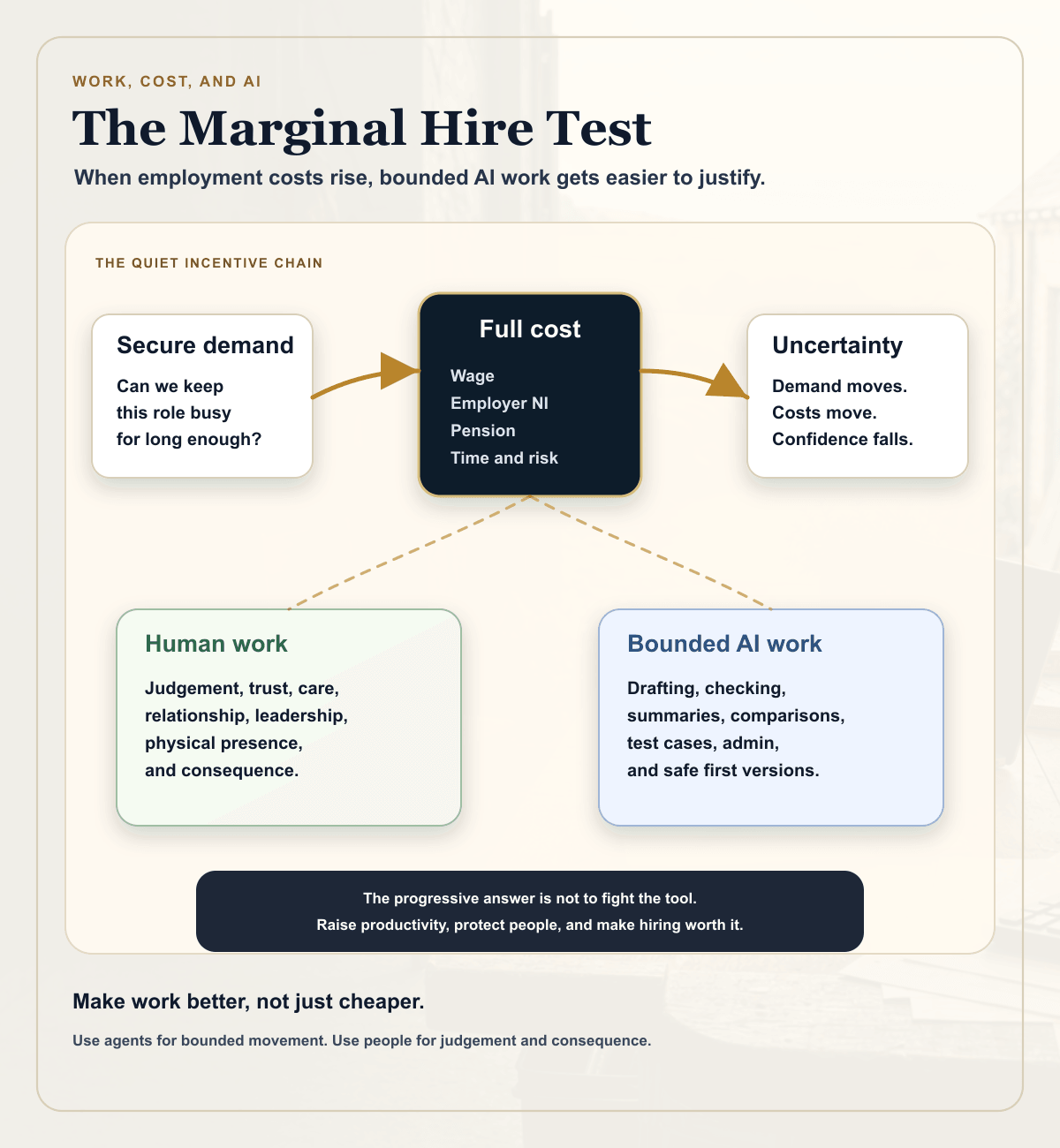
It is choosing the wage, employer National Insurance, pension duties, payroll administration, management time, HR process, training, equipment, supervision, sick leave, holiday cover, compliance, and the moral responsibility of taking someone into the organisation and trying to keep them there.
That last bit matters.
A decent employer does not hire lightly. If you hire someone properly, you are making a promise. You are saying, "I think there is enough work here. I think we can afford this. I think we can give you a stable place to do good work."
In a stable environment, that is a good promise to make.
In an uncertain environment, it becomes much harder.
Energy costs move. Demand moves. Finance costs move. Taxes move. Customers delay decisions. The business still needs work done, but the decision to add another permanent person becomes heavier.
So employers hesitate.
Not always because they dislike people.
Sometimes because they are trying not to make a promise they cannot keep.
Work still has to get done
That is the bit people sometimes miss.
If a business decides not to hire, the work does not politely disappear.
The emails still arrive. The proposals still need writing. The reports still need checking. The customer questions still need answering. The data still needs cleaning. The process notes still need updating. The website still needs improving. The invoices still need chasing. The board still wants a view.
So the business looks for another route.
It may use contractors. It may outsource. It may delay. It may overload the existing team, which is usually the worst option. Or increasingly, it may use AI.
And this is where the economics start to bite.
A small company can put a machine on a desk, run one of the current agentic harnesses, connect it to a safe folder, and get useful work done. Not all work. Not everything. Not judgement, trust, relationship, accountability, care, taste, responsibility, or the deep human work that makes organisations worth being part of.
But a lot of bounded work.
Draft this. Check that. Summarise this. Compare these documents. Produce the first version. Tidy the data. Make the checklist. Search the notes. Write the test cases. Prepare the pack. Find the contradiction.
That changes the marginal decision.
The question is no longer, "Should I hire a person or do nothing?"
The question becomes, "Which parts of this work genuinely require a person, and which parts can an agentic worker do well enough under supervision?"
This is an adoption policy, whether we admit it or not
Here is the policy tension.
If government raises the floor on pay and protection, that can be a good thing. It can make work more dignified. It can reduce exploitation. It can force poor business models to face reality.
But if the same system also makes hiring feel risky, slow, expensive, and hard to reverse, then it changes the calculation.
Every extra fixed cost makes automation slightly more attractive.
Every extra uncertainty makes the next hire feel slightly harder.
Every productivity problem makes the AI option look slightly more reasonable.
That does not mean the policy is bad. It means the policy has a second-order effect.
Higher employment costs can become an AI adoption policy.
Not because anyone wrote that in a manifesto.
Because businesses respond to incentives.
The progressive answer is not to fight the tool
I think this is where the conversation needs to grow up a bit.
If AI can do useful work, then pretending businesses will ignore it is fantasy. If hiring is expensive and uncertain, then pretending employers will always choose the human route is also fantasy.
The progressive answer is not to try to make AI worse, slower, or harder to use.
The progressive answer is to make human work more valuable, more productive, and more worth hiring for.
That means using AI to lift people, not just replace tasks. It means giving small businesses practical ways to adopt AI safely. It means helping workers become excellent at managing agents, checking outputs, applying judgement, building trust, working with customers, and doing the human work that cannot be reduced to a prompt.
It also means being honest about entry-level work.
If the first rung of the ladder was mostly information movement, formatting, basic drafting, copying, checking, chasing, and routine admin, then that rung is going to change. We should not sneer at that work. A lot of people learned through it. But we cannot pretend it will stay unchanged when software can now do a large part of it.
So we need new ladders.
Better apprenticeships. Better AI supervision skills. Better practical training. Better ways for small firms to take a chance on people. Better routes from education into work that assume everyone will be working with agentic systems, not competing against them unaided.
The human job has to move up
What remains for people?
A lot, actually.
Judgement. Taste. Care. Trust. Leadership. Relationship. Physical presence. Accountability. Persuasion. Listening. Coaching. Selling. Teaching. Making the call when the information is incomplete. Owning the consequence when the answer matters.
Those things are not small.
But they are not always the things we trained people for first.
That is the challenge.
If employment becomes more expensive, the human role has to justify itself at a higher level. That sounds brutal, but it does not have to be dehumanising. It can mean the opposite. It can mean we stop using people as slow APIs between badly connected systems. It can mean we stop asking bright humans to spend their day copying facts from one box to another. It can mean we build teams where people are responsible for judgement and agents do more of the dull movement underneath.
That could be good for humanity.
But only if we design it properly.
The risk is a two-speed economy
The danger is not that some companies use AI.
The danger is that some organisations can carry employment costs because they are funded by taxation, monopoly position, regulation, or scale, while smaller firms and competitive businesses quietly stop hiring unless a role is absolutely unavoidable.
That could create a strange economy.
Large public or protected organisations still employ people because they can absorb the cost. Smaller companies automate because they have to survive. Entry-level commercial work thins out. The middle gets squeezed. The people who most need a first chance find fewer places willing to take the risk.
That is not a reason to make work cheap and insecure.
It is a reason to make the transition explicit.
If we want decent wages, we also need serious productivity. If we want strong employment rights, we also need employers to feel able to hire. If we want AI to help humanity, we need people to participate in the upside, not simply watch the work move away from them.
So yes, AI adoption may speed up
I started thinking this was a bad thing.
Now I am not so sure.
If rising employment costs push businesses to adopt AI, that may accelerate something useful. It may force organisations to get more productive. It may make them look hard at pointless admin. It may help small teams do more. It may make good work more focused on judgement, care, trust, and creation.
But that is not automatic.
It depends what we do next.
If we use AI only to avoid employing people, that is a thin and miserable vision.
If we use AI to make businesses more productive, make human work more meaningful, and make it easier to pay people properly when we do hire them, then that is a much better future.
So perhaps the question is not whether higher employment costs will push companies toward AI.
I think they will.
The better question is whether we can use that pressure well.
Can we make companies more productive without making people disposable?
Can we make work better, not just cheaper?
Can we build a world where the agent does the dull movement, and the human does the judgement?
That is the progressive challenge.
Not to slow the technology down.
To make sure the gains show up in human lives.
Research notes
- GOV.UK, Rates and thresholds for employers 2026 to 2027 - current employer payroll thresholds and National Insurance context.
- GOV.UK, National Minimum Wage and National Living Wage rates - official minimum wage rates by age and category.
- GOV.UK, Workplace pensions for employers - employer duties around automatic enrolment and pension contributions.
- Office for Budget Responsibility - public fiscal and economic forecasts that track labour-market, tax, and policy effects over time.