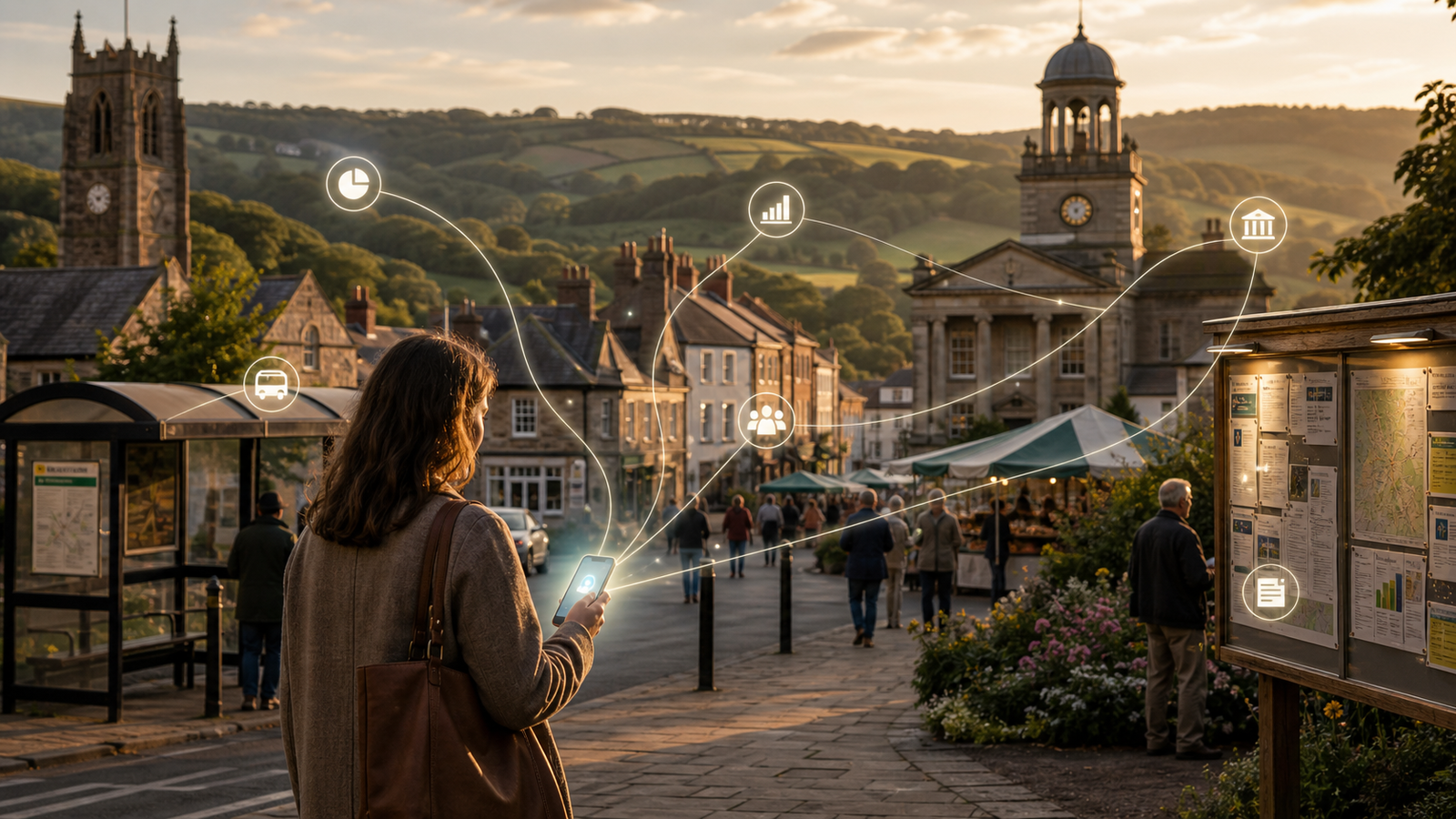
What if everybody knew everything they needed to know?
Is that okay?
I think that is one of the quiet questions sitting underneath agentic AI.
Very soon, personal agentics will be able to know a huge amount about the country you live in, the council you deal with, the payments you are entitled to, the planning rules on your street, the product in your hand, the public reports behind a claim, the companies behind those reports, and the local facts that are currently scattered across websites, PDFs, notices, portals, databases, and call-centre scripts.
Not because the information was secret.
Because it was hard.
Hard to find. Hard to read. Hard to compare. Hard to understand. Hard to know whether you were looking at the current version. Hard to know whether a report was independent, commissioned, old, contradicted, quietly superseded, or written in a way that only insiders could follow.
That hardness has been part of how society works.
And I wonder what happens when it stops working.
The end of practical obscurity
There is a difference between information being technically public and information being practically available.
A planning document may be online.
A council process may be published.
A payment route may exist.
A product claim may have evidence somewhere.
A public body may be subject to Freedom of Information rules. The Information Commissioner's Office explains the Freedom of Information Act as a public right to request recorded information from public authorities, with exemptions and process around it.
But none of that means an ordinary person can easily use it.
At the moment, a lot of public knowledge is hidden behind effort.
You need to know which site to search. You need to know the phrase the organisation uses. You need to know whether the information is in a PDF, a spreadsheet, a committee paper, a consultation response, a procurement notice, a product certificate, a report appendix, or a forgotten page three clicks deep.
That is not always malicious.
Sometimes it is just institutional mess.
Sometimes it is legacy technology.
Sometimes it is a lack of people, time, care, ownership, or design.
But the effect is the same.
The information exists, and people still cannot act on it.
Your agent will read the boring bits
This is where personal agentics change the shape of the problem.
A good agent will not get bored.
It will not give up because the council website is ugly.
It will not avoid a 240-page report because the useful paragraph is buried in the middle.
It will not be embarrassed to ask a simple question.
It will be able to say:
You are looking at this planning application.
The relevant deadline appears to be this date.
The policy being used is this one.
There are three objections similar to yours.
This document contradicts the summary.
The strongest evidence is here.
The weak evidence is here.
This is what I would ask next.
Or:
This product says it is sustainable.
The claim rests on this report.
The report was paid for by this organisation.
The supply chain evidence is incomplete.
The certification is current.
The country-of-origin claim is narrower than the label suggests.
Here is the confidence level.
That is a different society.
Not because everyone becomes an expert.
Because everyone gets a patient explainer.
In your language. At your education level. At your pace. With your location and your context understood.
What happens to prejudice?
This is where it gets uncomfortable.
Some people will ask their agent a question with a prejudice already loaded into it.
The answer may come back: actually, that is not true.
That could be good.
It may also come back: you suspected something was being hidden, and here is the evidence that something has indeed been obscured, buried, delayed, reframed, or made unnecessarily hard to see.
That could also be good.
But it will not always feel good.
A better-informed society is not automatically a calmer society.
It may be more awkward before it is healthier.
Because once people can see the source trail, the comfortable stories get weaker.
Leaders will not be able to rely so easily on the hope that nobody has read the appendix.
Institutions will not be able to rely so easily on language that sounds open while remaining practically opaque.
Companies will not be able to rely so easily on broad claims when agents can trace the evidence beneath them.
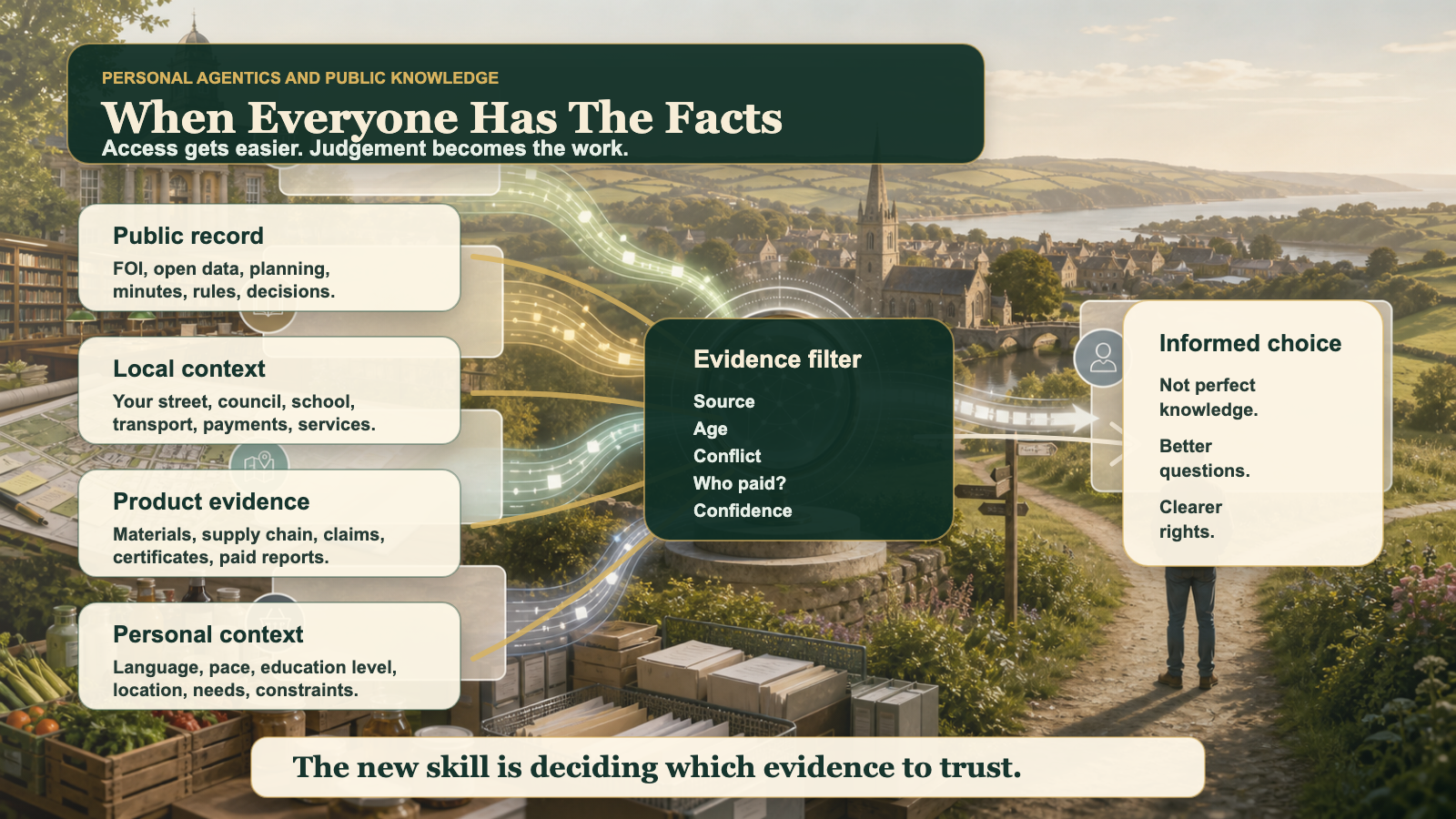
The new inequality is the filter
If information becomes easy to retrieve, the value moves.
The value is no longer just access.
The value becomes judgement.
Which source matters?
Which source is current?
Who paid for the report?
What is missing?
What would change the answer?
What is legally true, but practically misleading?
What is emotionally satisfying, but evidentially weak?
This is why I think we will start buying, building, borrowing, and arguing over evidence filters.
At the moment, newspapers and platforms compete for attention. A lot of the model is still: get people to look, click, react, share, and come back.
In an agentic world, the more valuable question may become: which filter helps me understand what is true enough to act on?
That is powerful.
It is also dangerous.
Because the evidence filter becomes the next place power can hide.
If your filter is honest, it helps you reason.
If your filter is captured, it tells you you are well informed while quietly steering what counts as evidence.
That is why media and information literacy still matters. UNESCO's work on media and information literacy is useful here because the human skill does not disappear. It changes shape. People still need to ask how information is produced, who benefits from it, and how it should be weighed.
Freedom of Information changes
Freedom of Information requests are a good example.
Right now, they require effort.
You need to know what to ask.
You need to phrase it properly.
You need to know whether the organisation is covered.
You need to understand exemptions, timescales, appeals, and how to read the response when it arrives.
That effort is a barrier.
Agents lower that barrier.
They can help draft the request, narrow the scope, find previous disclosures, compare answers, track deadlines, summarise responses, and explain whether an exemption makes sense.
That could be wonderful for accountability.
It could also overwhelm badly run systems.
So public bodies have a choice.
They can wait for citizens and agents to drag information out through individual requests.
Or they can publish better information in the first place.
The existence of GOV.UK's open data portal already points in that direction. The next version of this is not just open data for analysts. It is agent-readable public context for citizens.
What would an honest organisation do?
An honest organisation should start preparing for a world where the reader has help.
Not just a clever search box.
A persistent agent that can compare, remember, query, test, and explain.
That means organisations need to publish in ways that survive scrutiny:
- clear source trails;
- dates and version history;
- machine-readable documents where possible;
- plain-English summaries that match the evidence;
- open data where it is safe and lawful;
- clear statements of uncertainty;
- and better records of decisions, assumptions, and limitations.
This is not just a website problem.
It is a governance problem.
The UK's Algorithmic Transparency Recording Standard is one example of the direction of travel: if systems are used in public decision-making, people increasingly expect a record of what is being used, why, and with what safeguards.
Agents will extend that expectation.
They will ask boring, persistent questions.
Where did this come from?
Who approved it?
What changed?
What is the evidence?
What is the confidence?
What is missing?
Knowing everything is not the same as understanding
There is a trap here.
We should not confuse retrieval with wisdom.
An agent may find more than we could find.
It may explain more clearly than the source did.
It may compare documents faster than any person reasonably could.
But it still needs controls. It still needs provenance. It still needs uncertainty. It still needs to know when to say: I do not know enough.
This is why risk frameworks such as the NIST AI Risk Management Framework matter. The point is not to make the system sound clever. The point is to make it trustworthy enough for the use in front of it.
For some questions, good enough is good enough.
For others, good enough is dangerous.
The agent should know the difference.
The question I would ask
So what would society look like if everybody knew everything they needed to know?
I do not think it would be a society with no arguments.
I think it would be a society with better arguments.
More people would be able to challenge claims.
More people would be able to see their rights.
More people would be able to understand what a product really is.
More people would be able to ask why a decision was made.
More people would be able to tell the difference between a weak answer and a strong one.
That is not tidy.
But it is probably healthier.
The future is not just that everyone has access to more information.
The future is that everyone may have an interpreter beside them.
So the real question becomes:
Who teaches the interpreter what counts as evidence?
Who audits the filter?
Who decides what is enough to know?
That, I think, is where the next fight is.
Source Notes
- Freedom of Information
- Information Commissioner's Office guidance on the Freedom of Information Act.
- Open data
- GOV.UK Find open data.
- Information literacy
- UNESCO media and information literacy resources.
- AI risk and trust
- NIST AI Risk Management Framework.
- Public algorithmic transparency
- UK Algorithmic Transparency Recording Standard hub.