I teach at universities. I also spend a lot of time talking to people who teach in universities, run universities, work with students, or are trying to work out what a student should do now that AI is here.
The question comes up a lot.
What do we tell students?
What do we tell the person starting university in 2026, or leaving it this year, when the press is full of stories about graduate jobs disappearing, junior roles being squeezed, and companies deciding that a token is cheaper than a person?
It is a fair question.
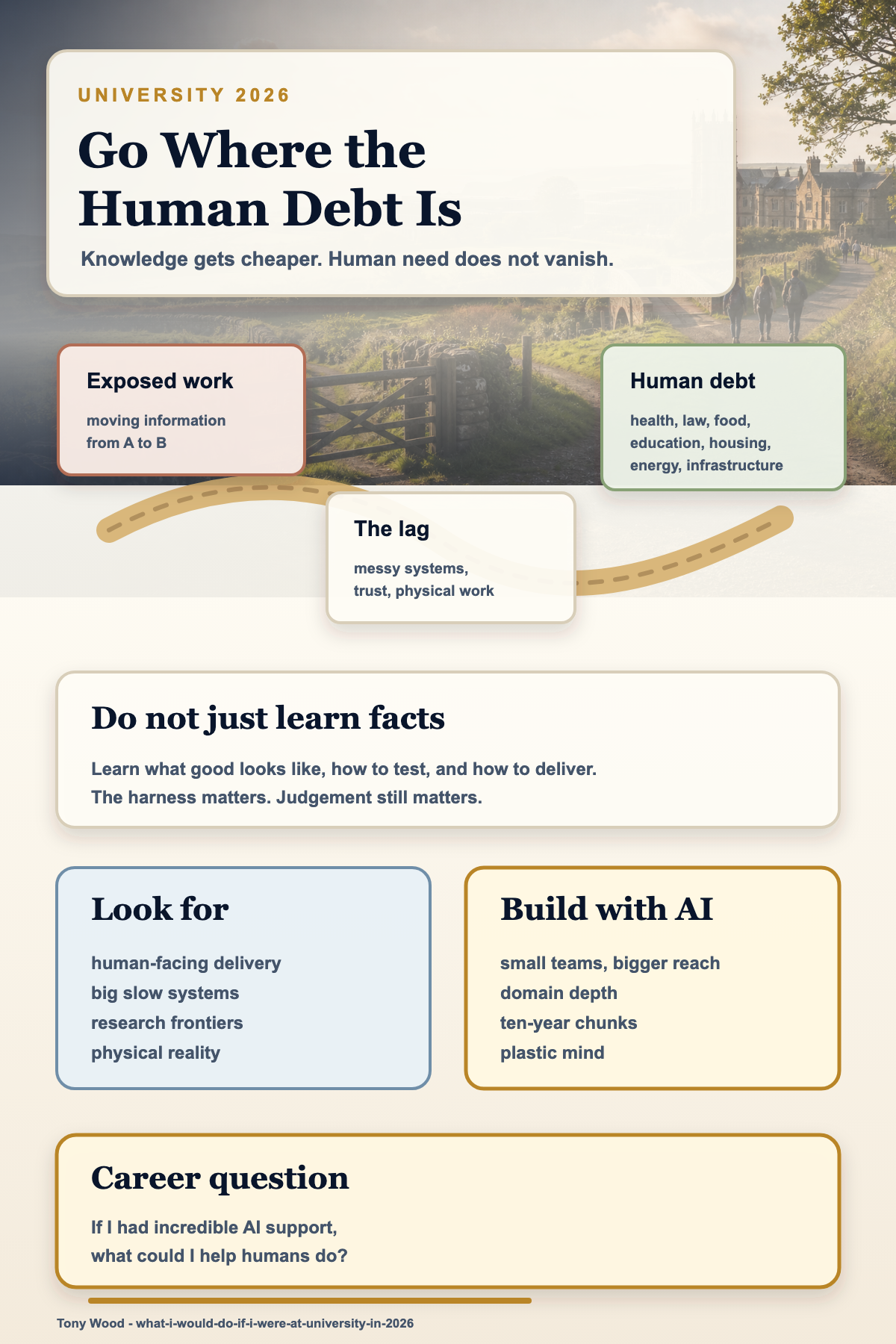
Some of the anxiety is justified. If your job is only to move information from one place to another, organise it a little, and hand it to someone else, then yes, I would be worried. That work is exposed.
But that is not the whole story.
If I were at university in 2026, I would not be asking, "What job survives AI?" I would be asking, "Where is the human debt?"
The lag matters
There is a strange assumption in some of the public conversation. It goes something like this: once AI is intelligent enough, the work just disappears.
I do not think it will be that clean.
There is information in hard-to-reach places.
Bad systems. Old databases. Half-used SaaS platforms. Folders nobody quite owns. Policies that exist in one place and reality that exists somewhere else. Institutional knowledge in people's heads. Procurement history in email. Medical notes that need interpretation. Legal context spread across documents, practice, habit, and human judgement.
Even if the intelligence improves very quickly, access will lag.
Integration will lag.
Trust will lag.
Physical work will lag too. Things still need to be built, moved, repaired, installed, tested, cleaned, delivered, maintained, and explained.
So yes, AI may change the economics of knowledge work.
But the world does not instantly become a clean API.
The backlog is enormous
The more important point is that we have a massive backlog of human need.
Call it human debt.
People need healthcare.
People need education.
People need legal help.
People need food, housing, safety, energy, transport, and practical support.
People need someone to explain what is happening, help them make a decision, and help them act on it.
Very few people get proper access to legal advice. Many people cannot feed themselves properly. Many people cannot get enough time with a doctor. Many people need education that is more personal, more patient, and more available than the system can currently provide.
That debt does not vanish because a model can write a document.
In fact, this is the optimistic bit.
Even if AI doubles or triples productivity, there is still a long way to go before we have helped everyone who needs help.
There is work everywhere.
Knowledge becomes cheaper
I think knowledge is becoming more like a commodity.
Not wisdom. Not judgement. Not care. Not taste. Not trust.
Knowledge.
The thing that used to be expensive because it was hard to find, hard to summarise, hard to format, hard to compare, or hard to explain at the right level.
That changes what is valuable.
The whole conversation about hallucination is useful up to a point, but it can also become a smokescreen. Humans hallucinate too. Put a human in a room with poor information, pressure, and no clear view of what good looks like, and they will confidently produce nonsense as well.
The question is not, "Can AI be wrong?"
Of course it can.
The question is, "Do you know what good looks like, and do you have a harness that helps you check?"
That is where the student should pay attention.
Do not just learn facts.
Learn what good looks like.
Learn how to test.
Learn how to ask better questions.
Learn how to spot when the output is plausible but wrong.
Learn how to work with people who need the result, not just the report.
Do not choose pure friction
If I were choosing a path now, I would be careful about careers that are mostly friction.
By friction I mean moving information from one system to another, reformatting it, chasing it, copying it, packaging it, and passing it along.
Some of that work will remain for a while because organisations are messy.
But as a long-term bet, I would not build my identity around being the person who moves information from A to B.
I would look for the human part.
The delivery.
The judgement.
The persuasion.
The care.
The field work.
The research question.
The thing that requires a person to understand what is happening in the world and then do something with other people.
Where I would look
I would look at the places where the backlog is huge and the work matters.
Healthcare.
Education.
Law and access to justice.
Food systems.
Energy.
Housing.
Infrastructure.
Physics, engineering, materials, climate, transport, public services, and the big systems that take years to plan and years to build.
Look at something like a major research facility. Some of the work can take years just to calibrate, organise, prepare, and make usable. If AI helps reduce that cycle, it does not mean the human opportunity disappears. It means the frontier moves.
Look at infrastructure. Big projects are slow, expensive, political, physical, and messy. If intelligence gets cheaper, we still need people who can understand the real constraints and make things happen.
That is where I would be looking.
Think in ten-year chunks
I would also stop trying to plan a forty-year career.
That was always a bit of a fantasy, but now it is particularly unhelpful.
Think in ten-year chunks.
What can you become useful at over the next ten years?
What problem can you move closer to?
What field has enough human need that even a large productivity gain does not empty the work?
What would become possible if a small team had extraordinary AI support?
There may be a period where very powerful intelligence exists but is not evenly available, not properly integrated, not trusted, not cheap enough, or not connected to all the systems and physical processes that matter.
That period could be strange.
It may feel like driving a Bugatti to the shops: extraordinary capability, used in oddly constrained ways.
But that transition period is also opportunity.
My advice
If I were at university in 2026, I would do this:
- Pick a field with real human debt.
- Learn the domain deeply enough to know what good looks like.
- Use AI early, but do not outsource your judgement to it.
- Avoid work that is only information transfer.
- Get close to delivery, people, systems, and physical reality.
- Learn how teams work when every person has an intelligent assistant.
- Keep your mind plastic.
That last one matters.
Let your mind stay flexible. Do not attach your identity too tightly to one tool, one workflow, or one version of a profession.
Ask a better question:
If I were supported by incredible AI, what could I help humans do?
That is the career question.
And honestly, I think it is an optimistic one.