
This year I am teaching the end-of-year Hackathon for the MSc Financial Technology students at the University of Exeter.
The format is familiar.
The students build a business plan. They work through the shape of an idea, the customer, the market, the numbers, the delivery, the story, and the pitch. At the end, they present it in a Dragon's Den style session.
The content I teach will be broadly the same.
How I teach it will be different.
I have learned a lot from working with agentic AI. More than I expected. And one of the things I have realised is that the way I brief an agent is often the way I wish I had been taught, managed, and briefed as a human.
If I want an agent to do good work, I have to be clear. Maybe students deserve the same standard.
The North Star comes first
When I work with an agent, I do not start by throwing a vague instruction over the wall.
At least, not if I want a good result.
I start with the North Star.
What are we trying to achieve?
What is the end point?
What should exist when the work is done?
That is how I want to teach the hackathon.
At the beginning of the two or three day section, I want the students to know the destination. Not every turn in the road. Not every sentence they should write. But the destination.
By the end, you need a business plan that can be understood, challenged, and defended.
You need a pitch that makes someone care.
You need enough evidence to make the idea credible.
You need to show that you understand the customer, the economics, the risks, and the choices you have made.
That is the North Star.
Then show what good looks like
The next step is to say what good looks like.
This is the part that is so often missing.
People say, "write me a report", "make a business plan", "build a pitch", "do the analysis", or "come up with a strategy".
Then everyone acts as if the standard is obvious.
It is not obvious.
Not to students. Not to new employees. Not to teams. Not to agents.
So I am going to be more explicit.
This is what a strong final pitch looks like.
This is what a weak one looks like.
This is what a useful market assumption looks like.
This is what a lazy one looks like.
This is what evidence does in a business plan.
This is where confidence is earned, and this is where confidence is being faked.
That does not remove the students' responsibility to think. It gives them something to aim at.
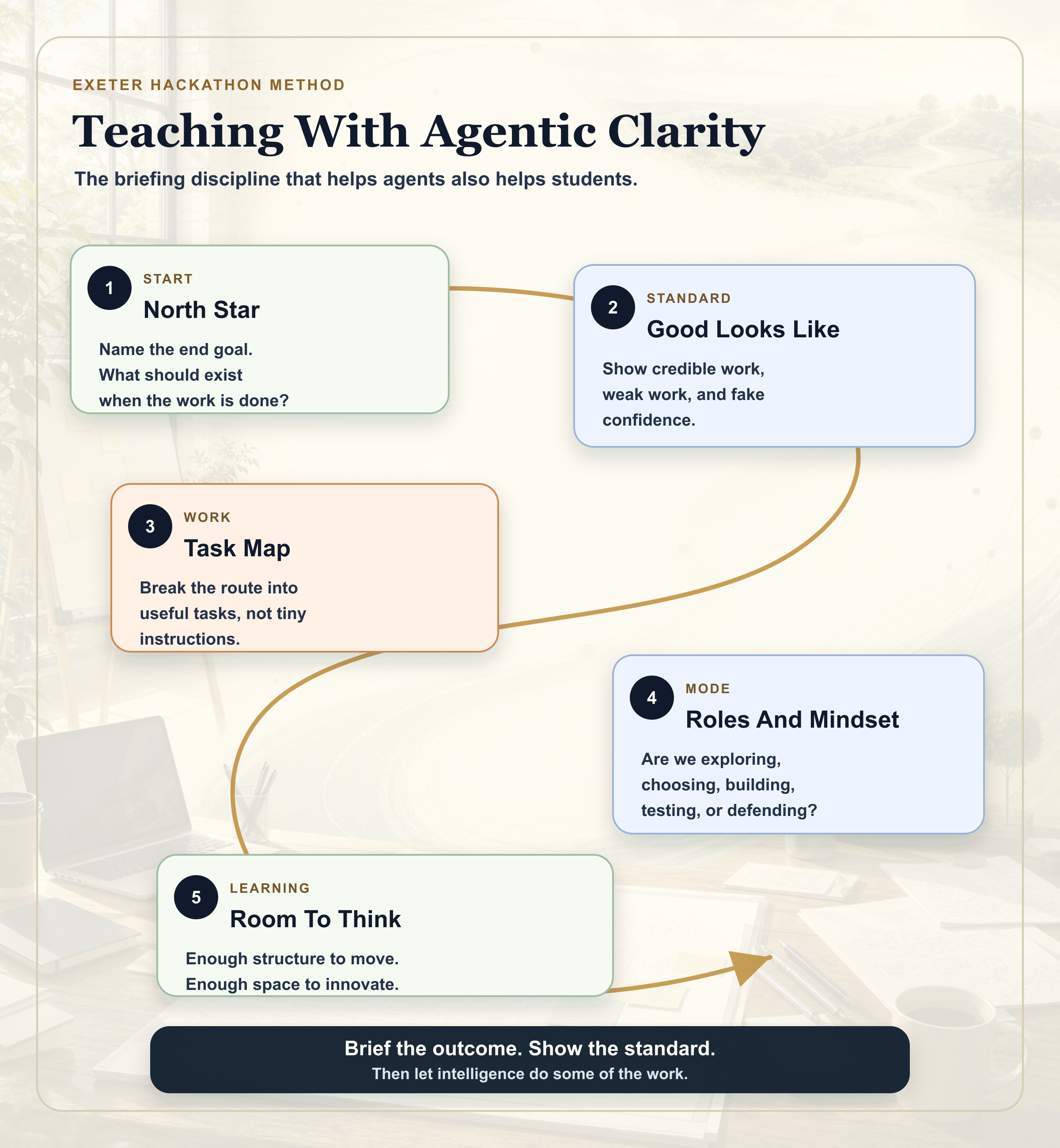
Tasks, not tiny instructions
The danger is going too far.
If I break everything down into tiny instructions, I can make the work easier to follow, but I can also remove the space where the students do the real thinking.
The same is true with agents.
If you tell an agent every single step, you may get obedience, but you often lose intelligence.
You get your own assumptions back, just faster.
So the structure needs to sit at the right level.
Here is the task.
Here is what good looks like at the end of the task.
Here are the constraints.
Here are the inputs you should consider.
Here is the decision you need to make.
Now think.
That is different from saying, "put this sentence here, use this slide, ask this question, make this exact point, and do not deviate."
One approach creates learning.
The other creates compliance.
Roles and mindset matter
I also want to be clearer about roles.
Some parts of a hackathon need individual thinking.
Some parts need team alignment.
Some parts need a finance brain.
Some need customer empathy.
Some need someone to challenge the story.
Some need someone to say, "we have twenty minutes left, make the decision".
That is not just project management. It is learning design.
Students need to know what mode they are in.
Are we exploring?
Are we choosing?
Are we building?
Are we testing?
Are we preparing to defend the work?
The mindset for each of those stages is different.
If I can name the mode, students can move more deliberately. They can also use AI tools more intelligently, because they know whether they are asking for options, critique, synthesis, evidence, rehearsal, or challenge.
Briefing slop is real
This has made me think differently about a lot of my own career.
I remember being asked to create a report, a plan, or a piece of analysis, and being told, in effect, "you should just know what good looks like".
For years, I sometimes assumed the problem was me.
I did not know enough.
I had not understood the role.
I was missing something obvious.
Now I am less sure.
Sometimes the person asking did not know either.
They knew they wanted something. They knew they would recognise the wrong thing when it arrived. But they could not describe the outcome, the standard, the constraints, or the path to a useful first version.
That is briefing slop.
It happens in management. It happens in education. It happens in AI work. It happens anywhere people ask for a result without doing the thinking needed to make the request legible.
And it is not solved by becoming a control freak.
The answer is not to write every move in advance.
The answer is to make the work understandable enough that another intelligence can engage with it.
The teaching experiment
So that is the experiment I want to run at Exeter.
Same content.
Better briefing.
I will give the students the North Star.
I will show what good looks like.
I will break the work into meaningful tasks.
I will explain the roles, skills, and mindset each task needs.
I will give them enough structure to move, but not so much structure that I do the thinking for them.
Then I will watch what happens.
Maybe it will work beautifully.
Maybe parts of it will fail.
Either way, I think it is worth trying.
Because the deeper lesson is not really about AI.
It is about clarity.
Working with agents has forced me to become more explicit about the work I want done. It has made weak instructions visible. It has made hidden standards visible. It has made vague management visible.
And, slightly uncomfortably, it has taught me something about people.
Humans do not always need more pressure.
They often need a clearer North Star, a better example of good, a sensible task map, the right role, and enough room to think.
That may be true for students.
It may be true for teams.
It may be true for all of us.
Source note
The University of Exeter describes its MSc Financial Technology (Fintech) programme as including a practical Hackathon module and group work designed to build practical team-working and employment-ready skills. See the official course page: MSc Financial Technology (Fintech).