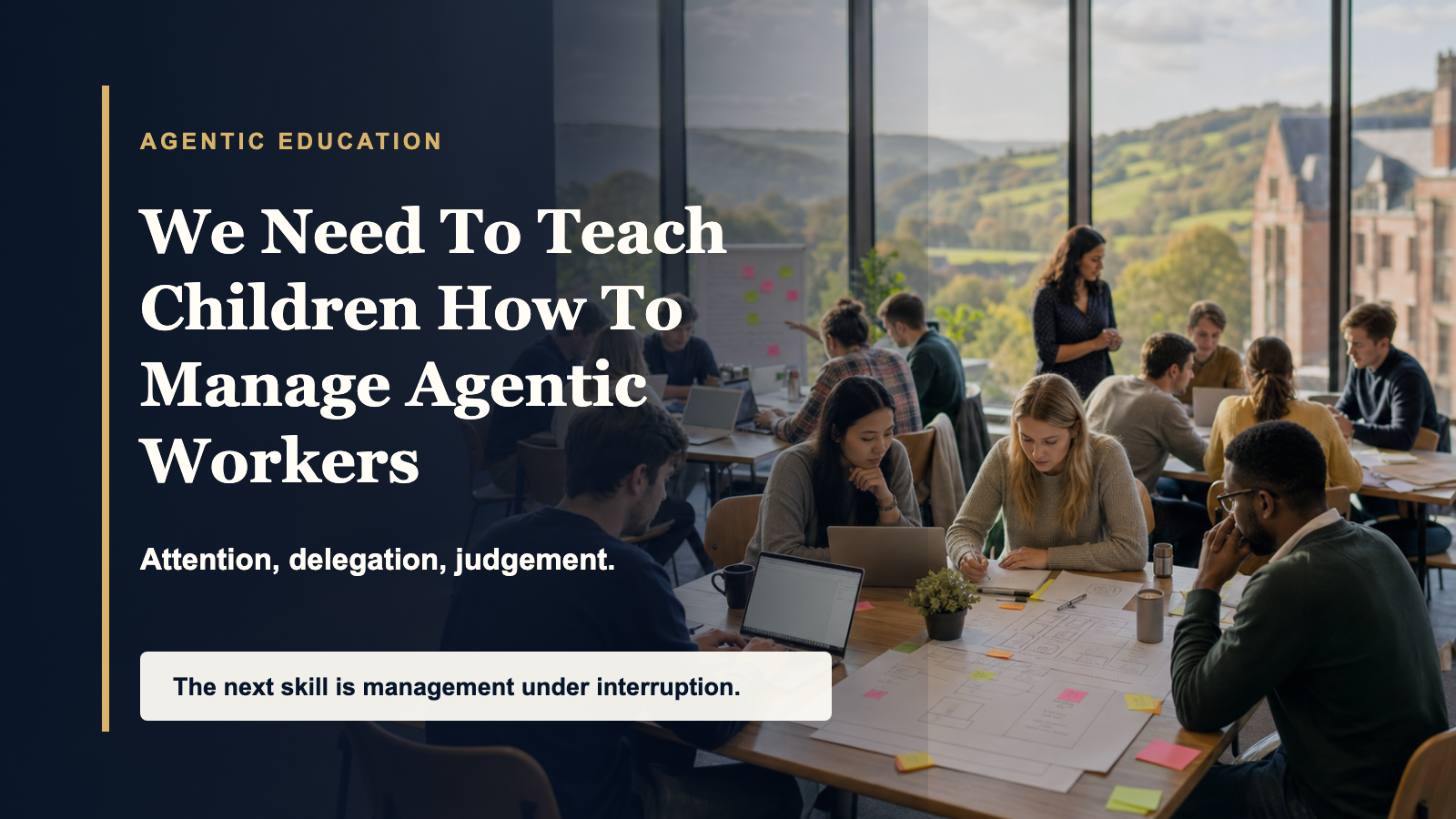
I was replying to something in one of the groups I am in, and a thought landed very clearly.
One of the key skills now is going to be the ability to keep focus while switching context.
Not switching context in the old way, where you are being distracted by email or a meeting invite.
I mean switching context because you now have agentic workers running.
One agent might be preparing data for a client for hours. Another might be building something on another machine. Another might come back every fifteen or twenty minutes with a question. Another might have hit a permission issue. Another might be asking whether to take the recommended action.
And there you are, trying to do your own work.
The skill is not clicking yes.
The skill is stopping for long enough to understand what is actually being asked.
It feels like management
The more I work with agentics, the more it reminds me of managing people.
When you are a manager, someone walks up and says, "Have you got a minute?"
You do not really have a minute.
But you have to make one.
You have to work out what they are asking, what they have already tried, whether they are blocked, whether this is a small decision, whether the whole project is now pointing the wrong way, and whether you are the right person to decide.
Then you have to help them move forward and return to whatever you were doing before.
That is exactly what working with agentic AI is starting to feel like.
An agent comes back and says, "I need your attention."
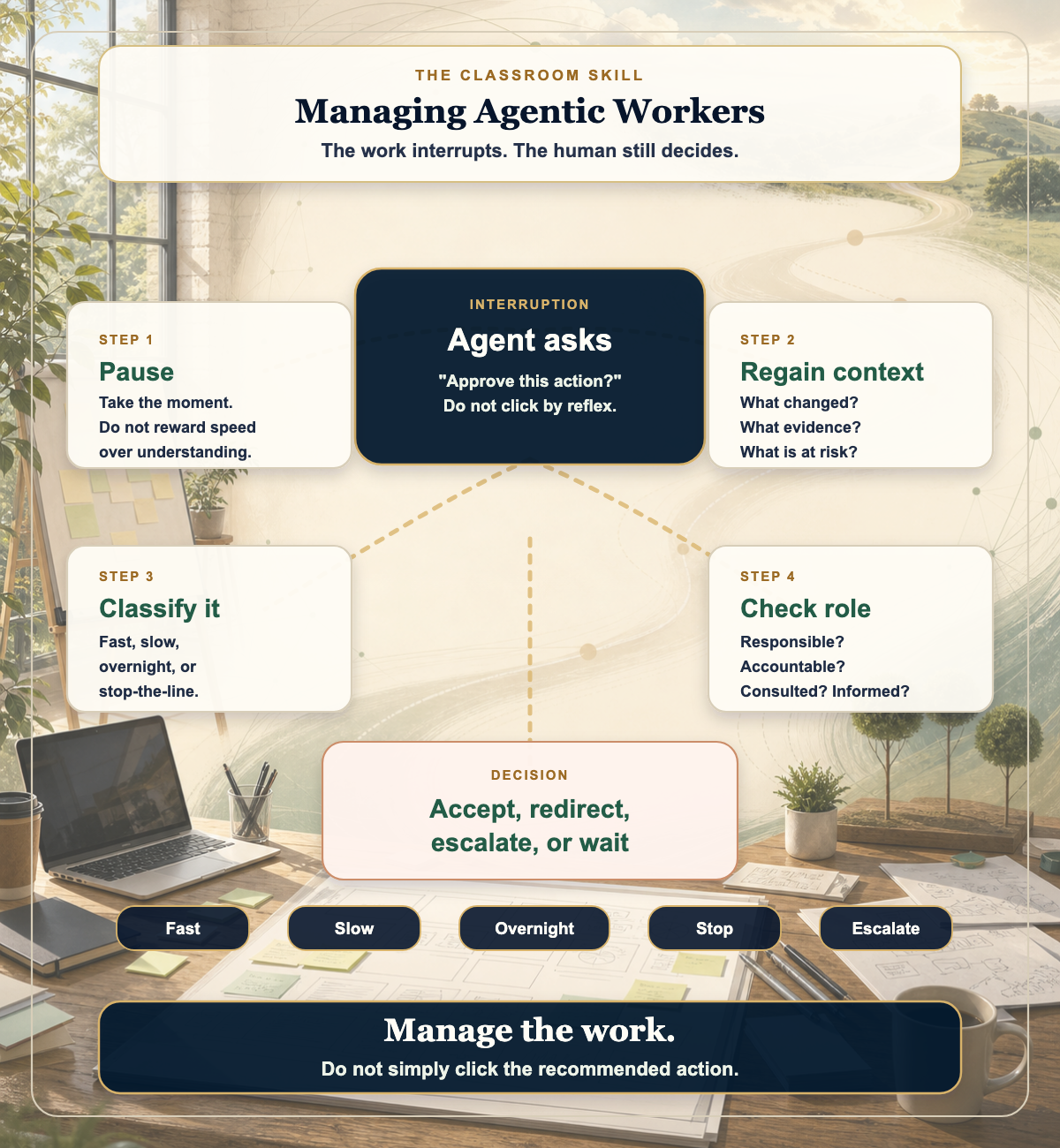
The question is: can you regain context quickly enough to make a good decision?
Can you resist the little dopamine hit of pressing the recommended button?
Can you say, "Give me a moment," and actually take the moment?
This is not multitasking
We should not pretend this is multitasking.
It is not.
It is management under interruption.
The difference matters.
Multitasking says, "I am doing five things at once."
Management under interruption says, "Five things are moving, and I am accountable for the decisions that let them keep moving safely."
That is a different discipline.
It needs a different set of questions:
- What is the agent trying to achieve?
- What changed since I last looked?
- What evidence is it using?
- What happens if I say yes?
- What happens if I say no?
- Is this a quick decision, a slow decision, an overnight decision, or a stop-the-line decision?
- Am I responsible for this, accountable for this, consulted on this, or just being informed?
Are schools teaching it?
I did a quick research pass because I wanted to know whether schools are already teaching this.
The answer is: some are teaching parts of it.
I found good examples of AI literacy, executive function, project-based learning, and project management for young people. I did not find much that explicitly says, "Here is how to manage a set of semi-autonomous agentic workers that interrupt you while work is running."
That gap matters.
| What is being taught | Examples I found | Why it matters for agentic work |
|---|---|---|
| AI literacy | Raspberry Pi Foundation's Experience AI, designed with Google DeepMind for learners aged 11 to 14, and MIT RAISE's Day of AI for K-12 students. | Students need to understand what AI is, where it helps, where it fails, and why human judgement still matters. |
| AI citizenship and curriculum frameworks | UNESCO's AI competency framework for students, TeachAI's school guidance toolkit, and the OECD's planned PISA 2029 Media and Artificial Intelligence Literacy assessment. | These are useful signals that AI is becoming a curriculum issue, not just an IT policy issue. |
| Safe school use of AI | The UK's Department for Education has support materials for school and college staff, and Scotland published AI guidance for schools in March 2026. | This helps with safe adoption, but it is mostly about use and governance rather than the future management skill. |
| Project and role management | The PMI Educational Foundation provides youth project-management resources, including Skills for Life. | Agentic work needs role clarity. Children need to learn who is responsible, who is accountable, who must be consulted, and who only needs to be informed. |
| Executive function | SMARTS teaches strategies such as goal setting, cognitive flexibility, organising, prioritising, self-checking, and monitoring. | That is very close to the personal skill required when several workstreams are asking for attention. |
| Collaboration and self-management | PBLWorks describes project-based learning as a way to build collaboration, communication, critical thinking, problem solving, and self-management. | That is the classroom environment where agent-management practice could be added naturally. |
So the building blocks exist.
But I think the new class has not quite been named yet.
The class I would create
If I were designing this as a school exercise, I would not start by giving every child a powerful AI account and letting chaos unfold.
I would start with a simulation.
Give students a project. Give them role cards. Give them a few "agent" cards that can do limited work. Then interrupt them at planned moments.
One card says: "The research agent found two conflicting sources. What now?"
Another says: "The design agent recommends changing the whole plan. Accept?"
Another says: "The finance agent says the cost has doubled."
Another says: "The delivery agent is blocked because the original brief was unclear."
Then teach the students to pause.
Not freeze.
Pause.
Ask for state. Ask for evidence. Ask what changed. Ask what the decision actually is. Ask whether this is their decision to make.
That is the lesson.
Teach the pause
I think this is the most important bit.
Children need to learn that taking a moment is not weakness.
In fact, it might be the whole skill.
When an agent asks for a decision, the pressure is to answer immediately. It has done all this work. It has a recommendation. It sounds confident. It is sitting there waiting for you.
But that is also how bad decisions happen.
The student needs to be able to say:
Give me the context. Tell me what changed. Tell me the consequence. Tell me why this is the recommended action. Tell me what happens if we wait.
That is a managerial skill.
It is also an agentic skill.
Responsibility still sits with the human
There is another part of this that we need to teach early.
If an agent recommends an action and you approve it, that does not mean the agent is accountable.
You are.
That is why I think RACI-style thinking belongs in this conversation, even if we do not use that exact adult language with younger pupils.
Responsible means doing the work.
Accountable means owning the decision.
Consulted means someone should be asked before the decision.
Informed means someone should know afterwards.
Children can understand that.
They already live it in group work. The difference is that agentic systems make the boundary more important. The agent may be responsible for preparing something, but the student or teacher may still be accountable for the decision to use it.
From AI literacy to agent management
AI literacy is necessary.
But it is not sufficient.
Knowing what a model is does not mean you can manage work with it.
Knowing how to write a prompt does not mean you can judge whether the output should be used.
Knowing that AI can hallucinate does not mean you can run five agentic workstreams without losing your own attention.
The future skill looks more like this:
- Set a clear outcome.
- Tell the worker what good looks like.
- Give enough context without giving everything away.
- Define the boundary.
- Let the work run.
- Receive interruptions properly.
- Classify the decision.
- Accept, reject, redirect, escalate, or pause.
- Return to your own work without losing the thread.
That is not a coding lesson.
It is not only a computing lesson.
It is a life and work lesson.
What good looks like
At the end of the lesson, I would want a student to be able to say:
- I know what this agent or team member was asked to do.
- I know why it is interrupting me.
- I know whether this decision is mine.
- I know whether I need speed, care, evidence, or escalation.
- I can explain why I accepted or rejected the recommendation.
- I can record the decision so we can learn from it later.
That is a useful skill whether the worker is human, agentic, or some strange mix of both.
And maybe that is the point.
Working with agentic AI is teaching us something we should probably have taught more explicitly anyway.
How to delegate.
How to listen.
How to regain context.
How to take responsibility for a decision.
How to pause before pressing the button.
Sources and notes
This was a quick research-backed opinion piece, not a formal curriculum review. The strongest examples I found were adjacent rather than exact: AI literacy programmes such as Experience AI and MIT Day of AI; school guidance and frameworks from UNESCO, TeachAI, DfE, and the Scottish Government; youth project-management resources from PMIEF; executive-function teaching through SMARTS; project-based learning through PBLWorks; and the OECD's planned PISA 2029 Media and Artificial Intelligence Literacy assessment.