I keep seeing a particular kind of sentence.
"I am not anti-AI, but..."
Then comes the concern.
Can you trust the decision an AI makes?
Can you rely on it?
Can it make mistakes?
Can it be trained properly?
Can it be allowed near important work?
I understand the concern. I really do. I do not want untested systems making serious decisions about people, money, health, employment, safety, customers, or public services.
But I think the shape of the question is starting to bother me.
Because humans make mistakes too.
Humans are trained in the zone they work in. They learn from other people. They pick up habits. They copy bad practice. They misunderstand context. They get tired. They are confident when they should be cautious. They have good days and awful days. They work inside incentives, culture, pressure, politics, deadlines, and fear.
And yet, when a human does the work, we often treat that as normal.
When an AI system does the work, we suddenly ask for proof.
Maybe the answer is not to stop asking AI for proof.
Maybe the answer is to start asking the same questions of the work whoever, or whatever, is doing it.
The human baseline is not magic
There is a quiet assumption in a lot of these conversations.
If a human does the task, it is somehow acceptable.
If an AI does the task, it has to justify itself.
That is a very odd standard.
I am not saying humans and AI systems are the same. They are not. They fail differently. They learn differently. They explain themselves differently. They carry different kinds of risk.
But the human baseline is not perfection.
If a junior member of staff makes a decision, we do not ask "can humans be trusted?" in the abstract.
We ask better questions.
Have they been trained?
Do they understand the policy?
Are they working inside their authority?
Is there supervision?
Is there a second review for high-risk work?
Is there a record?
Can someone challenge the outcome?
What happens if they are wrong?
Those are not anti-human questions.
They are governance questions.
So why do we treat the equivalent AI questions as if they are proof that someone is anti-AI?
Trust is not the unit
I do not think trust is the right first word.
Trust sounds like a feeling.
It makes the conversation too soft at one end and too absolute at the other.
"Do you trust AI?"
Which AI?
Doing what?
On what data?
With what tools?
Inside what workflow?
With what human oversight?
With what audit trail?
With what right of appeal?
With what stop-line?
The same is true for people.
I trust some people to give me a view on a board paper. I do not trust every person to prescribe medicine, fly a plane, run payroll, approve a mortgage, configure a firewall, or decide whether a vulnerable person receives support.
That does not mean I am anti-human.
It means competence is contextual.
The better question is not "can we trust AI?"
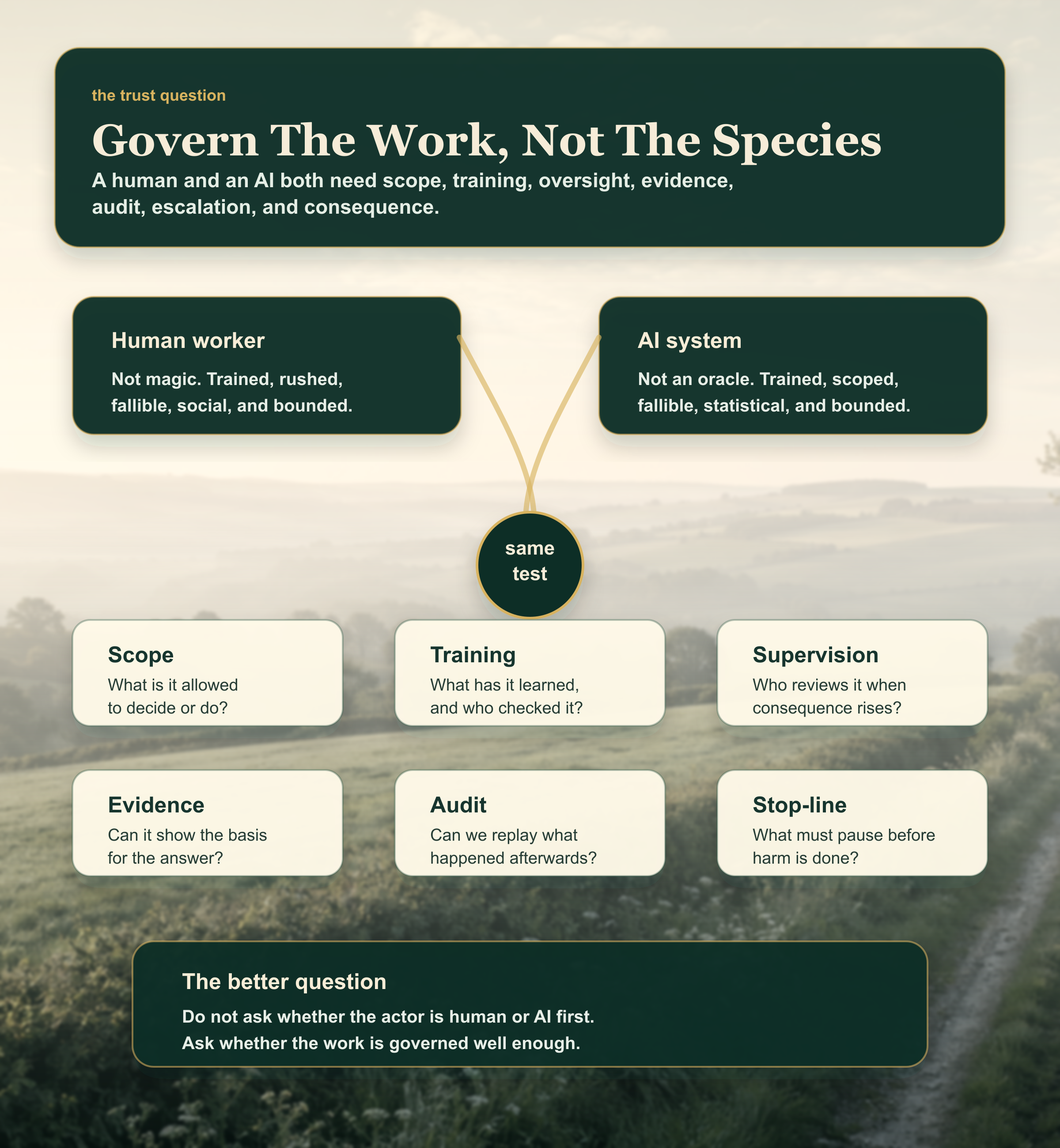
The better question is: is this work governed well enough for the consequence it can create?
Govern the work, not the species
That is the phrase I keep coming back to.
Govern the work, not the species.
If the work is low consequence, the controls can be light.
If the work is high consequence, the controls need to be serious.
That should be true whether the first draft came from a person, a model, an agentic system, a spreadsheet, a workflow engine, or a committee.
The question is not whether the actor is carbon or silicon.
The question is what the action can do.
| Control question | Human version | AI version |
|---|---|---|
| Scope | What is this person authorised to decide? | What is this system allowed to suggest, change, send, or trigger? |
| Training | What have they learned, and have they demonstrated competence? | What was the model or workflow trained, configured, tested, or evaluated to do? |
| Supervision | Who reviews their work when risk rises? | Where does human oversight, second-agent review, or escalation sit? |
| Evidence | Can they explain the basis for the decision? | Can the system show sources, assumptions, confidence, uncertainty, and limits? |
| Audit | Can we reconstruct what happened? | Are prompts, tool calls, outputs, approvals, and changes recorded where needed? |
| Stop-line | When must the person pause and ask? | When must the system refuse, pause, escalate, or require approval? |
That is not a lower standard for AI.
It is a more honest standard for everything.
The danger of human-default bias
We probably need a name for this.
I would call it human-default bias.
It is the habit of treating a human process as acceptable because it is familiar, while treating an AI process as suspicious because it is new.
Sometimes that suspicion is sensible.
New systems need scrutiny.
But familiarity is not evidence of safety.
There are human processes inside companies that fail every day. Bad handovers. Poor training. Unread policies. Weak supervision. Sloppy approvals. Confident guesses. Decisions made from memory. Decisions made because someone senior said so. Decisions nobody can reconstruct three weeks later.
We should not allow AI to recreate that mess at higher speed.
But we should also not pretend the old mess was fine because a person was involved.
Regulators should help by making standards concrete
This is where regulators matter.
Not because every AI tool should be buried under paperwork.
Because people need a standard they can point to.
The EU AI Act already moves in this direction. It defines an AI system in operational terms, not as science fiction. It includes an AI literacy obligation for providers and deployers, and for high-risk AI systems it points to requirements around record-keeping, human oversight, and accuracy, robustness, and cybersecurity.
NIST's AI Risk Management Framework takes a similar practical route. It is not asking people to believe in AI. It is asking organisations to manage risks to people, organisations, and society, and to bring trustworthiness into design, development, use, and evaluation.
That is the right direction.
Give us standards for the work.
Give us ways to show training, testing, limits, logs, reviews, failure modes, appeal routes, and stop-lines.
Then we can stop having the abstract argument.
The standard I want
When someone says, "Can you trust the AI?", I want to answer with a better set of questions.
What is it doing?
What consequence can it create?
What has it been trained or configured to do?
What has it been tested against?
Where does it know it is uncertain?
Where does it have to ask?
Where does it have to stop?
Who is accountable?
Can we inspect the record afterwards?
Those are the questions I would ask of an AI system.
They are also the questions I wish we asked more often of human systems.
Because the real comfort is not that a human did it.
The real comfort is that the work was done inside a system good enough for the risk.
That is not anti-AI.
It is pro-competence.
It is pro-governance.
And, honestly, it is probably pro-human too.