I have been noticing how much time used to disappear before the work even started.
Not the work itself. The crud before the work.
The emails. The calendar. The meeting location. Who is coming? What do they do? What was the thread again? What did they ask for? Did I miss an attachment? Was there a decision hiding in the fifth reply? What is the actual point of this meeting?
That stuff is real work, but it is not usually the valuable work.
The hidden warm-up tax
Before a meeting, I could easily lose ten or fifteen minutes just getting back into the shape of the situation.
Read the emails. Open the calendar. Check the names. Click through a profile. Look at the company. Try to remember where the conversation started. Skim a document. Get distracted by a side thread. Come back. Re-read the first email because now the whole thing has gone slightly foggy.
By the time I had finished assembling the context, I might have had five minutes left for the thing that actually mattered.
What do I want from this meeting?
What do they need?
Where is the risk?
What is the best useful thing I can bring?
That is the valuable thinking. But it used to come after the crud had taken its share.
Agents change the shape of preparation
This is one of the quiet shifts with agentic workers.
It is not just that they can write a document or summarise an email. It is that they can collect the boring context before I need to think.
They can pull the recent emails together. They can check the calendar. They can find the relevant person or company profile. They can tell me what the conversation seems to be about. They can surface the attachments. They can point out the commitments. They can say, "This appears to be the thrust of the thread."
Then I can check it.
That distinction matters. I do not want the agent to decide the meeting for me. I want it to clear the table so I can think properly.
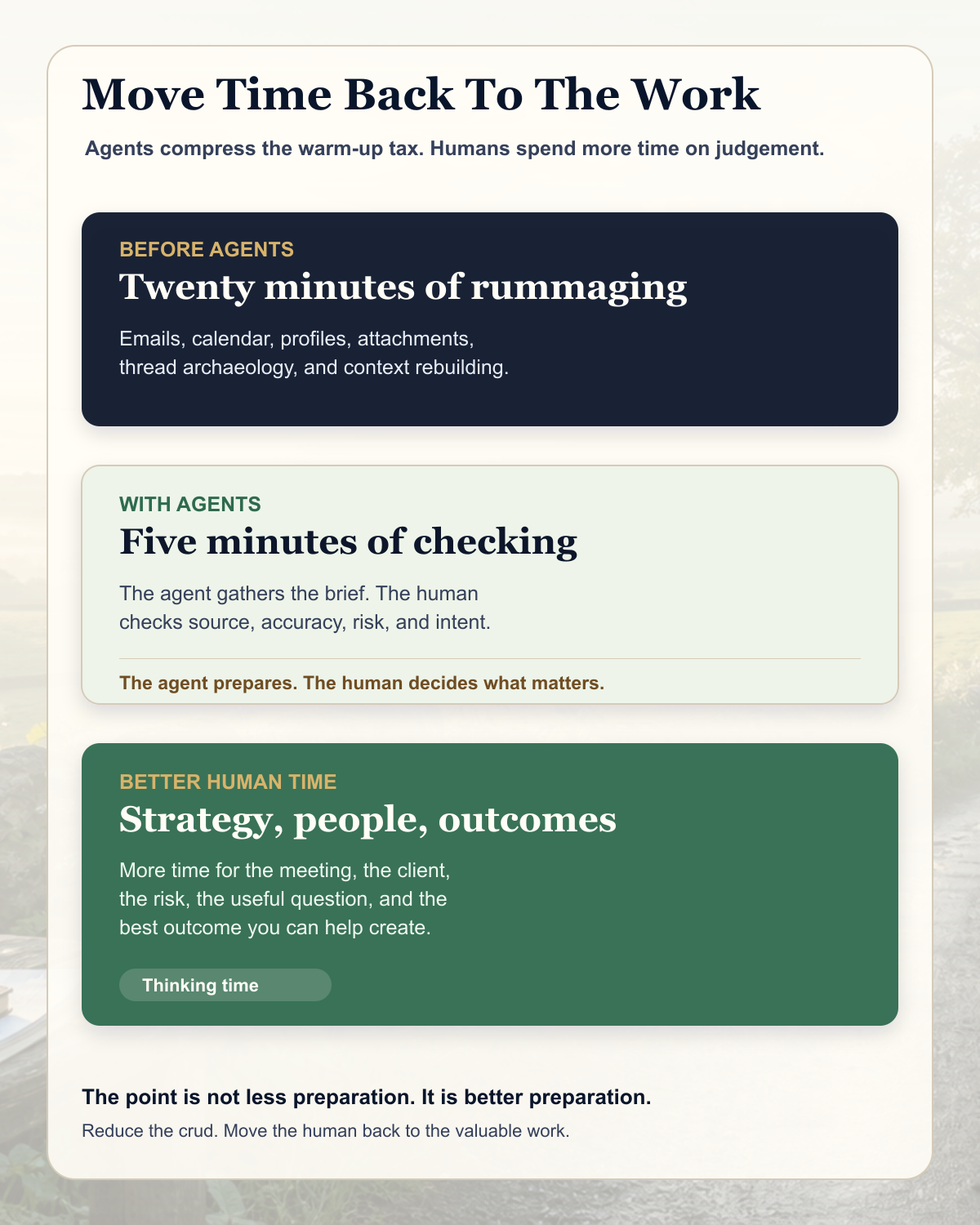
From twenty minutes of rummaging to five minutes of checking
The useful thing is not that preparation disappears.
The useful thing is that preparation changes shape.
Previously, I might spend twenty minutes rummaging through emails, context, calendars, files, and profiles, and then only five or ten minutes thinking about the actual engagement.
With agents, that can flip.
I might spend five minutes checking the briefing: is this the right person, the right thread, the right context, the right meeting, the right source? Then I can spend the rest of the time on the useful part.
Strategy.
People.
Outcomes.
How to carry the conversation well.
How to be useful.
If I were paying for a consultant
This is the test I keep coming back to.
If I were paying for a consultant's time, what would I want them doing?
Would I want them fiddling around with emails, trying to find the attachment, clicking between the calendar and LinkedIn, and reconstructing the thread from scratch?
Some of that has to happen, obviously. You need the facts. You need the context. You need to know where you are going.
But that is not where the value is.
I would want them thinking.
I would want them making connections. I would want them seeing the pattern. I would want them considering the people in the room. I would want them thinking about risk, outcome, timing, tone, and the one useful question nobody has asked yet.
That is what clients are paying for.
The agent as preparation layer
I think one of the best uses of agents is as a preparation layer.
Not the boss. Not the performer. Not the decision-maker.
The preparation layer.
"Get me ready for this."
That instruction is deceptively powerful. It means gather the context, find the thread, summarise the movement, check the people, show me the risks, and ask me the questions that make my thinking better.
It also means the preparation becomes repeatable. I can ask for the same pattern every time:
- What is this meeting about?
- Who is involved?
- What has happened so far?
- What do they probably need?
- What do I need to decide?
- What should I not miss?
- What would a good outcome look like?
That is not glamorous automation. It is better thinking hygiene.
More thinking in the same time
The promise here is not that we all work less.
Sometimes we might. That would be nice. I remain open to the idea in principle.
But the more immediate benefit is that we get more thinking into the same amount of time.
Twenty minutes before a meeting used to mean a mixture of email archaeology, calendar checking, profile scanning, document hunting, and maybe a little actual strategy.
Now that same twenty minutes can be mostly strategy.
And that is a different quality of work.
The practical lesson
When people talk about AI productivity, they often look for big visible tasks.
Write the report. Build the app. Produce the deck. Analyse the data.
Those are useful, but there is another layer that may matter just as much: all the small bits of crud that sit between you and the actual work.
The hidden warm-up tax.
The context reconstruction.
The rummaging.
If agents can reduce that, they do not just save time. They change what the time is for.
That is the bit I think leaders should notice. The question is not only "how many minutes did we save?"
The better question is: did we move the human back to the work only the human should be doing?