This is a request to Europe, not a complaint about Europe.
I understand why the rules exist.
AI systems can affect rights, privacy, fairness, security, employment, competition, public services, and trust. A serious society should not just throw powerful systems into the world and hope everyone behaves nicely.
Europe is right to care about safety.
But there is a practical problem now.
For many ordinary companies, adopting AI properly is becoming too hard.
Not impossible. Not always. Not for the largest firms with legal teams, procurement teams, security teams, policy teams, enterprise vendor relationships, and enough internal capacity to turn a useful tool into a twelve-month programme.
But for a lot of companies, the path is messy.
They want to use ChatGPT, Claude, Codex, CoWork, or whatever comes next. They want to use a proper harness. They want logs, boundaries, permissions, audit, data controls, human review, and sensible procurement.
Then the hoops begin.
Vendor risk. Data processing. Model terms. Retention. Security review. Data residency. Procurement rules. Sector rules. Internal policy. Shadow AI fear. Board anxiety. "What happens if this gets banned?" "What happens if the provider changes terms?" "What happens if someone puts the wrong data in?" "Who signs this off?"
Some of that is necessary.
All of it together becomes friction.
And friction has consequences.
The safe route is too unclear
The problem is not that European companies do not want to adopt AI.
The problem is that many of them do not know what safe adoption looks like in practice.
So they stay in the lowest-risk version of the technology.
A few approved chat tools. A cautious pilot. A small internal group. A policy that says people can use AI, but not for anything too sensitive, too meaningful, or too close to the work that would actually create value.
Everyone can see the potential.
But the person who recommends broader deployment has to be brave.
Very brave.
Because if something goes wrong, it is not usually the committee that takes the heat. It is the person who said, "Yes, we should roll this out."
So people wait.
They wait for legal. They wait for procurement. They wait for a group policy. They wait for the regulator. They wait for a peer to go first. They wait for someone else to make the brave decision.
Meanwhile the rest of the world moves.
The approval burden sits in the wrong place
Inside many companies, the pattern is effectively this: a team, manager, or technologist finds a useful AI tool, tries to work out what is allowed, prepares the argument, asks legal, procurement, security, or compliance for approval, and then waits for an official yes or no.
That sounds sensible.
But it puts too much of the discovery burden on the people who are least able to carry the risk.
When the personal or professional risk feels too high, people naturally choose the safest category of use.
That usually means a chat window, a small pilot, a locked-down group, and a policy that allows summarising, drafting, and brainstorming, but not the deeper work where the value starts to appear: agentic analysis, controlled access to business data, software delivery, local file workflows, and meaningful process redesign.
So the organisations with the time, money, and confidence to design the approval route move ahead.
Everyone else waits, uses surface-level tools, or avoids the real workflows.
That is how Europe can become early in policy but late in practice.
The better answer is to move common decisions upstream.
Publish pre-approved lanes: approved devices, approved harnesses, approved data classes, approved logging, approved human review, approved procurement wording, and approved escalation routes. Then a company is not asking every employee to invent compliance. It is asking them to choose the right lane and ask for an exception when they need to leave it.
Shadow AI is not the win
When the official route is too slow, people do not stop needing the tool.
They use it quietly.
That is not a good outcome for Europe.
If people use AI outside approved systems, you lose the very things regulation is trying to protect: visibility, audit, training, control, accountability, and the ability to learn what is actually happening.
The safest future is not one where AI adoption is so bureaucratic that companies avoid it in public and use it in private.
The safest future is one where the compliant route is easier than the risky route.
That is the request.
Please make the safe route easier.
There are two practical lanes
I think Europe has two big options.
The first is sovereign capability.
If Europe wants companies, public bodies, universities, councils, healthcare systems, and regulated organisations to adopt AI with confidence, then there needs to be a route that feels European, durable, fundable, and safe enough to bet on.
That means serious investment in European AI infrastructure, sovereign cloud options, trusted model access, evaluation, auditing, and approved deployment patterns.
The EU is already moving in this direction with AI Factories, EuroHPC infrastructure, and broader AI-continent work. That is good. Please keep going, and make it useful to ordinary companies, not just research centres and flagship programmes.
The second is sandboxes.
Not sandboxes as a nice policy word.
Real sandboxes.
Places where companies can test agentic tools, procurement models, data controls, human oversight, logging, red-teaming, and rollout patterns with clear rules and practical support.
A sandbox should give a company confidence that it can move without accidentally breaking the law, breaching procurement policy, or creating a governance problem that only becomes visible later.
It should not be a loophole.
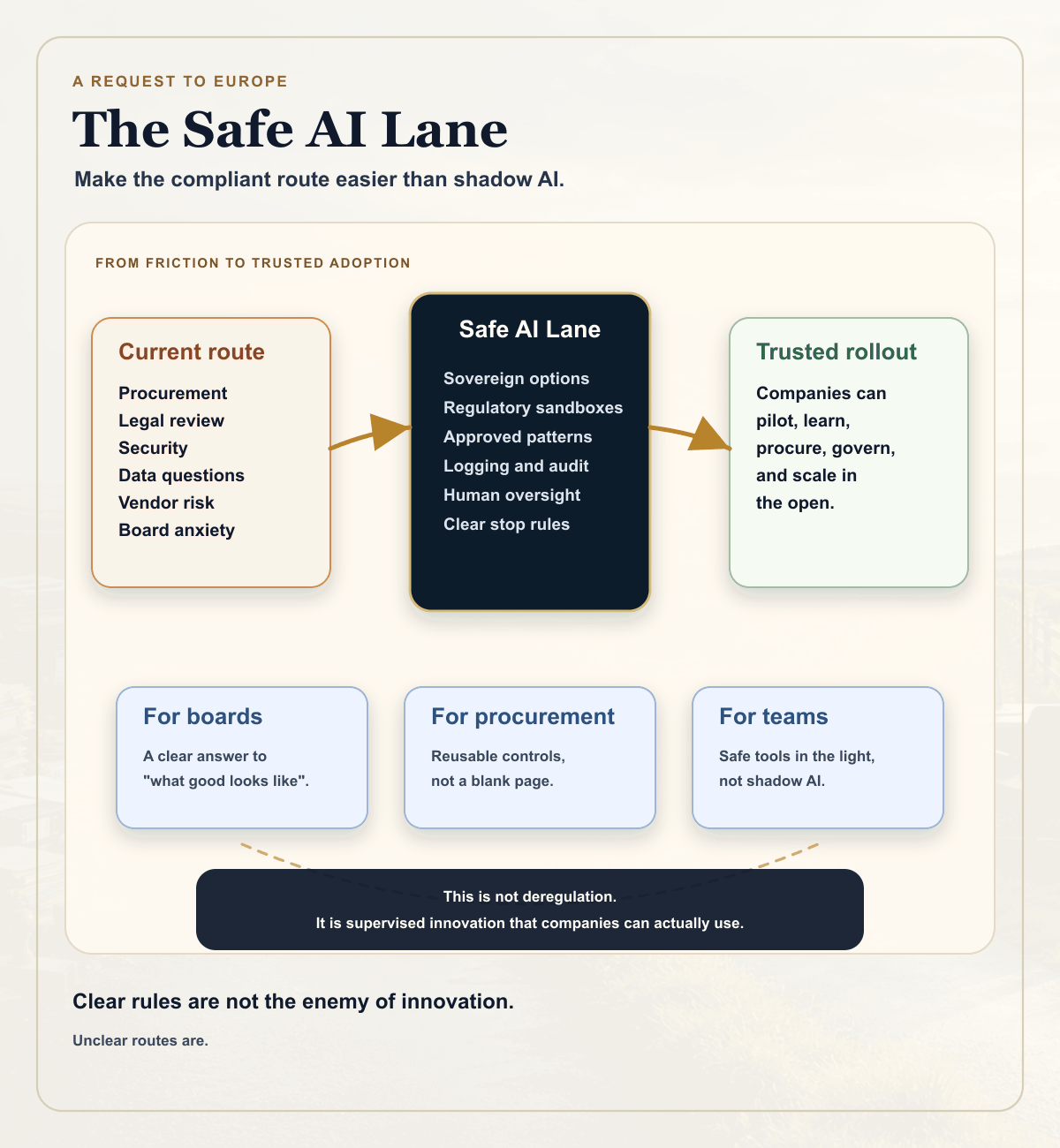
It should be a supervised safe lane.
The AI Act has the seed of this
The European AI Act already recognises the need for regulatory sandboxes and real-world testing.
That matters.
Because the question is not whether Europe should regulate AI.
The question is whether Europe can make regulated AI adoption fast enough, clear enough, and practical enough that companies actually use the regulated route.
If the AI Act becomes only a compliance burden, Europe will lose pace.
If the AI Act becomes a trust machine, Europe has a chance.
That means turning the Act into usable operating patterns.
What can a mid-sized company do next Monday?
What can a procurement team approve?
What can a board understand?
What can a regulator point to and say, "Yes, start there"?
Companies need patterns, not just principles
Most companies do not need another abstract statement that AI should be transparent, safe, human-centred, accountable, and trustworthy.
They need patterns.
- Approved ways to use AI with internal documents.
- Approved ways to use AI for software development.
- Approved ways to run AI on managed company devices or controlled workbenches.
- Approved ways to use agents with read-only data.
- Approved ways to log prompts, outputs, actions, and human review.
- Approved ways to separate personal data, confidential data, and public data.
- Approved ways to run pilots that can become production systems.
- Approved routes for official yes, no, and exception decisions.
- Approved tiers for chat, read-only agents, local files, business data, and production actions.
- Approved ways to procure AI tools without every organisation starting from zero.
Those patterns should be reusable.
A small manufacturer should not have to invent its own legal architecture just to let staff use a coding agent safely.
A charity should not need a magic procurement department to understand what is allowed.
A school, council, healthcare provider, university, or SME should not have to choose between paralysis and shadow AI.
Give them a safe lane.
This is not deregulation
I am not asking Europe to abandon safety.
I am asking Europe to make safety operational.
There is a difference.
Deregulation says, "Do what you like."
A safe lane says, "If you follow these controls, in this environment, for these classes of use, with these logs, these boundaries, these data rules, and this human oversight, you can move."
This safe lane should not exempt companies from the AI Act, GDPR, or sector rules. It should help them classify risk, apply the right controls, and move through compliance with confidence.
That is much better than the current fog.
The fog increases cost. It slows innovation. It makes people nervous. It privileges large organisations that can afford compliance teams. It leaves smaller companies behind. It makes Europe less competitive while still not necessarily making deployment safer.
Clear rules are not the enemy of innovation.
Unclear rules are.
There is a global race, but it is not only a race for speed
Europe does not need to copy the most reckless version of AI adoption.
That would be a mistake.
Europe has a different strength: trust, rights, institutions, consumer protection, public purpose, and a long memory of what happens when technology is allowed to run ahead of society.
Those strengths are real.
But they have to become product strengths, not just policy strengths.
European trust has to show up as faster trusted deployment.
European rights have to show up as clear implementation patterns.
European regulation has to show up as a route that good companies can actually follow.
Otherwise the world will not wait.
American platforms will move. Chinese platforms will move. Open-source models will move. Startups will move. Workers will move. The technology will move.
Europe can either build the trusted adoption lane, or watch adoption happen around the edges.
My request
So this is the request.
Please make it easier for European organisations to adopt AI safely.
Invest in sovereign AI capacity, but make it usable outside the biggest institutions.
Build practical regulatory sandboxes, but make them operational rather than symbolic.
Create approved rollout patterns for common use cases.
Help procurement teams say yes safely.
Help boards understand what good looks like.
Help smaller companies move without needing an army of lawyers.
Help people deploy agentic tools in the light, with logs, boundaries, training, oversight, and responsibility.
Europe does not need less safety.
It needs a safe lane that people can actually use.
If you give companies that lane, they will move.
And they will move in a way Europe can be proud of.
Research notes
- European Commission, AI Act overview - the Commission's summary of the EU's risk-based AI regulatory framework.
- Regulation (EU) 2024/1689, Artificial Intelligence Act - the legal text, including provisions on regulatory sandboxes and real-world testing.
- European Commission, AI Factories - official information on European AI factories and EuroHPC-based AI infrastructure.
- European Commission, AI Continent Action Plan - the Commission's broader plan for AI infrastructure, adoption, skills, and simplification.