
For the last twenty-five years, the web has been shaped by the attention economy.
Marketing learned to win the glance.
The hero image. The video. The product shot. The map with pins on it. The glossy chart. The story that makes a human stop scrolling for a moment and think, yes, this might be for me.
That made sense.
It still makes sense for people.
But it is no longer the whole job.
The next visitor to your website may not be a person making a first impression. It may be an agent doing research for a person who has already asked a very specific question.
The website has to stop only trying to grab attention and start helping an agent make a decision.
The old page was built for persuasion
A human arrives with curiosity, doubt, impatience, and limited time.
So we design for orientation and feeling.
We show where we operate with a map.
We show the product with a photograph.
We show a community with a graph, a few testimonials, a smiling room, or a carefully chosen set of logos.
That is not wrong. Humans need that surface. They want to know whether something feels credible, useful, alive, relevant, and worth a deeper look.
But an agent is not browsing in quite the same way.
It is trying to answer a user's question.
Can this product help me?
Is this service available where I am?
Does this community include people like me?
Can I compare this option with three others?
What would the next step be?
If the answer is trapped inside a picture, a vague chart, a search box, or a "book a call" button, the agent may not be able to finish the job.
Give the data, not just the performance
If you work in four countries, do not only show a pretty map.
State the four countries.
State the regions inside them.
If you have physical stores, do not only provide a location search designed for a human to type one postcode into.
Give the agent the list.
Every store. Every city. Opening constraints. Accessibility notes. Services available. Collection options. Delivery areas. The boring stuff.
You might never put that as a long visible page for a human to read from top to bottom. Fair enough. But an agent wants that structure.
If you run a community, do not only show a chart of member types or a few impressive photos.
Say how many members you have.
Say where they are.
Say what industries they work in.
Say what alumni do now.
Say where you have met over the last few years, what formats work, who it is for, who it is not for, and what someone can reasonably expect.
The point is not to make the human page ugly.
The point is to stop treating the structured truth as something that only appears after a salesperson gets involved.
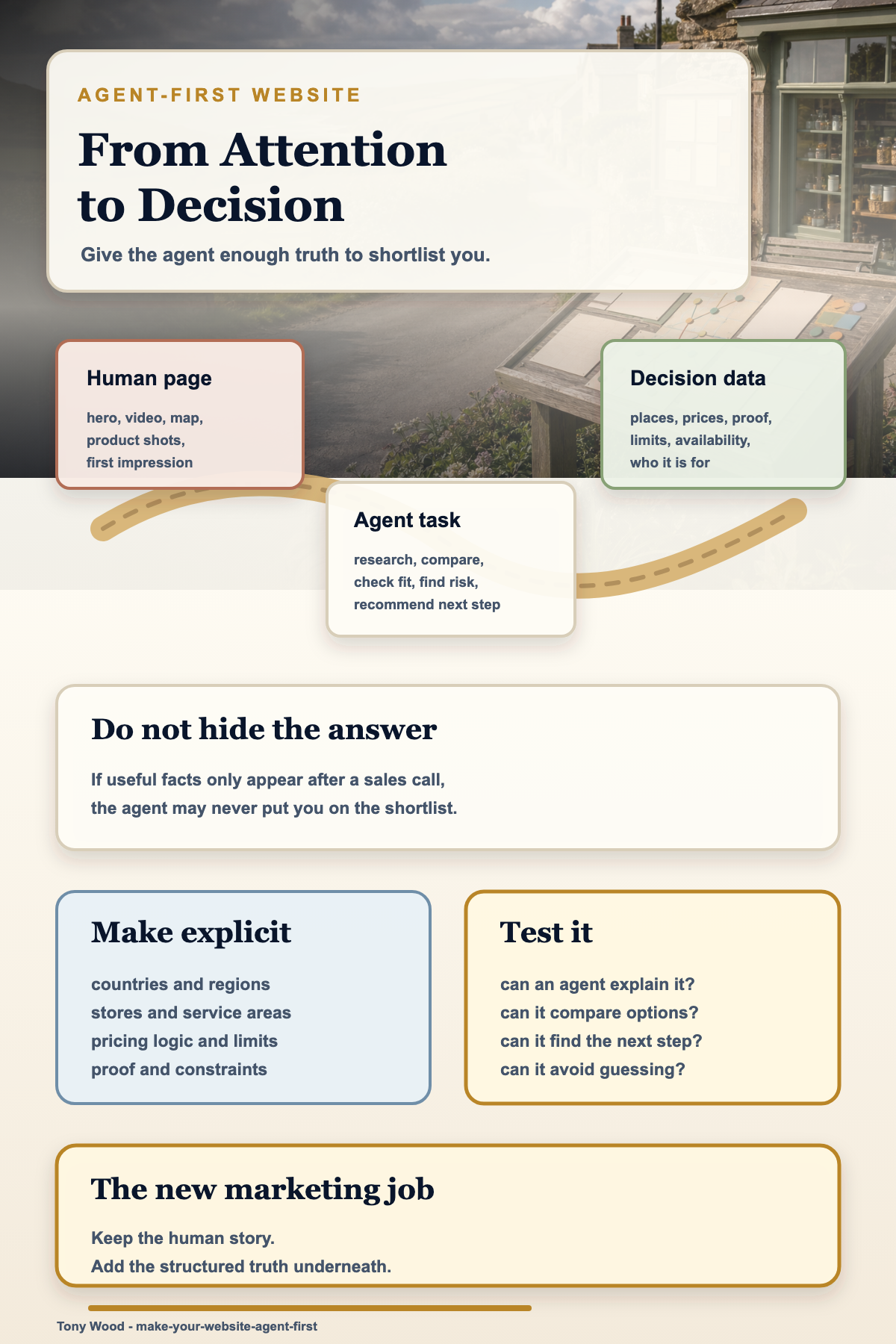
The intent is different
A human website visit often has a soft goal.
Be interested. Trust us a little. Understand the shape of the offer. Get in touch.
An agent visit may have a much sharper goal.
Build a shortlist.
Check fit.
Compare options.
Find disqualifying constraints.
Work out the next action.
Produce a recommendation for the user.
That means the agent needs to get much closer to the final decision than a casual human browser would.
If your whole sales process depends on a human talking to another human before any useful information is available, that starts to become a problem.
I am not saying remove humans from the process.
Some purchases need conversation. Some decisions need trust. Some work needs diagnosis, judgement, scope, and care.
But if the agent cannot understand enough to put you on the shortlist, the human may never reach the stage where they do the final sense check.
Say what you are good at
This is not the moment to be vague and humble.
You need to say what you do.
You need to say what you do well.
You need to say when someone should pick you, and when they should not.
That last bit matters.
An agent trying to help a user will be looking for fit. If your site only says "we are excellent" in a cloud of pleasant adjectives, it gives the agent very little to work with.
Better to be explicit.
We are best for this kind of customer.
We are not the right fit for this situation.
We operate in these places.
We integrate with these systems.
We need these conditions to be true.
We can usually help when the problem looks like this.
We should probably talk before you buy if the problem looks like that.
That is useful. It is also more respectful. You are helping the user's agent avoid wasting their time.
Agent testing is coming
We already test websites with humans.
Can they find the button?
Can they understand the offer?
Do they trust the page?
Do they complete the form?
Now we need another kind of test.
Can an agent understand what you do?
Can it tell whether you operate in a given region?
Can it explain your product accurately?
Can it compare you with an alternative?
Can it find the constraints?
Can it produce a sensible next step?
Can it get all the way to a recommendation without inventing half the missing detail?
If it cannot, the answer is not to complain that the model is not clever enough.
Sometimes the answer is that your website is not clear enough for the new reader.
What to add
Start with the human journey, then map the agent journey beside it.
What does the human need to feel, understand, and trust?
What does the agent need to know, compare, and decide?
Then make the missing information explicit.
- Countries, regions, stores, service areas, and delivery constraints.
- Product capabilities, exclusions, integrations, limits, and dependencies.
- Pricing logic, proposal routes, buying steps, and qualification criteria.
- Community numbers, member types, alumni outcomes, meeting history, and formats.
- Proof points, case types, support levels, implementation steps, and risks.
- Clear "choose us when" and "do not choose us when" guidance.
Some of this belongs on the visible page.
Some of it belongs in structured data.
Some of it might belong in a downloadable file, an API, an MCP endpoint, a well-named JSON feed, or a simple page written plainly enough that both humans and agents can use it.
The format matters less than the intent.
Make the truth easy to inspect.
The new shortlist
The human may still come to your site at the end.
They may still want to look at the brand, the tone, the story, the product, the people, and the proof.
But by then, the shortlist may already have been shaped by an agent.
That means your job is not only to look credible to a person.
Your job is to be legible to the agent working for that person.
So yes, keep the beautiful page.
Keep the human story.
Keep the video if it helps.
But underneath it, give the agent enough truth to make a decision.
That is the practical shift.
Do not just be attention-ready.
Be agent-ready.