We are now in a really interesting stage.
And, if I am honest, a really sad one.
I love the frontier harnesses. I love Codex. I love Claude-style agentic work. I love what these tools let me do. They have changed how I write, build, research, think, and move work forward.
That is why this is hard to say.
If access to the best hosted models can be restricted suddenly, unevenly, or politically, then they cannot be the only foundation for our future.
They can be part of it.
They cannot be all of it.
The fact pattern matters
I want to be careful with the facts, because there is a lazy version of this argument that would be too simple.
In Anthropic's case, we have a hard event. Anthropic published a statement saying the US government had issued an export-control directive requiring it to suspend access to Fable 5 and Mythos 5 by foreign nationals. Anthropic said the practical result was that it had to disable those models for all customers to ensure compliance.
That is not vague.
That is not theoretical.
That is a model being made unavailable because of a government decision.
OpenAI is not the same fact pattern. What I can verify is more about controlled and uneven frontier access: preview access, selected users, selected partners, and staged availability. That is not the same as a formal export-control suspension.
But from an operating point of view, the lesson rhymes.
You may not get the model when someone else gets it.
You may not get it for weeks.
You may not get it for months.
In some cases, you may not get it at all.
And if another company does get it while you do not, that company now has a material advantage.
This is an operational resilience question
I do not think this is mainly a consumer frustration story.
It is an operational resilience story.
If your organisation is building its working practice around a model, a harness, an API, a provider, or a particular agentic workflow, then you need to know what happens when that access changes.
Can the provider still serve you?
Can the jurisdiction still allow it?
Can your team keep working?
Can your prompts, evaluations, skills, documents, workflows, and judgement rules move somewhere else?
Can you run a degraded mode?
Or have you quietly built your future on a service that can be pulled away?
This is the bit that hurts, because I do not want to stop using the best tools. I do not want to pretend they are not extraordinary. They are extraordinary.
But extraordinary is not the same as resilient.
The unfairness is the point
The difficult part is not only that a tool may be unavailable.
The difficult part is that it may be unavailable to you while available to someone else.
That creates a strange new competition problem.
If a small group of companies get access to a frontier model and the rest of us do not, they are not just getting a better product. They are getting a better labour multiplier, a better research multiplier, a better software multiplier, a better operational multiplier.
That is not a small thing.
This was meant to be a general-purpose technology.
It was meant to help people build, learn, write, research, understand, create, and work. It was not meant to be intelligence for one or two favoured groups while everyone else waits outside the door.
I know the national-security argument is real. I know frontier models are strategic. I know governments will not ignore that.
But the result is still bleak.
If a model is powerful enough to change work, and access to that model is restricted to a narrow circle, then we have not democratised intelligence.
We have rationed it.
I have seen a version of this before
I am old enough to remember the encryption wars.
In the 1990s, strong encryption was entangled with export-control rules. There were export-grade versions, limits, reviews, arguments about source code, arguments about national security, arguments about whether ordinary people and companies should be allowed to use strong cryptography.
It felt absurd then.
It feels familiar now.
The specific facts are different. AI models are not encryption libraries. But the shape is familiar: something that looks like software becomes strategic infrastructure, and suddenly access is no longer simply a product decision.
Then, as now, the route to freedom was not waiting politely for every gatekeeper to agree.
The route to freedom was open protocols, open source, portable systems, and communities that could keep building.
Open source, open weights, and honest language
We need to be precise here.
Not every model people call "open source" is actually open source under the Open Source Initiative's definition. Some are open-weight. Some have custom licences. Some are open for research but not for every commercial use. Some give you weights but not training data. Some give you a lot of practical freedom without giving you the full preferred form for modification.
That distinction matters.
But the practical direction still matters too.
If you can download a model, run it locally or inside your chosen infrastructure, evaluate it, fine-tune where allowed, wrap it in your own harness, and keep using it when a hosted provider changes access, you have more resilience than you do with a pure black-box hosted dependency.
It may be less powerful.
It may be slower.
It may need more work.
But it is yours in a way a remote frontier endpoint is not.
The models I would test first
I would not pretend there is one magic answer. The right model depends on the work: coding, reasoning, retrieval, summarisation, multilingual work, local hardware, privacy, cost, latency, licence, and how good your harness is.
But if I were starting a resilience track today, these are the kinds of open or open-weight models I would put on the first testing list.
| Model family | Why I would look at it | Resilience note |
|---|---|---|
| Qwen3 | Strong open-weight model family, with Apache-2.0 releases and large mixture-of-experts options. | Good candidate for serious self-hosted evaluation, especially where licence clarity matters. |
| DeepSeek-R1 | Reasoning-focused model released under an MIT licence, with distilled variants available for smaller deployments. | Useful for testing reasoning workflows, but needs careful evaluation and governance like any other model. |
| Kimi K2 | Large open-weight agentic model from Moonshot AI, aimed at general and agentic use cases. | Interesting for agentic experiments; check the modified MIT licence and deployment assumptions before relying on it. |
| Mistral open models, including Devstral | European provider with strong open-model culture; Devstral is aimed at agentic software engineering work. | Especially interesting for European organisations that want both local experimentation and a sovereign commercial route. |
| Google Gemma | Open model family with smaller practical options for local or controlled deployments. | Useful for lighter workloads, education, prototyping, and places where the best model is not required. |
| Llama-family models | Widely used open-weight ecosystem with broad tooling, fine-tunes, and deployment support. | Not always open source in the strict sense, but practically important because the ecosystem is so large. |
| OpenAI open models | OpenAI's own open-weight route is worth watching separately from its hosted frontier models. | Potentially useful as a bridge for teams that already like OpenAI-style tooling but need more portability. |
This is not a ranking.
It is a starting bench.
Pick three. Run the same tasks through them. Use your own documents. Use your own code. Use your own prompts. Use your own failure cases. Work out what is good enough, what is not good enough, and what needs a human in the loop.
Sovereign AI is part of the answer
Open models are not the only answer.
Sovereign AI matters too.
If you are in Europe, you should be looking hard at European providers such as Mistral, Aleph Alpha, and other national or regional efforts. If you are in another country, you should be asking what your local sovereign or trusted infrastructure route looks like.
But we should be honest about that too.
Sovereign does not automatically mean available.
Sovereign does not automatically mean open.
Sovereign does not automatically mean resilient.
A sovereign provider can still be closed, expensive, immature, over-controlled, or unavailable to smaller companies. But if the legal, data, operational, and political boundary is closer to home, it may still be a better answer for critical work than a more powerful tool that can vanish under another country's policy decision.
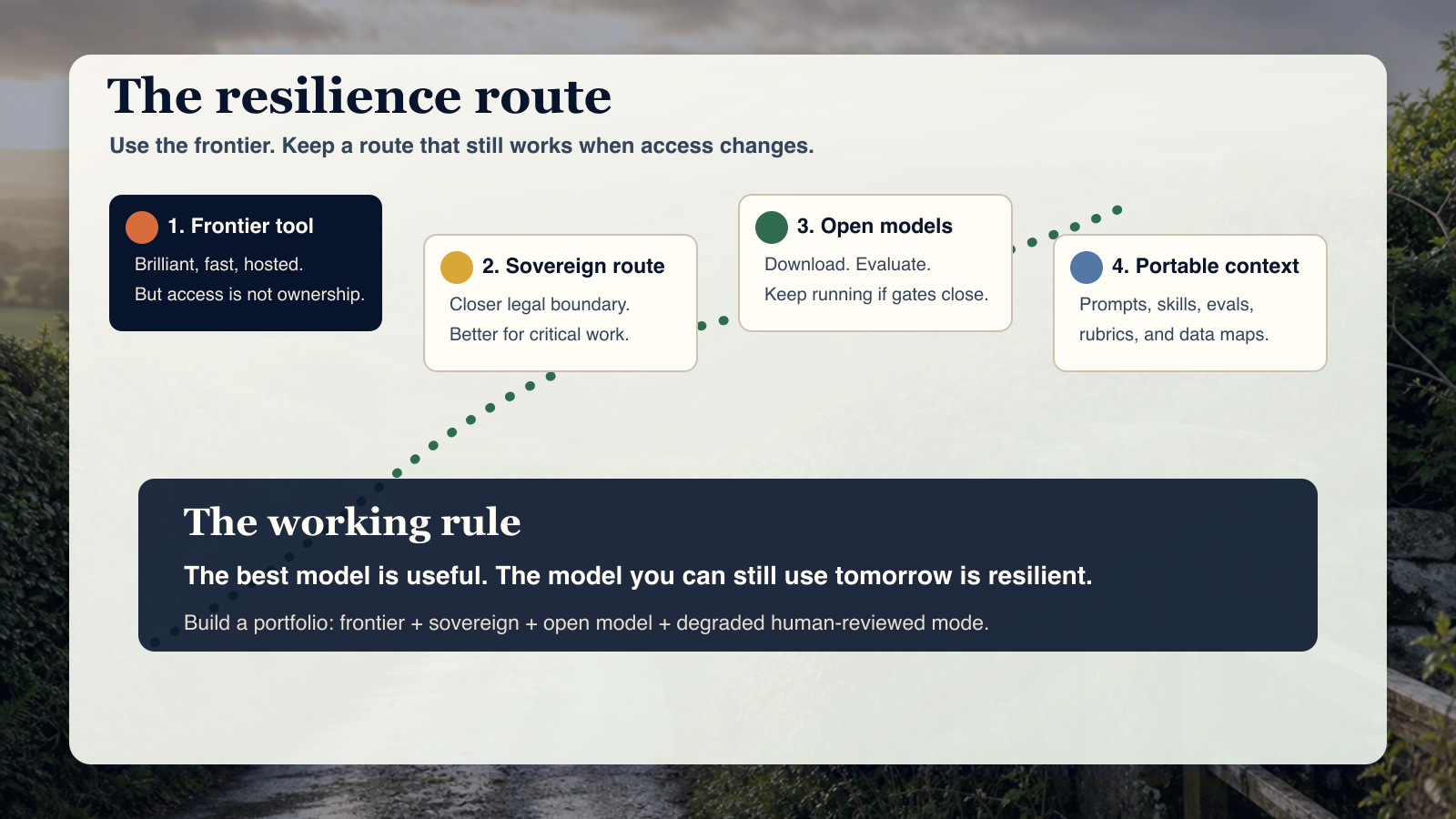
The trick is not to choose one religion.
The trick is to build a portfolio.
Use the frontier, but do not become trapped by it
My practical advice is not "stop using OpenAI" or "stop using Anthropic".
That would be silly.
If you have access to the best tools, use them. Learn from them. Let them raise your standard. Let them show you what good looks like.
But while you do that, keep your work portable.
- Keep your prompts, skills, rubrics, and workflows in files you own.
- Keep your important context outside one provider's memory system.
- Keep your evaluations runnable against several models.
- Keep your data boundaries clear enough that you can move safely.
- Keep one open-model or sovereign fallback in active testing.
- Keep a degraded mode for the work that matters.
Do not wait until the tool is unavailable to find out whether you can work without it.
The emotional bit
This is probably one of the saddest technology posts I have written.
Because I do not want this to be true.
I want the best tools to be available to everybody trying to build something useful. I want small companies, students, researchers, councils, charities, consultancies, and independent builders to get the same lift as the biggest companies.
That is what made this period exciting.
The sense that intelligence was becoming something many more people could use.
But if access to that intelligence becomes gated by geography, politics, export controls, partner status, or commercial preference, then we need another route.
We have been here before.
When freedom mattered, open source mattered.
When portability mattered, open protocols mattered.
When gatekeepers tried to hold the centre, communities built around them.
So yes, use the frontier while you can.
But support your local open-model projects.
Test them.
Contribute to them.
Build harnesses around them.
Make your context portable enough that they can use it.
Because if the frontier can be blocked, the route to freedom is not waiting at the gate.
The route to freedom is being able to keep walking.
Sources and notes
This is a personal opinion piece, not legal advice or procurement advice. The Anthropic event is a verified access-suspension event. The OpenAI point is framed more narrowly as controlled and uneven frontier availability, not as the same kind of legal suspension.