There is the version of governance people think they have, and then there is the version they actually practise.
The first one lives in policies, board packs, annual reviews, terms of reference, committee structures, registers, risk maps, and all the calm language that makes a company look properly held.
The second one lives in behaviour.
Did the directors read the papers? Did they understand the decision? Did they challenge the assumption? Did they correct the minutes? Did they know what the policy actually meant in operation? Did the board hear what was really happening, or only what everyone hoped was happening?
That is where governance either becomes useful or turns into slop.
We already have a phrase for low-quality AI output: AI slop. It is the generic stuff. The plausible stuff. The thing that looks like an answer until you read it properly and realise it has no real grip on the situation.
I think we need the same phrase for boards.
Governance slop is what happens when a board produces the appearance of oversight without doing the work of governing.
It is not usually dramatic. That is the problem. It is not a director standing up and saying, "I have decided to be negligent today."
It is quieter than that.
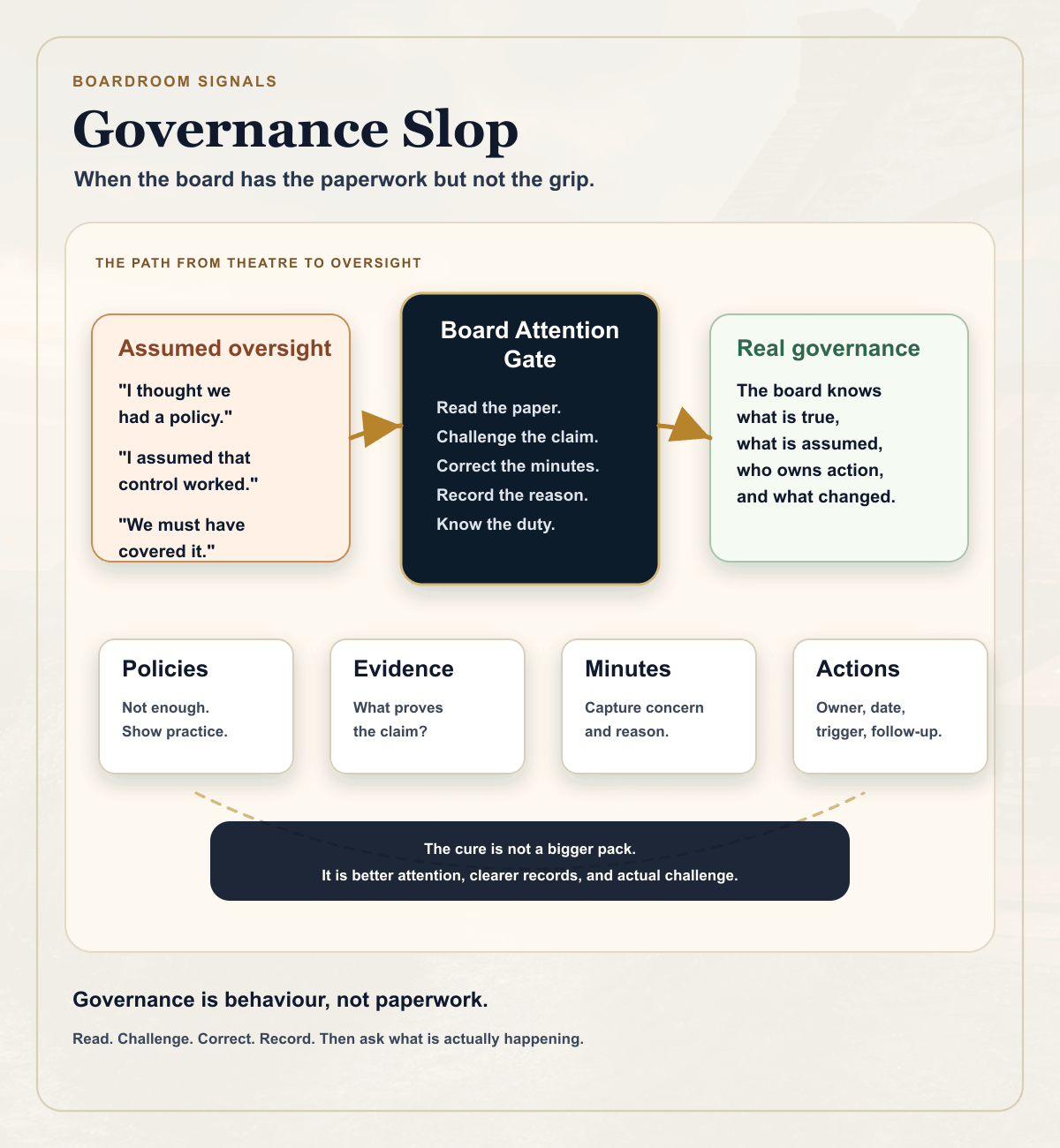
It is the half-read pack. The unchallenged assumption. The policy everyone thinks exists. The risk that was "noted" but never owned. The minutes that are approved even though they do not reflect what happened. The director who says, "I thought we did that," when nobody did.
That is governance slop.
The policy is not the practice
Governance often fails in the gap between paper and practice.
A board sees a policy and assumes the behaviour exists. A CEO gives a reassuring update and the board assumes the control is working. A committee receives a report and everyone assumes the hard bit happened somewhere else.
But a policy is not a control.
A dashboard is not assurance.
A board paper is not challenge.
A minute is not truth unless someone has taken the trouble to make it true.
The UK director duties are not fluffy. Directors are expected to exercise independent judgement and reasonable care, skill and diligence. The UK Corporate Governance Code keeps returning to the same practical point: boards need clear information, constructive challenge, proper time, effective controls, and reporting that focuses on outcomes rather than boilerplate.
That is not a paperwork exercise.
It is an attention exercise.
What governance slop looks like
Governance slop has a particular smell once you have seen it a few times.
- Imagined policy: someone confidently says a policy exists, but nobody can find the live version or show where it is used.
- Unread assurance: a report is tabled, noted, and filed, but no one asks whether the evidence supports the conclusion.
- Decision fog: the board discusses a topic, but the decision, owner, risk, and next action are not clear afterwards.
- Minute drift: minutes are approved even though they miss the challenge, soften the concern, or record a conclusion that was not actually reached.
- Fiduciary vagueness: directors know they have responsibilities, but have not refreshed what those responsibilities require in the real situation in front of them.
- Control theatre: everyone points at a framework, but nobody can explain how the control works, who owns it, what failed last time, or what would trigger escalation.
The board has the forms. It has the ritual. It has the papers. But the governing has gone soft.
A good board is context-rich
When you are on a good board, it is a joy.
Not because everyone agrees. Often the opposite.
It works because the board is in context. People have read the papers. They know the company. They understand the previous decisions. They know where the live risks are. They can tell the difference between a policy, a control, an owner, and a hope.
A good board is like an AI system with strong context and sensible guardrails.
Ask it a question and it does not just produce generic mush. It knows the environment. It knows what has happened before. It asks for missing evidence. It challenges the prompt. It says, "Hang on, that does not follow from the paper." It knows when a decision needs to be recorded properly because someone will rely on it later.
Bad governance is the opposite.
It fills in the gaps with confidence.
"I thought finance had approved that."
"I assumed the policy covered it."
"I am sure we discussed this last year."
"That must be in the minutes somewhere."
That is not knowledge. That is boardroom predictive text.
The CEO should not accept it
This is not only a board-member problem.
CEOs and executive teams should not accept governance slop either.
Yes, executives can get frustrated by boards. They can feel that directors are parachuting in, misunderstanding the business, asking obvious questions, slowing things down, or focusing on the wrong detail.
Sometimes that is true.
But a weak board is not a gift to the CEO. It is a future problem with a calm face.
If the board does not understand the business, the risk comes back later. If minutes are vague, the record will not protect anyone. If decisions are not clear, accountability becomes politics. If directors are operating on imagined facts, the CEO is leading without a properly informed board.
That is dangerous.
The job is not to drown directors in paper and then complain that they do not understand. The job is to create a governance rhythm that makes understanding possible.
Good board packs should make the ask clear. Is this for decision, challenge, noting, assurance, or direction? What changed since last time? What is management recommending? What are the risks? What evidence supports the position? What decision will be recorded? What would make this wrong?
That last question is underrated.
A board that asks, "What would make this wrong?" is much less likely to swim in slop.
The director has to do the work
There is also no polite way around this: directors have to do the work.
If you take the role, read the papers.
If you do not understand the paper, ask before the meeting.
If the minutes are wrong, correct them.
If you have a concern, make sure it is captured.
If the board is relying on a policy, ask how that policy is lived.
If a control is important, ask when it last failed.
If a decision is material, ask what evidence the board has, what assumptions are being made, and what consequence follows.
This is not about being awkward. It is about being useful.
A board member who does not prepare, does not challenge, does not correct the record, and does not know the duties of the role is not being collegiate. They are adding noise to the system.
Governance slop is often produced by people being pleasant, rushed, vague, and underprepared.
That makes it more dangerous, not less.
The cure is not a bigger pack
The answer is not always more documentation.
Boards can drown in information and still starve for truth.
The cure is better structure and better attention.
- Separate policies from evidence that the policy is working.
- Make every board paper clear about the decision or challenge required.
- Record assumptions, not just conclusions.
- Use minutes to capture the real discussion, especially concerns and reasons.
- Give directors enough time and clarity to prepare properly.
- Refresh director duties and board expectations regularly, not just at induction.
- Ask management to show what changed, what failed, and what is still unknown.
There is a good parallel with AI here.
If you give an AI a vague prompt with no context and ask for something important, you should not be shocked when the answer is generic.
If you give a board vague packs, weak minutes, unclear decisions, soft assumptions, and no time to think, you should not be shocked when the oversight is generic too.
AI did not invent slop.
It just gave us a word for the low-quality output we were already tolerating.
Governance slop is worse than AI slop because it can sit inside serious institutions wearing a suit. It looks respectable. It sounds measured. It gets approved. It enters the minutes. Then one day something breaks and everyone discovers that the board knew less than it thought it knew.
So the challenge is simple.
Do not let governance become theatre.
Read the papers. Challenge the assumptions. Correct the record. Know the duties. Ask what is actually happening.
Governance is not the existence of a policy.
Governance is whether the people responsible know enough, care enough, and act clearly enough to make the policy real.
Research notes
- GOV.UK, Director information hub: General duties - a plain-language anchor for director duties including independent judgement, reasonable care, skill and diligence, and conflicts.
- Companies Act 2006, section 172 - the statutory duty to promote the success of the company while considering relevant stakeholder and long-term factors.
- FRC, UK Corporate Governance Code 2024 - useful framing on board leadership, outcomes-based reporting, internal controls, and the responsibility of boards to apply the spirit of the Code.
- FRC, Corporate Governance Code Guidance - practical guidance on timely board information, challenge, board papers, minutes, and the role of directors.
- Merriam-Webster, Word of the Year: Slop - background on the current use of "slop" for low-quality AI-generated digital content.