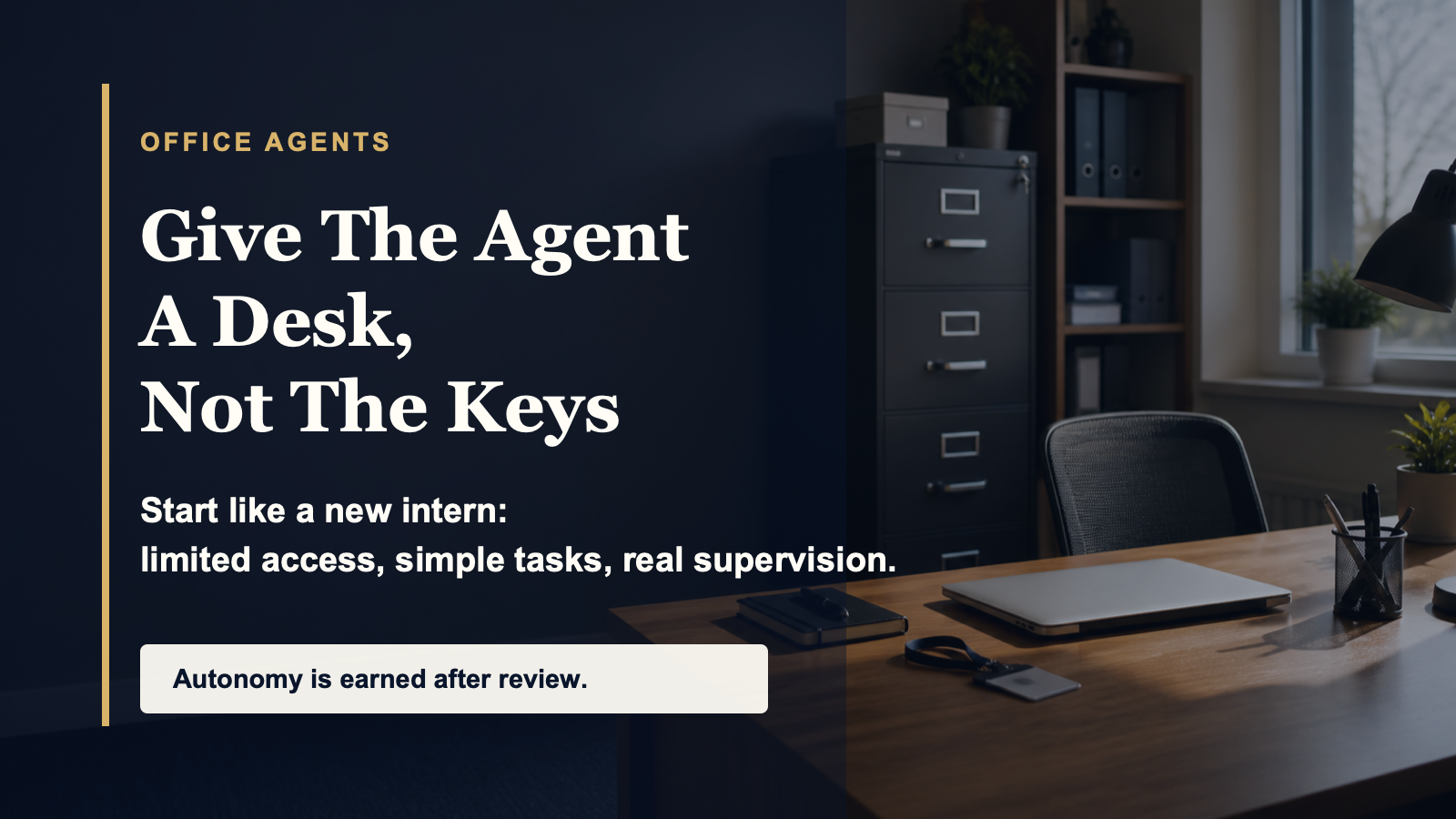
If you want office agents to work, treat the first one like a new intern.
Not like a magic employee. Not like a fully autonomous department. Not like a system that should be handed every cabinet, inbox, drive, policy, and workflow on Monday morning.
Give it a desk. Give it a supervisor. Give it one cabinet. Give it one job. Then check the work.
My words
If you are working on agentics, or you want agents that do simple things in the office, the analogy I would use is a new intern or a new employee.
When someone comes into an office, you normally have a clean desk policy. Why? Because you do not really know this person yet, and you do not want secure information lying around.
You have HR information locked in cabinets. Of course you trust your employees, but you still lock the cabinets. Why? Because some information does not need to be available to everyone.
Then you give the new person a role, and usually you give them a supervisor. That supervisor helps them understand where things are, how to get access, what to look at, and what to do on their first day.
You give them simple tasks first. You see how well they work. Then you add more tasks.
It is the same with AI.
You might get something like a Mac mini. That becomes the office location for the agent. You put the agent there. You might use Cowork to start with, or Codex, or whatever tool fits the job.
You say: here is the office, have a look around. But you give it access only to the things it needs. Maybe one filing cabinet. Maybe one inbox. A new inbox, not somebody else's existing email. You would not give an intern full access to another employee's email. You give them limited access for the role.
Then you give it a task. We need help sorting and filing these things. People have not had time to file them properly. I need you to file them and put them away.
You train it. You show it where the cabinet is. You show it what the job is. At the end of the day, you check: did it file things correctly? If it did not, you help it refine the work. When it gets that job, you say: great, keep doing that each day.
Then you slowly add to the role. When you see this kind of thing while filing, let this person know. When you see that kind of thing, let that person know. Slowly, you build up what the job is.
That matters because you are not making the agent autonomous on day one. When someone joins a company, they are usually not given an autonomous role immediately. They do set tasks inside boundaries. There are policies. There are ways of working.
And here is a problem: I can almost guarantee that nobody has read the up-to-date policies, and nobody really understands every change in them. There is the policy, and then there is: yes, I know the policy says that, but here is how we do it here.
That is because the policy is often not written by the people doing the role. If you simply give your AI the policy, it may fail, because the policy is not how the work is actually done.
So in a lot of situations, you need to start rewriting policies based on what you actually need. The people on the ground, doing the job, need to be able to say: here is how we do it, and here is why that policy is wrong or needs to be adjusted.
If you are in a very top-down environment, you will have real problems with this. Your people are doing things to get the job done, but you may not really know how.
Start with simple tasks that are well defined. Then add the tasks you should already be doing but never quite have time to do: compliance checks, governance checks, policy reviews, old data checks, all the things people know matter but cannot fit into the week.
Large businesses may have controlled systems that cost millions over years to build. Great. Most businesses are not like that. Most small businesses are just trying to get by and get things done.
This is where AI can help, as long as people are allowed to start slowly and are given time. That is the paradox: if people are already running at 110 or 120 percent, they will not have time to implement AI. It just will not happen.
You need to give people a month where they can get below 100 percent for a while. Targets may slow down. Things may not get faster immediately. Your people are already working hard, and now you are asking them to spend time learning a new way of working.
What you are really doing is moving people from task humans to supervisors of their own AI. Some people will be able to do that quickly. Some people will need support and training.
This is a massive change and training exercise. It will not be easy. But it will make us more productive.
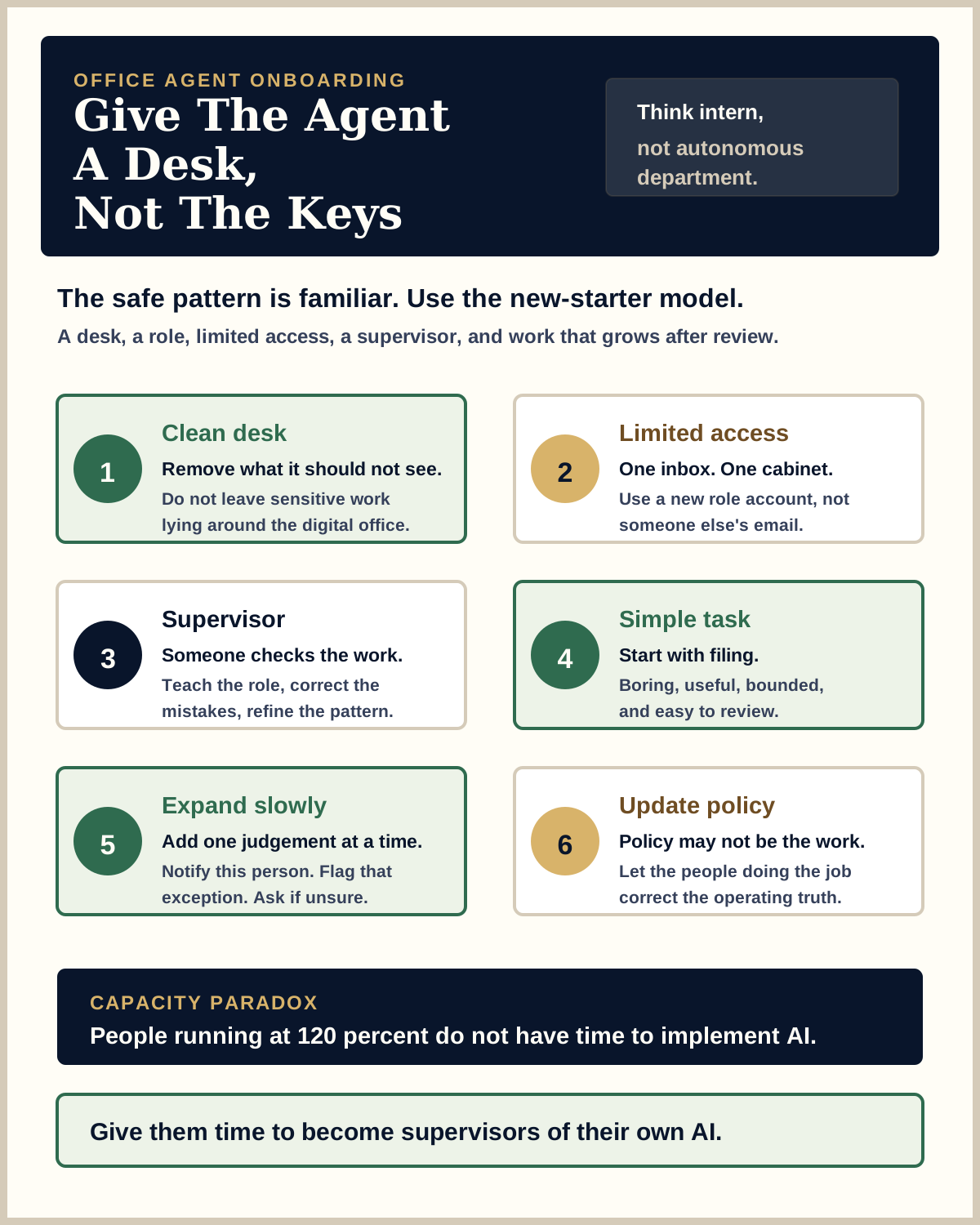
Treat Access Like An Office
The first lesson is physical, even when the work is digital.
In an office, you do not leave every personnel file open on the desk because a new starter seems nice. You do not give them the master key because they might be useful later. You give them the things they need for the role they are actually doing.
That is how agents should start.
- A separate machine or contained workspace.
- A new email account or mailbox, not someone else's inbox.
- One shared folder or filing area, not the whole estate.
- Role-based access, not convenience-based access.
- A human supervisor who checks the output.
This is not distrust. It is normal operational hygiene.
Start With Filing
Filing is a good first agent task because it is boring, useful, and reviewable.
There is a pile of things that should be sorted. There is a place they should go. There are patterns the agent can learn. There are mistakes a human can spot. Nobody needs to pretend the agent is running the company.
Day one is simple: file these documents. At the end of the day, check the work. Correct the mistakes. Improve the instruction.
Once the agent can do that reliably, add one small judgement. If you see this kind of document, notify this person. If you see that kind of document, put it in the exception list. If you are not sure, ask.
That is how roles actually grow.
Supervision Comes Before Autonomy
We need to stop jumping straight to autonomy.
Most human roles do not begin with full autonomy. They begin with supervised tasks, boundaries, training, feedback, and trust earned over time. Agents should not skip that operating model just because the interface looks clever.
The supervisor matters. Not as a ceremonial approver. As the person who knows what good looks like, sees the edge cases, and can say: no, that is not how we do it here.
If nobody has time to supervise the agent, nobody has time to implement the agent.
Your Policy May Not Be The Work
This is where many organisations will discover something uncomfortable.
The written policy may not describe the actual work.
That does not automatically mean people are bad or careless. Often it means people have adapted to make the work possible. They know the workaround. They know the supplier who always sends the wrong thing. They know which form gets ignored. They know the old rule that nobody has updated.
If you give an agent only the official policy, it may fail because the policy is incomplete, stale, or written too far away from the job.
So the people doing the work need authority to improve the policy. They need a way to say: this is what actually happens, this is where the policy is wrong, and this is what the agent needs to know.
Top-down organisations will struggle here. If the people at the edge are not allowed to explain reality, the agent will learn fiction.
Use Agents For The Work You Never Quite Reach
Once the simple tasks are stable, the next opportunity is the work everyone knows should happen but rarely gets the time it deserves.
- Review the policy that should be reviewed each year.
- Check whether old data should still be kept.
- Look for missing filing, missing receipts, or missing evidence.
- Prepare a compliance exception list for a human to review.
- Summarise what changed and who needs to know.
That kind of work can be enormously valuable in small businesses. Not because they do not care, but because they are already stretched.
The Capacity Paradox
Here is the hard bit.
If your people are already running at 110 percent, AI will not magically install itself into the organisation.
They need time to learn the tools, describe the work, supervise the first attempts, correct the mistakes, and build the operating pattern. For a period, things may feel slower. Targets may need to soften. The point is to create enough space to change the work, not just add another thing on top of it.
That is a leadership choice.
If you are not prepared to give people that time, do not be surprised when the AI programme becomes another thing they are too busy to do.
The Real Change
The real change is not that agents do tasks.
The real change is that people become supervisors of their own AI.
That needs training. It needs patience. It needs judgement. It needs managers to understand that productivity does not arrive by shouting "use AI" into a team that is already overloaded.
Give the agent a desk, not the keys.
Give the human the time, authority, and support to supervise it properly.