This story is not really about AI replacing lawyers.
It is about AI making the legal system more accessible.
For me, this feels like exactly the right place for AI to begin making a real difference. Not because the profession disappears. Not because judgement disappears. Not because a machine walks into court and wins an argument on its own.
That is not what happened.
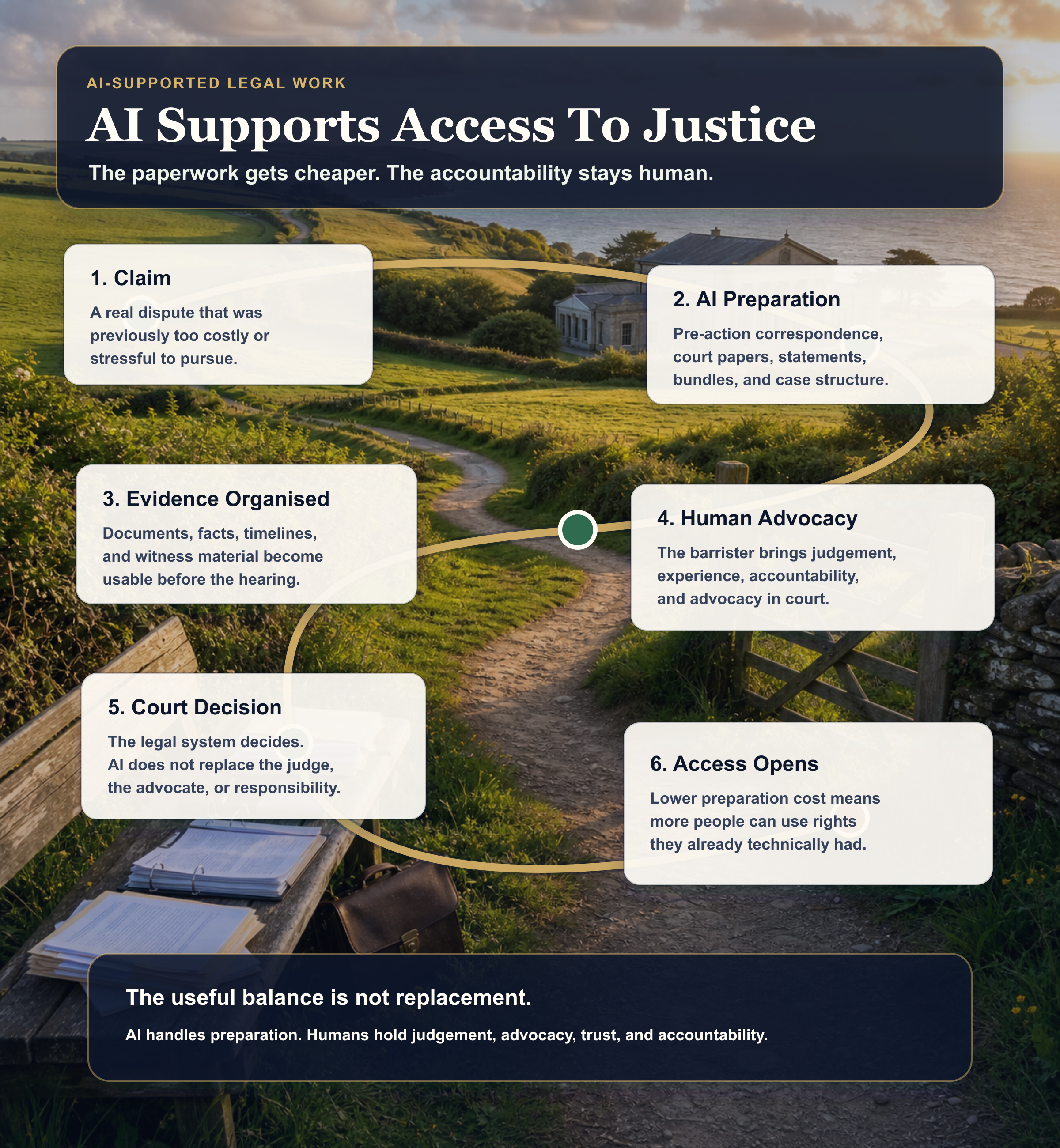
What happened, from the reporting and Garfield AI's own account, is more interesting and more useful. Garfield AI helped a claimant recover £7,000 in Wandsworth County Court. The AI-supported law firm prepared much of the document-heavy work before trial. A qualified human barrister represented the claimant at the hearing. The court then made the decision.
That distinction matters.
AI supported the preparation.
Humans remained accountable.
To me, that is the point.
The real access problem
There is a huge amount of unmet legal need.
Many people and small businesses have legitimate claims, but they cannot afford to pursue them because the legal costs are too high, the process is too stressful, or the paperwork feels too difficult to get through.
That creates a form of human debt.
People have rights, but not always the practical means to exercise them.
That is a serious failure of access. A right that is technically available but economically unreachable is not really available in the way most people need it to be.
Small claims are a good example. GOV.UK explains that people can apply to a county court to claim money they are owed by a person or business. The Civil Procedure Rules also make clear that the small claims track is a special procedure, with limits on recoverable costs. That is meant to keep low-value disputes proportionate.
But in practice, even a proportionate legal route can still feel impossible if the preparation, forms, evidence, deadlines and correspondence all sit on the shoulders of someone who is already busy, worried, or out of money.
Where AI fits
This is where AI can have a genuinely positive impact.
It can help do the research.
It can prepare documents.
It can organise evidence.
It can draft witness statements.
It can assemble the trial bundle and paperwork that traditionally takes lawyers many hours to produce.
That is not trivial work. It is the work that often makes the legal route too expensive to start.
If AI can reduce that preparation cost while keeping human legal judgement, advocacy, supervision and accountability in place, that seems like a much better model than either extreme.
One extreme says AI should replace the professional.
The other says AI should stay away from serious work because serious work has risk.
I do not think either position is good enough.
The useful model is more balanced:
AI supports.
Humans remain accountable.
Why this matters for professionals
I do not see this as bad news for good lawyers.
It should mean that more of their time goes into the work that actually needs their experience: judgement, advocacy, negotiation, strategy, ethics, client care and accountability.
There is no shortage of paperwork in professional life. The fact that something is important does not mean every human hour spent producing it is the highest-value use of professional skill.
If a barrister can spend more time on the argument, the client, the risk and the evidence, and less time watching cost accumulate in routine preparation, that seems like progress.
And if a small business or freelancer can bring a claim that would previously have been written off, that is not a small thing. That is the legal system becoming more reachable.
The accountable layer
The important word here is accountable.
Legal work cannot become a black box where nobody knows who checked the facts, who tested the evidence, who owns the decision, or who is responsible when something goes wrong.
The Garfield example is useful because it keeps the layers visible. The AI-supported system prepared the case. A human barrister advocated at trial. The judge decided.
That is not AI replacing law. It is AI changing where the cost and effort sit inside the legal workflow.
That is the pattern I think we are going to see across many professions.
The better question is not simply, "Will AI replace this profession?"
The better question is:
Which parts of this profession can AI perform, and which parts should remain with people because they require judgement, accountability and trust?
Information pack
What actually happened?
Garfield AI says it helped Tamires Camal Taquidir, a freelancer who had provided HR-related services, win a small debt claim at trial. The case concerned unpaid fees. According to Garfield's account, she used the service for pre-action correspondence, court proceedings, document production, four witness statements and trial bundles.
The trial took place at Wandsworth County Court on 14 May 2026. Both sides were represented by barristers. The court found for the claimant, awarded £7,000 and dismissed the counterclaim.
The Guardian and Financial Times both reported the same broad shape: Garfield prepared the pre-trial materials, while a human barrister handled courtroom advocacy.
Why this is important
The case demonstrates that AI can automate a significant proportion of the document-heavy work involved in a relatively routine claim while leaving judgement and courtroom advocacy with qualified legal professionals.
That could:
- reduce legal costs for smaller claims;
- make access to justice available to more people and businesses;
- allow lawyers to focus on strategy, negotiation and advocacy;
- improve the consistency of case preparation;
- help claimants pursue matters that would otherwise be uneconomic.
There are still obvious risks: bad facts, bad prompts, weak evidence, procedural errors, confidentiality, hallucinated authorities, and people over-trusting systems they do not understand.
But those risks argue for regulated, auditable, human-accountable systems. They do not argue for pretending the old cost model was working for everyone.
The bigger picture
If we get this right, AI will not remove expertise.
It will make expertise available to more people.
That is why this matters.
Not replacing people.
Supporting them.
Helping more people gain access to justice.
Helping professionals spend more time applying judgement rather than producing paperwork.
For me, that is one of the more positive examples of human and AI collaboration we have seen so far.
Sources and notes
- The Guardian: HR consultant wins English court case using AI lawyer in apparent legal first.
- Financial Times: AI-powered law firm wins first English court case.
- Garfield AI: AI Lawyer in Historic First Court Trial Win.
- GOV.UK: Make a court claim for money.
- Civil Procedure Rules: Part 27, the small claims track.