
I think one of the problems we are starting to run into is language.
Not the technology itself. Not only the risk. Not only the opportunity. The language.
We keep saying AI.
We say AI when we mean a chat box.
We say AI when we mean a proof of concept someone ran in a safe corner of the business.
We say AI when we mean a coding agent working through a folder.
We say AI when we mean a legal drafting tool that produced a fake citation.
We say AI when we mean a model running locally on a laptop.
We say AI when we mean a system making suggestions inside a hospital, a bank, a council, a car, a school, or a warehouse.
Those things are not the same thing.
They may all sit somewhere inside the broad artificial intelligence family, but they are not the same product, not the same risk, not the same operating model, and not the same conversation.
And yet we talk as if they are.
We did this with IT
We have been here before.
For years, people used the phrase information technology as if it meant one thing.
IT could mean the laptop on your desk. It could mean the network. It could mean the finance system. It could mean cybersecurity. It could mean the data warehouse. It could mean someone fixing the printer. It could mean the whole operating nervous system of the company.
That was useful as a budget line.
It was not always useful as a way to make decisions.
If someone said, "IT is slow", what did they mean?
The helpdesk?
The procurement process?
The old ERP?
The network?
The security rules?
The team?
The supplier?
The word was too big. It hid the thing that actually needed attention.
AI is becoming that kind of word.
The book problem
There is another analogy I keep coming back to.
Books.
Books can educate. Books can mislead. Books can inspire. Books can corrupt. Books can preserve wisdom. Books can preserve nonsense. Books can help a child learn to read. Books can spread propaganda. Books can save a life. Books can waste a life.
So if someone says, "books are bad", we know something has gone wrong in the sentence.
Which book?
Written by whom?
For what audience?
Used in what way?
With what context?
With what evidence?
With what controls?
We do not usually respond to a bad book by saying the category of books should not exist.
We ask better questions.
I think we need to do the same with AI.
When the container becomes the argument
The trouble with a container word is that it lets everyone argue at the wrong level.
One person says AI is dangerous because a system produced fake legal cases.
Another person says AI is wonderful because it helped them write a lesson plan.
Another says AI is overhyped because a chatbot gave a bland answer.
Another says AI will transform productivity because an agent built a working prototype in an afternoon.
They may all be telling the truth.
But they are not necessarily talking about the same thing.
A chatbot used casually for brainstorming is not the same as a tool used to draft a court filing.
A local model helping someone sort personal notes is not the same as an external service connected to confidential company data.
A coding agent operating in a safe folder is not the same as an autonomous system with permission to change production.
A decision-support tool is not the same as a system making decisions without meaningful human review.
A driver-assistance feature is not the same as a person asking a language model to summarise a meeting.
If we call all of that AI and stop there, we cannot govern it properly.
We cannot buy it properly.
We cannot teach it properly.
We cannot criticise it properly.
And we cannot use it properly.
Some failures are not one kind of failure
This matters because when something goes wrong, people often say, "AI failed".
Sometimes that is fair.
Sometimes the model was not good enough.
Sometimes the interface encouraged the wrong behaviour.
Sometimes the organisation used the wrong tool for the wrong task.
Sometimes there was no verification step.
Sometimes the human assumed authority where there was only fluent text.
Sometimes the data boundary was wrong.
Sometimes the governance was theatre.
Sometimes the proof of concept was fine, but the rollout was careless.
Sometimes the model hallucinated.
Sometimes the human did.
Sometimes the whole system was designed in a way that made misunderstanding almost inevitable.
That is why I am wary of saying either "AI is good" or "AI is bad".
It is too blunt.
It is like saying books are good or books are bad.
The better question is: what is this thing, what is it doing, who is using it, what does it touch, what happens if it is wrong, and what controls are around it?
Use better words
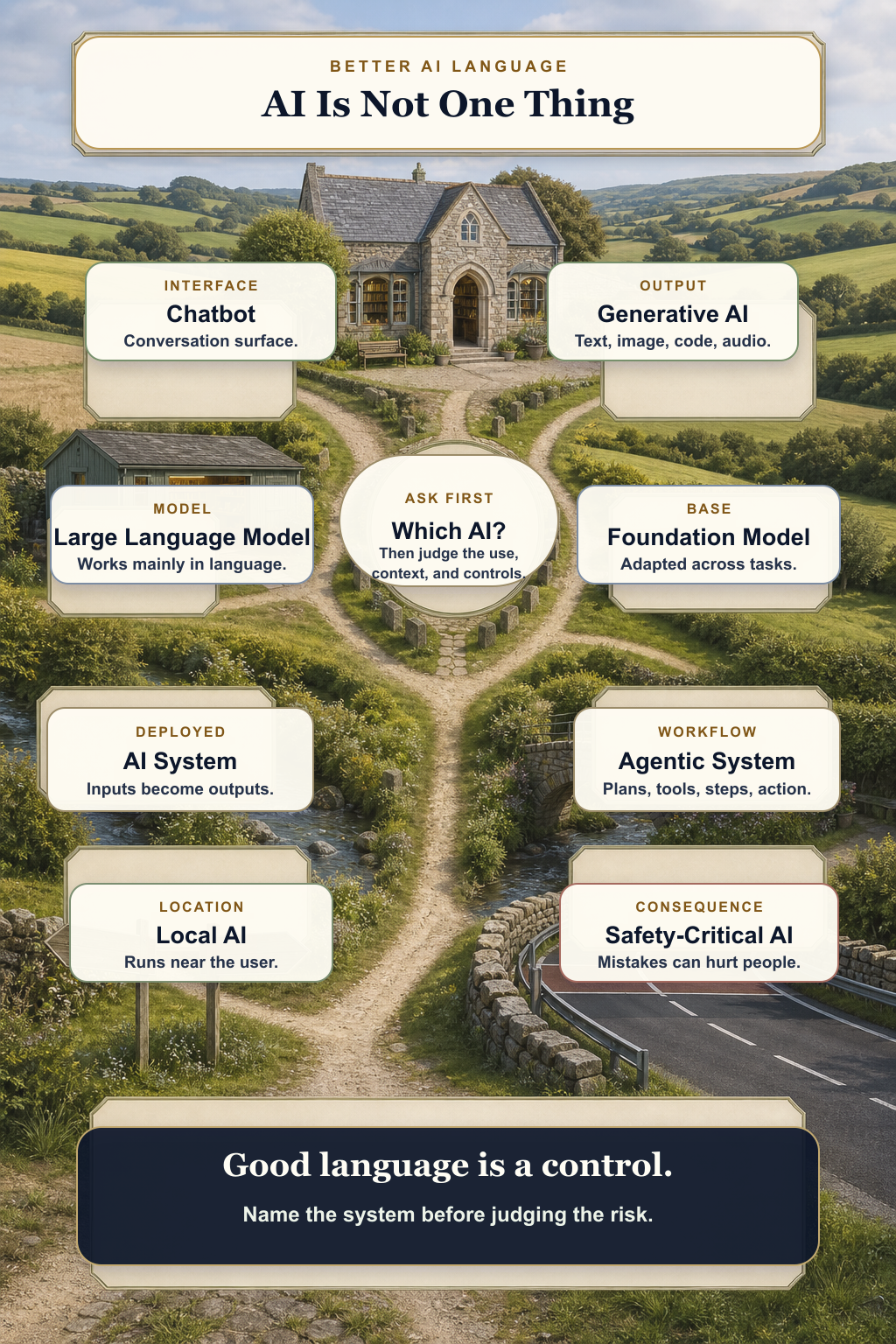
We do not need perfect terminology before we can move. But we do need better working language.
Here is a simple starting point.
| Say this | When you mean |
|---|---|
| Chatbot | A conversational interface where a person asks questions or gives instructions. |
| Generative AI | A system producing text, images, code, audio, video, summaries, drafts, or other content. |
| Large language model | A model whose main capability is working with language, reasoning over text, and generating text-like outputs. |
| Foundation model | A broad pretrained model that can be adapted or used across many different tasks. |
| AI system | A deployed machine-based system that uses inputs to infer outputs, predictions, recommendations, decisions, or content. |
| Agentic system | A tool or workflow that can plan, use tools, read context, take steps, and act through a harness. |
| Local or on-device AI | A model running close to the user, inside a device, laptop, local network, or controlled environment. |
| Safety-critical AI | A system where mistakes can affect physical safety, legal rights, finance, employment, healthcare, transport, infrastructure, or public services. |
Those words are still imperfect. The boundaries overlap. A chatbot can use generative AI. An agentic system may use a large language model. A safety-critical system may contain several kinds of AI at once.
But even imperfect words help.
They slow the conversation down just enough to make it useful.
The question before the judgement
Before we argue about whether AI should be allowed, banned, adopted, feared, funded, slowed, accelerated, regulated, or celebrated, we should ask a prior question.
Which AI?
That one question changes the conversation.
If we mean a chatbot helping someone draft an email, that is one risk profile.
If we mean a coding agent with access to a production system, that is another.
If we mean a model embedded in a medical workflow, that is another.
If we mean a local tool helping a person organise their own files, that is another.
If we mean a public agent representing a person or company, that is another.
The word AI cannot carry all of that by itself.
It is too small a word for too large a field.
Good language is a control
This is not just semantics.
Good language is a control.
If you name the thing clearly, you can make a better decision about it.
You can decide whether it needs a human in the loop.
You can decide whether it can touch private data.
You can decide whether it can act, or only suggest.
You can decide whether it belongs in a safe folder, a sandbox, a local environment, a governed workflow, or nowhere near the process yet.
You can decide whether the problem is the model, the prompt, the harness, the permissions, the evidence, the user, the policy, the rollout, or the business process.
That is where the conversation becomes useful.
Not "AI is good".
Not "AI is bad".
What kind of AI?
Doing what?
For whom?
With what context?
Under what controls?
With what consequence if it is wrong?
That is the level where we can start to think properly.
Sources and notes
The vocabulary in this piece is informed by the OECD's updated definition of an AI system, the EU AI Act's definition of AI system, NIST's AI Risk Management Framework and Generative AI Profile, ISO/IEC 22989 on AI concepts and terminology, Stanford's Emerging Technology Review material on foundation models and generative AI, and IBM's explainer on agentic AI.
- OECD: Explanatory memorandum on the updated OECD definition of an AI system
- EU AI Act, Article 3 definitions
- NIST AI Risk Management Framework
- NIST AI RMF Generative AI Profile
- ISO/IEC 22989: Artificial intelligence concepts and terminology
- Stanford Emerging Technology Review: Artificial Intelligence
- IBM: What is agentic AI?