The useful starting point for AI agents is not a big strategy document. It is ten minutes with a real workflow.
Let an agent work for you. Keep the data safe and bounded. Then ask one honest question: which repeated job would I trust it to prepare, but not decide alone?
Start with one visible job
If you are explaining agents to a leadership room, start by making one work.
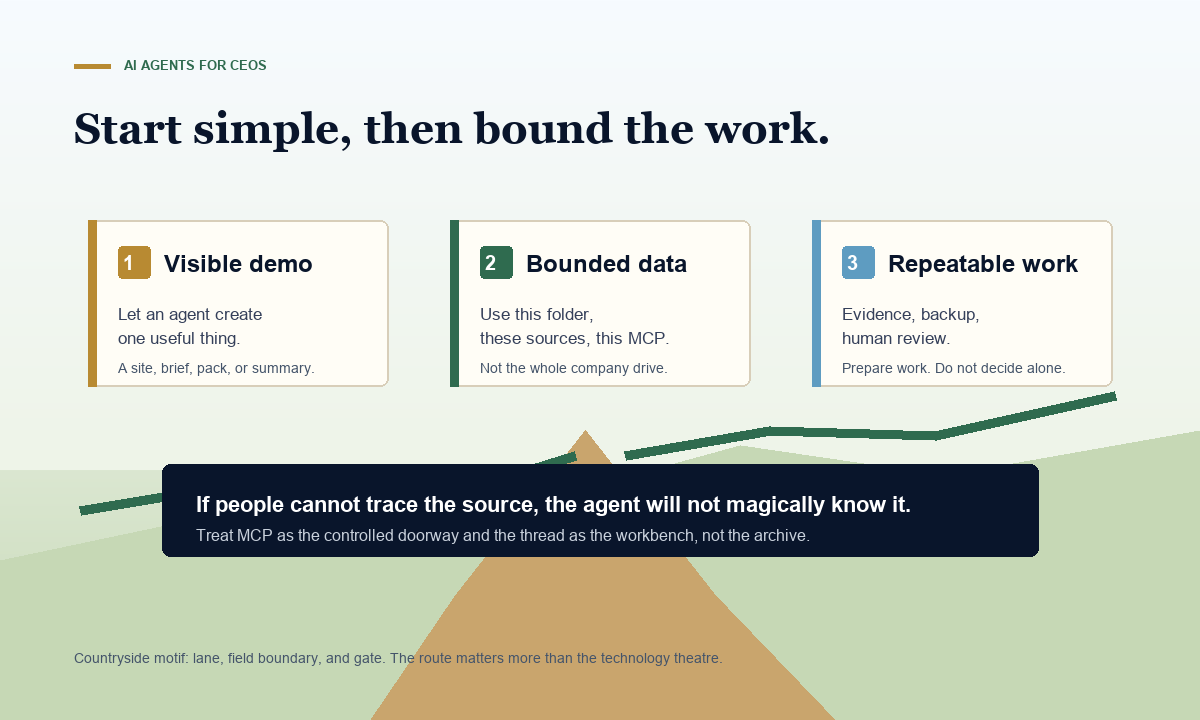
Ask it to create a simple site, summary, brief, pack, or analysis from information you are happy to share. Keep the task small enough that everyone can see the work happen. The point is not theatre. The point is to move the audience from "AI answers questions in a browser" to "an agent can prepare real work from a controlled set of sources".
That first jump matters. Chatbots are useful, but most chatbot work still depends on copying, pasting, remembering, checking, and starting again. Agents become more interesting when they can work inside a defined environment: files, tools, browser, memory, integrations, evidence, and review.
Keep the data bounded
Do not give the first agent the whole company drive.
Give it a clean shelf: this folder, this runbook, these approved documents, this data export, this read-only connection. Ask it to show the sources it used. Ask it to save where it got to.
Backup, backup, backup. The thread is the workbench, not the archive. Threads are brilliant for doing work, but they can disappear, be compacted, be deleted, become inaccessible, or sit in the wrong account. The business record belongs in a synced project folder, not only inside the chat.
Your company data may already be hallucinating
A lot of the time AI looks unreliable because the knowledge underneath it is unreliable.
SharePoint is stale. Spreadsheets live everywhere. Dashboards look official but nobody can trace the number. Someone has copied a figure into a board pack, someone else has updated the source, and six months later the team cannot remember which version is true.
If people cannot trace the source, the agent will not magically know it.
That is why messy data is not just a technology problem. It is an operating problem. The fix is not to tidy the entire company before doing anything useful. The fix is to pick one workflow and give the agent a narrow, trusted working set.
What MCP changes
MCP, the Model Context Protocol, is a practical way for an agent to connect to useful information and tools without turning the whole business into an unmanaged free-for-all.
For a CEO, the plain-English version is enough: MCP is a controlled doorway. It can expose a specific source, system, folder, or action to an agent. Done well, it helps answer the question, "What exactly is this agent allowed to see or do?"
That matters because agents will not stay as separate apps forever. Over time, tools like Codex, Claude, ChatGPT, and other co-worker environments will feel more like an operating layer for work. They will include a browser, memory, storage, integrations, permissions, and evidence trails. The question is not whether they can do more. They can. The question is how the business bounds the work.
The simplest pilot
Choose one repeatable workflow. Not a decision. A preparation task.
Good candidates are board pack preparation, monthly reporting, meeting prep, inbox triage, proposal drafting, customer research, or a recurring internal briefing. The workflow should have clear inputs, visible outputs, a human review gate, and a way to prove which sources were used.
Start there. Let the agent prepare the work. Keep the human responsible for the judgement.
Useful numbers
The statistics are not the main point, but they explain why this feels familiar. Salesforce reported that 84% of data and analytics leaders say their data strategies need a complete overhaul before AI ambitions can succeed. It also reported that leaders estimate 26% of organisational data is untrustworthy and that 89% of leaders with AI in production have experienced inaccurate or misleading AI outputs.
Precisely reported that 64% of organisations cite data quality as the top data integrity challenge, and 67% do not completely trust the data they use for decision-making. Gartner notes that poor data quality costs organisations at least $12.9 million a year on average, and recommends scoping data-quality work by business use case.
That is the practical lesson. Do not start by asking the agent to understand the whole company. Start by giving it one clean job, one clean shelf, and one human who still owns the decision.