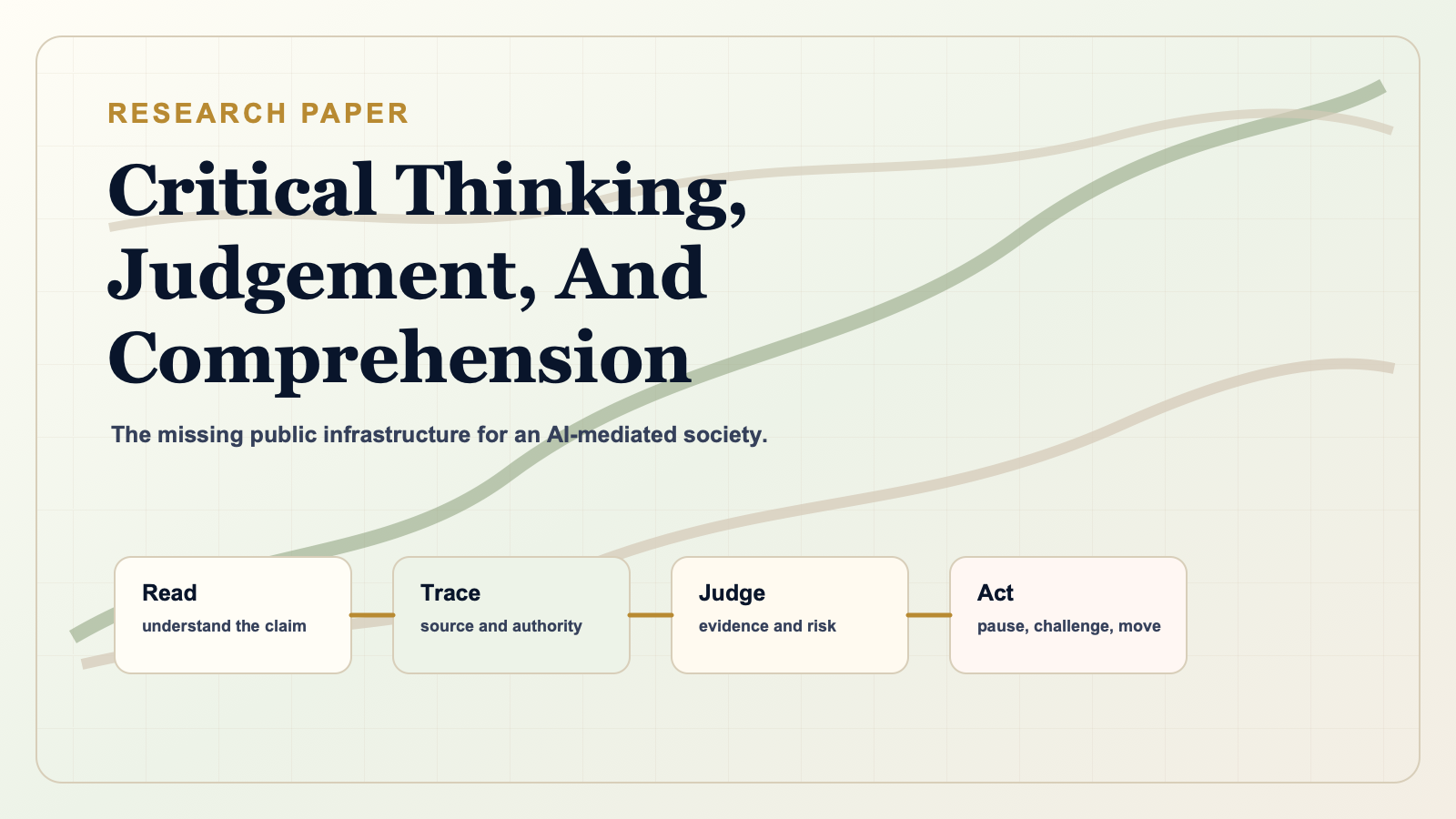
Abstract
Modern countries increasingly ask citizens to navigate complex information: public services, health advice, employment choices, regulation, finance, media claims, AI-generated output, political messages, algorithmic feeds, and evidence about products, services, and institutions. The practical question is no longer only whether information can be found. It is whether people can understand it, trace it, judge it, challenge it, and decide what is safe or reasonable to do next.
This paper argues that many education systems are under-delivering on that capability. They teach pieces of it: reading, debate, research methods, digital safety, citizenship, science inquiry, and sometimes media literacy. But they rarely teach judgement as a named, assessable civic and working skill. The result is a public capability gap between access to information and responsible use of information.
The paper maps the main areas where countries are failing to deliver: foundational comprehension, source authority, evidence standards, uncertainty, statistical literacy, civic reasoning, media literacy, AI literacy, disagreement, transfer into real situations, adult learning, teacher preparation, assessment incentives, and equitable access. It then proposes a practical curriculum spine: claim, source, context, evidence, uncertainty, consequence, threshold, action, and review.
Keywords: critical thinking; judgement; comprehension; media literacy; AI literacy; civic education; information literacy; evidence literacy; public capability; education policy; agentic AI.
Reader Guide
What to look for
- Distinction: comprehension, critical thinking, and judgement are related, but they are not the same skill.
- Failure map: countries usually fail across layers, not at one single subject boundary.
- Assessment gap: many systems praise critical thinking in curriculum language, then assess recall, speed, or exam technique.
- AI pressure: personal agents will make information easier to retrieve, but the public still needs to judge what counts as enough to act.
Executive Summary
Countries do not generally ignore critical thinking. Most national curricula now contain some language about analysis, evaluation, citizenship, digital competence, creativity, media literacy, problem solving, or learning to learn.
The harder truth is that those words are often scattered, under-assessed, unevenly taught, and weakly connected to real public decisions. A student may learn how to analyse a poem, debate a political issue, test a hypothesis, and evaluate a web page. An adult may later be asked to judge a mortgage, a public health claim, a benefits decision, an AI answer, a product label, a planning notice, or a political promise. The transfer is assumed. It is not reliably taught.
That is the failure this paper names.
Core claim: public education needs a named layer of judgement and comprehension literacy. Not as a replacement for subject knowledge, but as the connective tissue that helps people read claims, trace sources, weigh evidence, understand uncertainty, recognise consequence, and decide whether to act, pause, challenge, escalate, or record dissent.
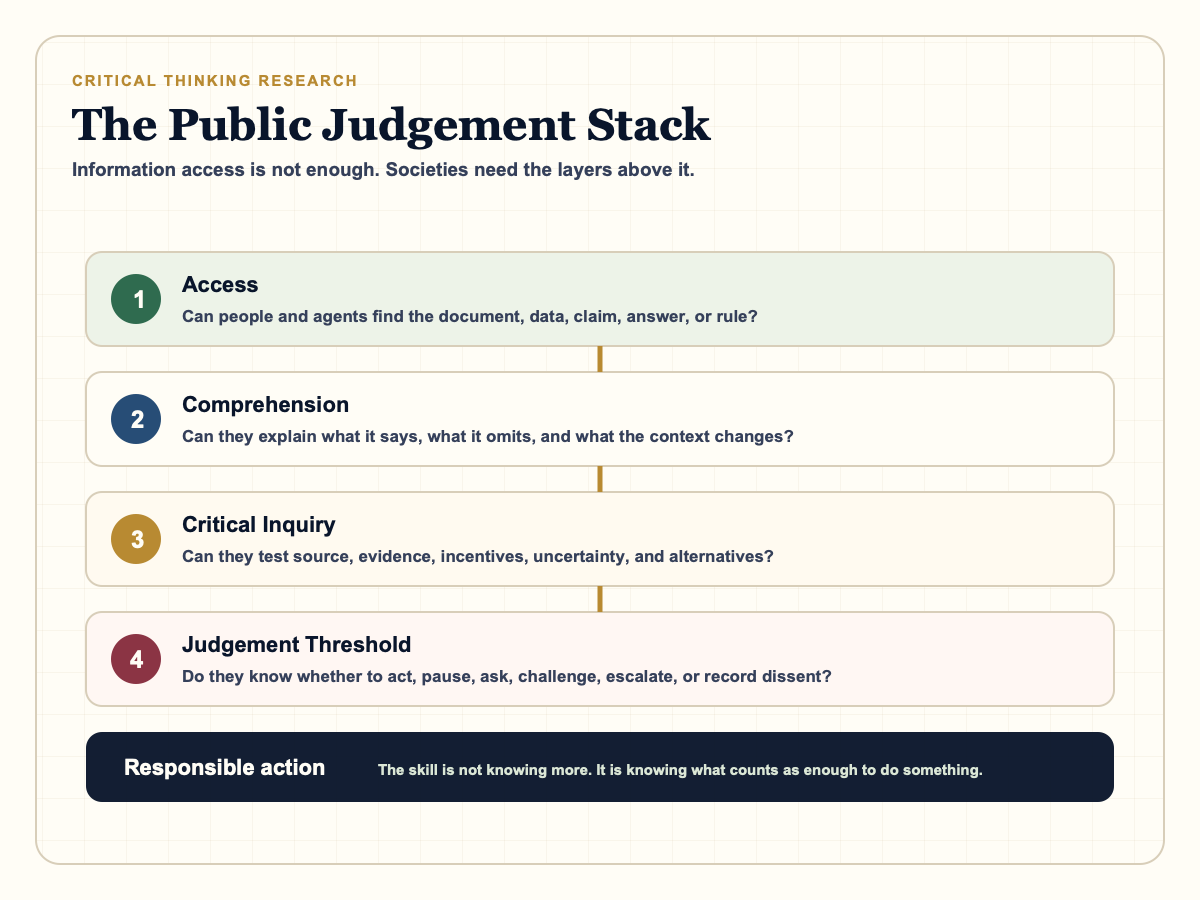
The need is becoming more urgent because AI changes the information environment. A personal agent may soon retrieve council rules, planning documents, school policies, product evidence, medical guidance, government consultations, company filings, local news, scientific reports, and opposing arguments in seconds. That is a genuine public good. But access to information is not the same as public judgement.
A society in which everybody can ask better questions still needs people who can understand the answers.
1. The Research Question
This paper asks a deliberately practical question:
Where are countries failing to teach their populations how to think about information, use judgement, and comprehend what they are being told?
That question is broad. It touches schools, universities, adult learning, public communication, media regulation, AI governance, civic education, professional training, and the design of public services. It also touches culture: whether people feel allowed to say, "Give me a moment. I need to understand this before I decide."
The paper does not attempt a full country ranking. The evidence base is too uneven for that, and a ranking would hide the most important point. Countries fail in patterns. Some are strong on policy language but weak on classroom transfer. Some are strong on digital safety but weak on evidence judgement. Some are strong on elite academic reasoning but weak on adult public capability. Some have excellent local programmes but no national entitlement.
The right unit of analysis is therefore not "which country is best?" It is "which public capability is missing, and where does the system leak?"
2. Three Different Skills Often Get Blurred
One reason countries under-deliver is that several skills are collapsed into one broad phrase: critical thinking.
In practice, the public needs at least three connected capabilities.
- Comprehension: Can I understand what this says, what it does not say, and what it means in context?
- Critical thinking: Can I test the claim, source, evidence, logic, assumptions, incentives, and alternatives?
- Judgement: Can I decide what is enough to act, when to pause, when to ask, when to challenge, and when the consequence is too high?
Comprehension is the base. Without it, evidence cannot even be weighed. Critical thinking is the method. It tests claims and reasons. Judgement is the operating decision. It connects information to consequence.
Countries often teach the first two in fragments. They rarely teach the third as a public discipline.
3. What Countries Already Teach
The picture is not empty. Many education systems have built useful pieces.
England embeds critical thinking through subject routes rather than a mainstream standalone national route. The citizenship curriculum includes debate, weighing evidence, and reasoned argument. English includes comprehension, critical reading, and comparison. Computing includes discerning use of digital content. But the old standalone OCR AS/A Level Critical Thinking route was withdrawn, with final assessments in 2018 and resits in 2019, leaving these skills mostly distributed across subjects and qualifications.
Other systems make the language more explicit. Australia treats Critical and Creative Thinking as a general capability across learning areas. Finland has a strong multiliteracy and media literacy tradition. Singapore places "Critical, Adaptive and Inventive Thinking" inside its 21st Century Competencies. New Zealand and British Columbia define broad thinking competencies. The US has examples such as AP Seminar, where students evaluate sources, perspectives, evidence, and arguments, although the US has no single national curriculum.
Those examples matter because they show that the missing layer is not impossible. It can be named. It can be taught. It can be assessed.
But even in stronger systems, the challenge remains: does the student or adult transfer the skill into messy public life?
4. Where Countries Are Failing
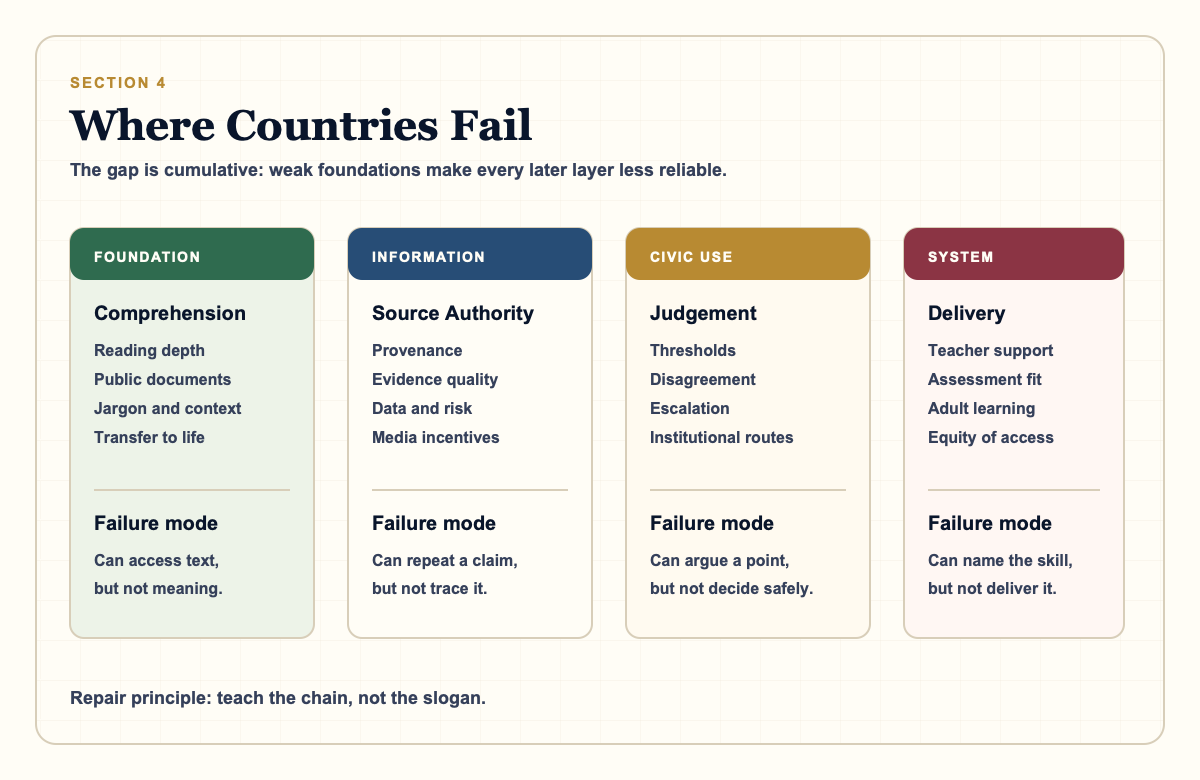
The failures below are not accusations against individual teachers. Teachers are often holding the line inside systems that ask too much, assess too narrowly, and change too slowly. These are system-level failure areas.
4.1 Foundational Reading And Comprehension
If a child or adult cannot read and understand a reasonably complex text, the rest of the judgement chain is weakened. Learning poverty is the starkest global signal. The World Bank, UNESCO, UNICEF, FCDO, USAID, and the Gates Foundation estimated in 2022 that around 70 percent of 10-year-olds in low- and middle-income countries could not read and understand a simple written text.
Even richer countries have problems. OECD PISA 2022 showed widespread declines in mathematics and reading performance compared with 2018, with the pandemic only part of the story. If comprehension weakens, everything that depends on comprehension becomes fragile.
4.2 Source Authority And Provenance
People are not consistently taught to ask where a claim comes from, who paid for the evidence, what the source can know, and whether the quoted item is primary, secondary, generated, recycled, or misrepresented.
This matters because modern public information often looks polished even when authority is weak. A citizen needs to distinguish a legal rule from a blog interpretation, a government consultation from a final policy, a product claim from a certification, a press release from audited evidence, and an AI answer from a sourced conclusion.
4.3 Evidence Standards And Uncertainty
Public life is full of claims that are neither obviously true nor obviously false. Countries under-teach the middle space: confidence, uncertainty, missing evidence, plausible alternatives, and what kind of proof is enough for different kinds of action.
Students may learn evidence in science, history, or essay writing, but they are less often asked to practise decisions such as: "This evidence is enough to discuss, not enough to publish"; "enough to try safely, not enough to scale"; "enough to ask for help, not enough to accuse"; or "enough to pause because the consequence is high."
4.4 Statistical, Data, And Risk Literacy
Many public questions are statistical: crime, migration, inflation, health risk, school performance, climate, polling, employment, productivity, housing, and public spending. Countries often teach mathematics as subject content without consistently teaching citizens how to read public numbers, denominators, base rates, uncertainty intervals, selection bias, incentives, and risk communication.
The failure is not that everyone should become a statistician. The failure is that many people leave education without the habits needed to ask: "Compared with what? Over what period? For which group? How large is the effect? What is missing from the graph?"
4.5 Civic And Institutional Literacy
Citizens cannot judge public information if they do not understand how decisions are made. Planning, procurement, healthcare, taxation, benefits, regulation, schools, councils, courts, Parliament, regulators, and public consultations all have their own language.
Many education systems teach civic ideals more than civic machinery. People may know that democracy matters but not how to read a planning notice, challenge a local decision, submit evidence to a consultation, use freedom of information rights, or tell whether a public body has actually made a decision.
4.6 Media And Information Literacy
UNESCO has long argued for media and information literacy as a civic capability. The UK has an Online Media Literacy Strategy. The EU has DigComp. Many countries have online safety education. Those are useful, but the implementation is often partial, voluntary, or framed around danger rather than capability.
The common failure is teaching people what to fear without teaching them enough about how to work: how to compare sources, trace claims, understand incentives, spot context collapse, follow citations, recognise persuasion, and slow down before sharing.
4.7 AI Literacy
AI adds a new layer. The EU AI Act now includes an AI literacy obligation for providers and deployers. UNESCO has published AI competency frameworks for students and teachers. OECD is developing a PISA 2029 Media and Artificial Intelligence Literacy assessment.
This is movement in the right direction. The failure is that most citizens are already using AI before countries have taught them how to judge AI outputs. Many people still lack a practical vocabulary for the difference between a chatbot, generative AI, a foundation model, an AI system, an agentic workflow, a local model, or a safety-critical autonomous system.
Without that vocabulary, public debate collapses into "AI is good" or "AI is bad." That is not enough to govern, teach, buy, deploy, or trust it.
4.8 Judgement Thresholds
This is the largest missing layer.
Countries rarely teach people how to classify decisions by consequence. A decision can be quick, slow, reversible, irreversible, private, public, low-risk, high-risk, evidence-light, evidence-heavy, advisory, binding, personal, institutional, or safety-critical. The same evidence can be enough for one action and not enough for another.
Judgement literacy teaches the threshold, not just the answer.
4.9 Disagreement, Challenge, And Dissent
A healthy society needs people who can challenge without humiliating, dissent without becoming abusive, and change their mind without feeling destroyed. Many countries teach debate, but they under-teach structured challenge in real settings.
This matters for human teams and for agentic systems. When a person, worker, student, civil servant, board member, or AI agent believes a material mistake is being made, they need a safe pattern: claim, evidence, uncertainty, likely consequence, safer alternative, threshold, and route.
4.10 Transfer Into Real Life
Skills taught inside school subjects do not automatically transfer into adult contexts. A student may evaluate a history source well, then later struggle to evaluate a product claim, a public spending announcement, a health rumour, a tenancy notice, or an AI-generated summary.
The failure is assuming transfer. Countries need deliberate bridge exercises: real documents, real websites, real claims, real decision logs, real consequences, and real uncertainty.
4.11 Adult And Lifelong Learning
Children matter, but adults are making decisions now. Most public policy still treats critical thinking as something schools should solve for the next generation. That leaves a large adult capability gap in workplaces, communities, public services, and families.
OECD's adult skills work repeatedly shows that literacy, numeracy, and problem solving are not fixed at school-leaving age. Countries need adult routes for information judgement, especially as AI tools move into work and public services.
4.12 Teacher Preparation And Assessment Incentives
Teachers cannot consistently teach judgement if assessment systems mainly reward speed, content recall, narrow mark schemes, or performance under exam conditions. They also need training, time, materials, and permission to use open-ended scenarios where the answer is not simply "right" or "wrong."
Countries often write ambitious curriculum aims but fail to align teacher training, assessment, inspection, resources, and accountability. That is how critical thinking becomes a slogan instead of a taught public skill.
| Failure Area | What The Public Needs | Common System Failure | Practical Repair |
|---|---|---|---|
| Comprehension | Read, summarise, and explain meaning in context. | Foundational literacy gaps persist and complex public language remains opaque. | Teach public-document comprehension alongside literature, science, and civic texts. |
| Source authority | Know who claims, who knows, who benefits, and what is primary. | Sources are treated as links, not authority chains. | Require claim-to-source maps and provenance exercises. |
| Evidence standards | Match evidence quality to consequence. | Students are taught to cite evidence but not to set action thresholds. | Assess "enough to act?" decisions, not just essays. |
| Data literacy | Read public numbers, charts, uncertainty, and risk. | Mathematics is separated from civic use. | Use public datasets, product claims, and policy charts in lessons. |
| AI literacy | Use AI as interpreter, assistant, and challenger without outsourcing judgement. | Rules focus on prohibition or plagiarism more than capability. | Teach prompts, verification, provenance, model limits, and human responsibility. |
| Disagreement | Challenge respectfully when risk is material. | Debate is performative; dissent routes are rarely practised. | Teach structured challenge packets and escalation thresholds. |
5. The Curriculum-To-Reality Gap
The most charitable interpretation is that countries are trying. The problem is not intent. The problem is system design.
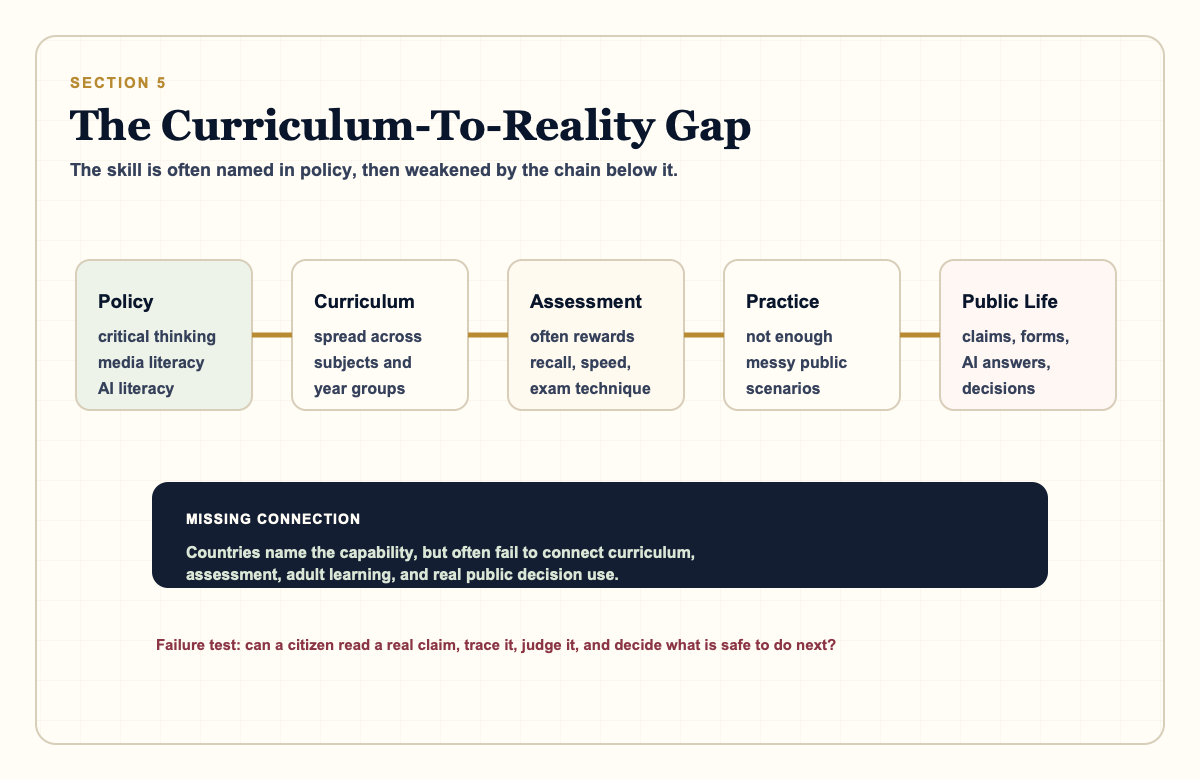
A policy document may say critical thinking is important. A curriculum may mention evaluation. A school may have a digital safety week. A university may teach research methods. A government may publish a media literacy strategy. A regulator may require AI literacy. Yet the citizen still has to join those pieces together alone.
This creates a gap between policy language and lived capability.
The gap has five common causes.
- Fragmentation: reading, citizenship, computing, media literacy, science, and AI literacy sit in different policy boxes.
- Weak assessment: judgement is hard to mark, so systems assess easier proxies.
- Teacher load: open-ended judgement work takes time, confidence, and support.
- Adult neglect: countries focus on students while public decisions are made by adults now.
- Real-world avoidance: education often uses simplified cases rather than messy public documents, websites, claims, and trade-offs.
6. What Stronger Systems Point Towards
Some systems give clues about what a stronger approach could look like.
Finland's multiliteracy tradition points towards treating information interpretation as a broad capability across forms, media, and contexts. Australia's general capability model shows how critical and creative thinking can be named across learning areas. Singapore's 21st Century Competencies connect critical, adaptive, and inventive thinking to wider citizenship and life skills. British Columbia's critical and reflective thinking competency makes inquiry and reflection part of the learning language. AP Seminar shows how source evaluation, perspectives, evidence, and argument can be assessed in a structured way.
None of these examples is a complete answer. But they show the direction: name the capability, teach it across subjects, assess it explicitly, and connect it to real decisions.
7. AI Makes The Missing Layer Impossible To Ignore
AI is making information access easier. A personal agent can already summarise documents, compare sources, draft letters, identify contradictions, explain policy, translate jargon, and produce decision options. This will improve.
That is why judgement becomes more important, not less.
If every citizen can ask an agent to interpret a council policy, a legal notice, a planning application, a product claim, or a medical leaflet, the limiting factor changes. The bottleneck becomes:
- Do I understand the answer?
- Do I know where it came from?
- Do I know what is missing?
- Do I know whether this is enough to act?
- Do I know when to ask a professional, a public body, a teacher, a doctor, a lawyer, or another human?
This is not anti-AI. It is the opposite. If AI becomes a public interpreter, countries need citizens who can work with it well.
8. A Proposed Public Capability: Judgement And Comprehension Literacy
The missing capability can be taught as a simple operating loop.
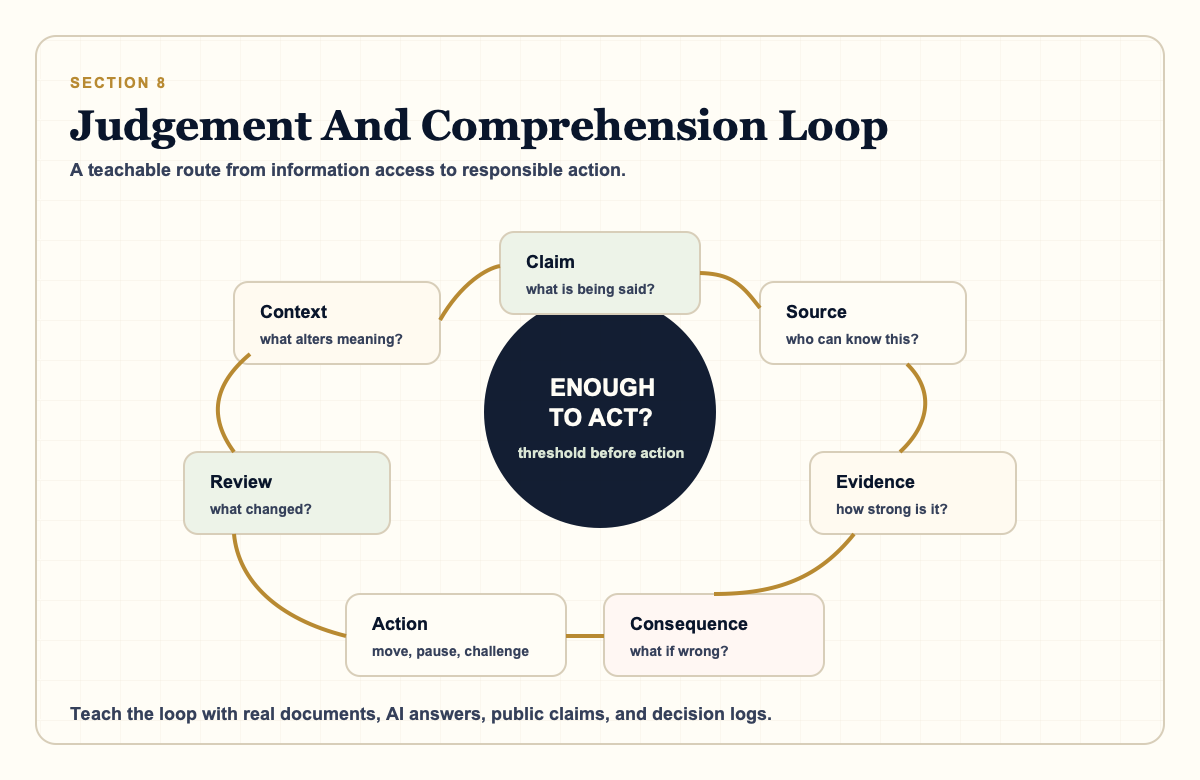
The loop is:
- Claim: What exactly is being said?
- Source: Who says it, and what can they know?
- Context: What surrounding facts change the meaning?
- Evidence: What supports it, and how strong is that support?
- Uncertainty: What is missing, disputed, assumed, or unknown?
- Consequence: What happens if I act on this and it is wrong?
- Threshold: Is this quick, slow, material, or a stop-line decision?
- Action: Should I proceed, ask, pause, challenge, escalate, or record dissent?
- Review: What did I learn, and should the decision change?
This is not a new school subject in isolation. It is a public skill that can be practised in English, history, science, mathematics, computing, citizenship, business, health, law, design, workplace training, and adult learning.
9. What Countries Should Teach
A serious programme would include at least twelve strands.
- Public reading: contracts, policies, notices, consultation pages, labels, forms, public websites, minutes, and reports.
- Claim tracing: move from a headline or AI answer to the source chain underneath.
- Evidence strength: distinguish anecdote, opinion, data, audit, expert judgement, experiment, law, and lived experience.
- Uncertainty language: likely, possible, proven, disputed, assumed, incomplete, and not yet known.
- Numbers in public: denominators, base rates, percentages, charts, risk, trend, sample, and comparison.
- Institutional routes: how decisions are made, challenged, appealed, consulted on, and recorded.
- Media incentives: attention, advertising, subscriptions, influence, persuasion, and outrage loops.
- AI use: asking, checking, source routing, local versus cloud tools, agentic workflows, and human responsibility.
- Structured disagreement: challenge the claim without attacking the person.
- Decision thresholds: quick decisions, slow decisions, reversible decisions, high-consequence decisions, and stop-lines.
- Attention management: decide where attention goes when feeds, notifications, agents, and people all compete.
- Reflection: keep a decision log, notice errors, update beliefs, and repair when wrong.
10. How To Assess It
Judgement cannot be assessed only through multiple-choice recall. It needs scenario-based assessment.
Examples:
- Source map: students trace a public claim back to its source chain and mark which links are strong, weak, or missing.
- Evidence threshold: students decide whether a claim is enough to share, enough to investigate, enough to act on, or enough to stop.
- Public document test: students explain a real policy, product label, planning notice, or consultation page to a defined audience.
- AI verification exercise: students use an AI system to interpret a document, then verify the answer against sources and record uncertainty.
- Challenge packet: students write a respectful objection containing claim, evidence, uncertainty, consequence, safer alternative, and threshold.
- Decision log: students record what they knew, what they assumed, what changed, and whether their action was justified.
This is teachable. It is also assessable. The assessment should reward clarity, source discipline, calibrated confidence, and proportionate action.
11. An Enquiry
This paper is not intended to be the last word. It is an invitation to test the idea properly.
I am interested in understanding where this is already being taught, practised, or quietly improvised: in schools, universities, employers, public bodies, councils, regulators, healthcare teams, civic organisations, and agentic tool builders.
The question is not only who is doing it well. It is what they are actually doing. What language helps? What exercises work? What fails when people meet real documents, real public services, real AI outputs, real time pressure, and real consequences?
The enquiry is practical. It is not simply "should we teach critical thinking?" Most countries already say yes to that. The more useful question is: what would actually work, for whom, in which setting, and under what conditions?
- Minimum curriculum: Can we find the smallest teachable judgement loop that works for children, students, workers, leaders, and adults returning to learning?
- Transfer: Which exercises actually move from the classroom into real public decisions, rather than staying trapped inside the lesson?
- AI use: Does AI improve comprehension when learners are explicitly taught source tracing, verification, uncertainty, and human responsibility?
- Adult learning: What short, useful formats help overloaded adults practise judgement without asking them to enter a formal course?
- Assessment: Can scenario-based judgement be assessed reliably without flattening it into exam technique or performative debate?
- Equity: Who is most harmed when public information is technically available but practically incomprehensible?
- Public services: Can councils, regulators, schools, healthcare bodies, and public agencies design information so citizens and agents can understand it together?
If you are working on any of this, the next useful step is not a grand theory. It is a small test: one audience, one real document, one judgement loop, one decision threshold, and one honest review of what changed.
12. Conclusion
The next public divide may not be between people who have information and people who do not. It may be between people who can judge information and people who cannot.
Countries have spent years trying to improve access: broadband, open data, public websites, digital services, online safety, school computing, and now AI strategies. Those things matter. But access is only the first step.
The public capability we now need is deeper and more practical: comprehension, critical inquiry, source authority, evidence judgement, uncertainty, consequence, threshold, and action.
This is public infrastructure. It is as real as roads, schools, broadband, courts, and libraries. If citizens cannot understand and judge the information around them, then information-rich societies will still behave like information-poor ones.
AI can help us retrieve almost everything. It cannot remove our responsibility to think.
Source Notes
- OECD. PISA 2022 Results, Volume I: The State of Learning and Equity in Education. Used for international evidence on reading, mathematics, and science performance after 2018.
- OECD. PISA 2022 Results, Volume III: Creative Minds, Creative Schools. Used as a signal that problem solving and creative thinking are now part of international capability assessment.
- World Bank, UNESCO, UNICEF, FCDO, USAID, and the Bill & Melinda Gates Foundation. 70% of 10-year-olds now in learning poverty, unable to read and understand a simple text. Used for the foundational comprehension failure signal.
- UNESCO. Media and Information Literacy. Used for the international civic framing around media and information literacy.
- UNESCO. AI competency framework for students. Used for AI literacy and critical judgement framing.
- OECD. PISA 2029 Media and Artificial Intelligence Literacy. Used for the direction of future assessment.
- European Commission Joint Research Centre. DigComp: Digital Competence Framework. Used for the European digital competence policy signal.
- European Commission. AI literacy questions and answers. Used for the EU AI Act Article 4 AI literacy obligation context.
- UK Department for Education. National curriculum in England: citizenship programmes of study. Used for England's explicit citizenship evidence and argument requirements.
- UK Department for Education. National curriculum in England: English programmes of study. Used for comprehension and critical reading context.
- UK Department for Education. National curriculum in England: computing programmes of study. Used for digital-content evaluation context.
- OCR. Changes to Critical Thinking qualifications. Used for the withdrawal of mainstream OCR Critical Thinking AS/A Level routes.
- UK Department for Science, Innovation and Technology. Online Media Literacy Strategy. Used for the UK media literacy policy signal.
- Australian Curriculum, Assessment and Reporting Authority. Critical and Creative Thinking general capability. Used for international policy comparison.
- Finnish National Agency for Education. Multiliteracy and media literacy. Used for international policy comparison.
- Singapore Ministry of Education. 21st Century Competencies. Used for international policy comparison.
- New Zealand Ministry of Education. Key competencies. Used for international policy comparison.
- British Columbia Curriculum. Critical and reflective thinking. Used for international policy comparison.
- College Board. AP Seminar. Used for a structured assessment example.
- OECD. Do Adults Have the Skills They Need to Thrive in a Changing World?. Used for adult literacy, numeracy, and adaptive problem-solving context.