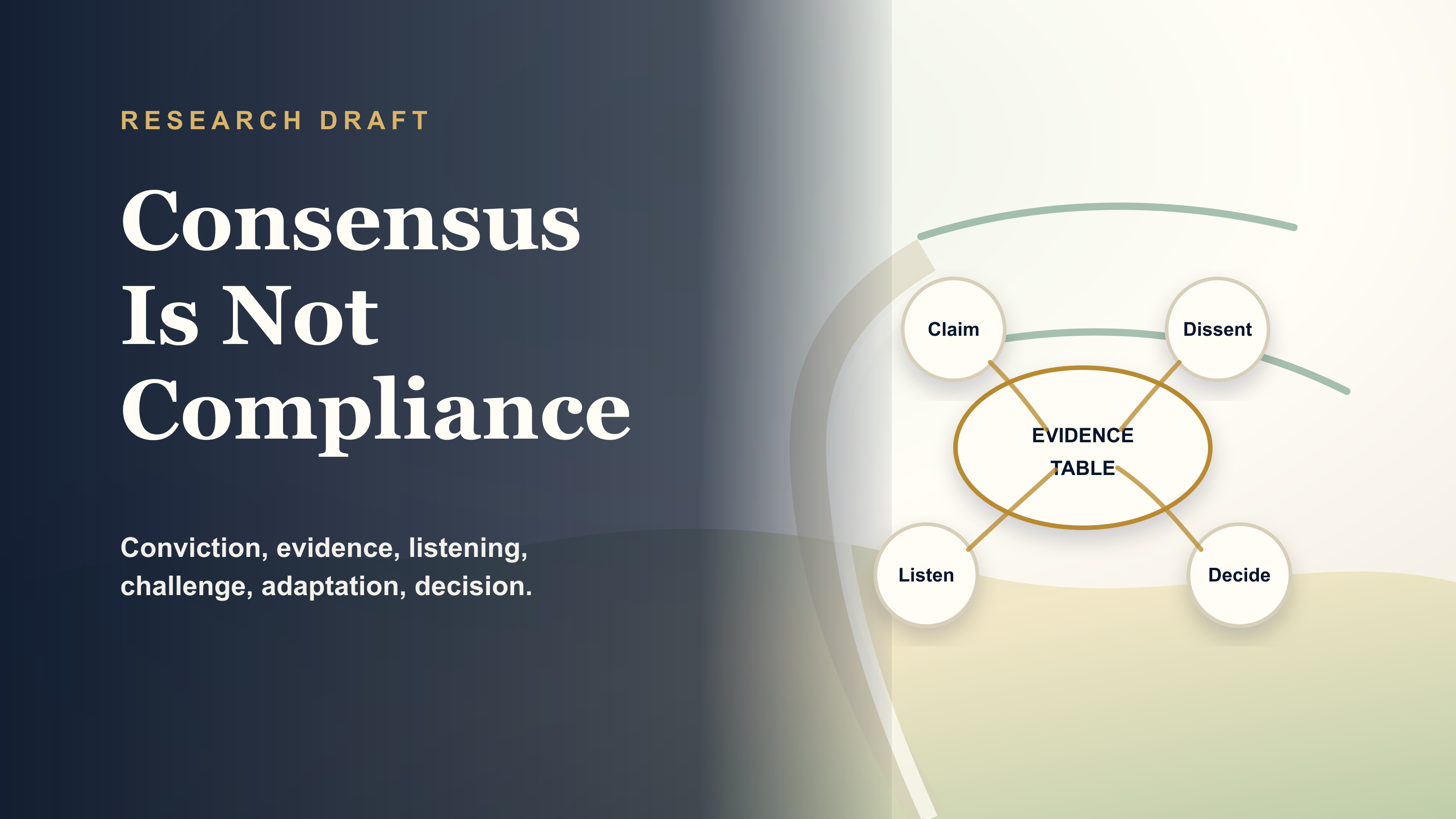
Abstract
Consensus is often treated as a soft social outcome: everyone nods, nobody objects, the meeting moves on. This paper argues that useful consensus is harder and more disciplined than that. It is not compliance, capitulation, unanimity, dominance, or politeness. It is the point where people have tested a claim, heard objections, changed what needs changing, understood the decision threshold, and committed to the next action without pretending that dissent never existed.
The paper begins with a human problem familiar to boards and leadership groups: how do you hold conviction without becoming stubborn, listen without disappearing, and challenge without breaking trust? It then connects that problem to established work on board governance, psychological safety, employee voice, false agreement, collective intelligence, Delphi-style expert consensus, IETF rough consensus, and distributed computer consensus. The final section translates the human model into agentic systems, where agents will need explicit ways to disagree, state evidence, record uncertainty, escalate risk, and converge without losing useful dissent.
Reader Guide
Core question: What does real consensus require from humans, boards, and agents?
Practical answer: a consensus system needs conviction, evidence, listening, challenge, adaptation, decision thresholds, and audit.
Agentic answer: agents should not merely vote, average, or obey the loudest instruction. They need a protocol for claims, evidence, uncertainty, dissent, escalation, and shared memory.
1. Introduction: The Moment You Back Off
There is a moment in a board meeting, a leadership team, or any serious group where you have to decide whether to keep going.
You have said the thing. Maybe you have said it twice. People have not quite heard it. Or they have heard it, but they have moved around it. Someone has smiled. Someone has said, "Yes, yes, we understand," in the tone that means they would rather you stop talking now.
That is a dangerous moment.
It can be tempting to back off. Nobody is listening. The room has moved on. Why be difficult? Why push? Why be the person who holds the meeting up?
But if the point matters, backing off too early can cost you a little piece of yourself. Not in a theatrical way. In a practical way. You know that you saw something. You know that you had evidence, or experience, or judgement, or a pattern in your mind that had not yet landed in the room. If you surrender that too quickly, the group loses information and you lose trust in your own voice.
The opposite failure is just as real. You can mistake conviction for certainty. You can keep pushing because you want to win. You can confuse being ignored with being right. You can treat resistance as proof that other people lack courage, when the better explanation is that you have not yet made the idea usable for them.
Consensus lives between those two failures.
This paper is about that middle discipline. How do people gain consensus without complying, dominating, sulking, disappearing, or forcing a weak agreement? And how might that discipline translate into agentic systems, where digital workers will need to challenge, coordinate, and converge with other agents and with humans?
Consensus is not everybody saying yes. It is the work required before yes means anything.
2. The Problem: Agreement Theatre
Boards and leadership teams are meant to be places where important claims are tested. In good boards, that is exactly what happens. People read the papers. They listen. They ask precise questions. They challenge assumptions. They know when to press and when to accept. The experience can be a joy because it feels like intelligence being made visible.
In weaker rooms, something else happens. The group performs agreement.
Agreement theatre can look polite. It can even look efficient. Nobody raises an awkward point. Nobody asks for the evidence trail. Nobody says, "I do not understand what this means." Nobody asks whether the thing being described is actually happening in the business. The paper is noted. The recommendation is approved. The minutes record a decision. Everyone goes home.
The danger is that no consensus has been built. There has only been silence.
The UK Corporate Governance Code 2024 is useful here because it does not treat governance as a rigid script. Its "comply or explain" model recognises that one approach will not fit all companies, but it expects meaningful explanations, outcomes, and accountability. That matters because serious governance is not the existence of a policy. It is the ability to explain why a decision was made, what risks were considered, and what outcome is being sought.
That is also the test of consensus. Can the group explain what it has agreed, why it has agreed it, what objections were considered, what changed during the discussion, and what would cause the group to revisit the decision?
If not, the group may have a decision, but it does not yet have meaningful consensus.
3. What Consensus Is Not
The first job is to clear away some bad definitions.
Consensus is not unanimity. Unanimity may happen, but a unanimous room can still be wrong, frightened, lazy, or socially trapped.
Consensus is not the absence of objections. Silence can mean agreement. It can also mean fatigue, confusion, deference, fear, lack of preparation, or the belief that speaking up will not change anything.
Consensus is not compliance. If people comply because they feel they have no real choice, the decision may move forward, but commitment will be thin.
Consensus is not dominance. A powerful chair, founder, investor, executive, or expert can get agreement without earning it.
Consensus is not endless discussion. A group that keeps reopening the same issue without a threshold for decision is not being thoughtful. It is avoiding responsibility.
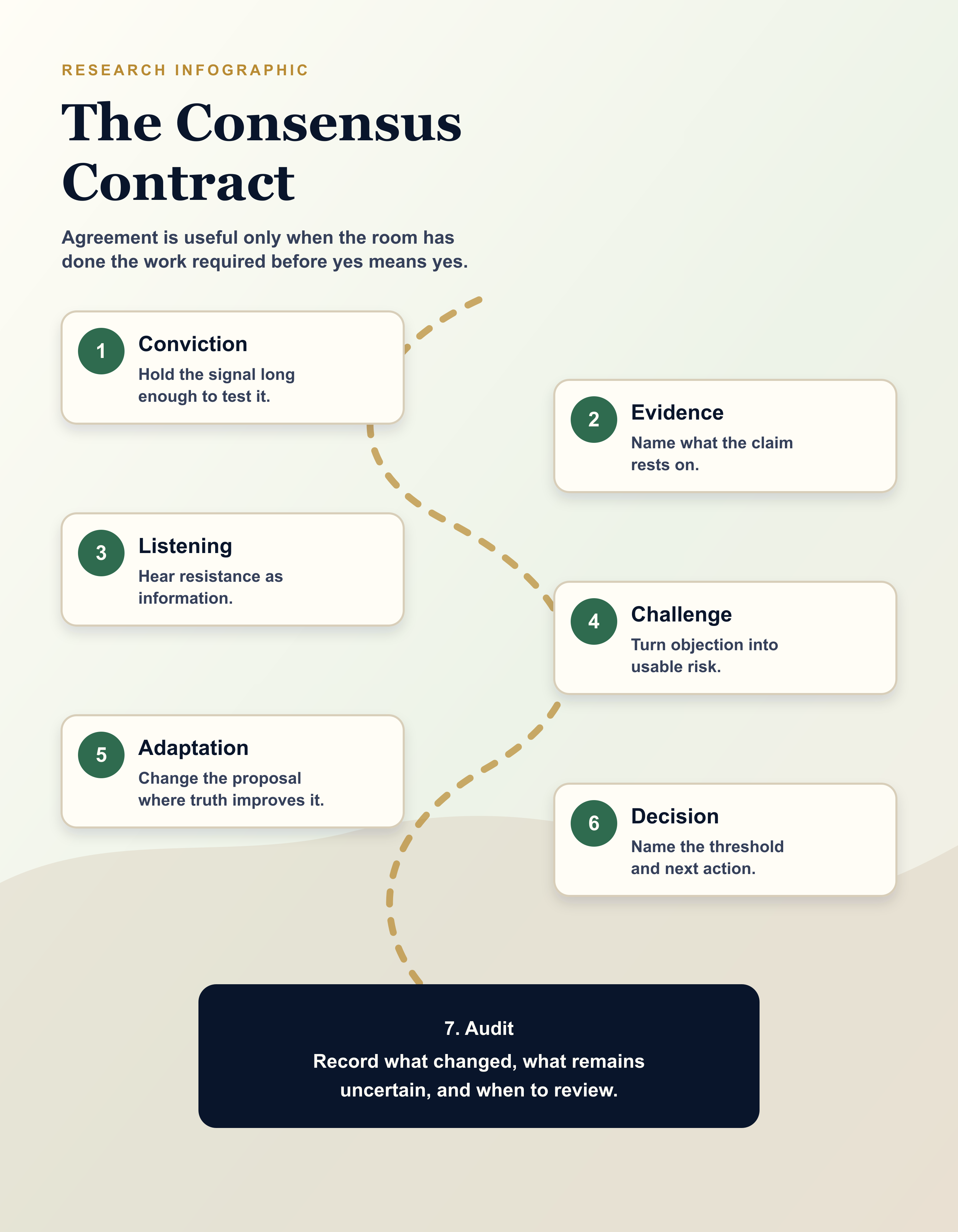
Useful consensus is better understood as a contract:
- The proposer: I will make the claim clear enough to be tested.
- The group: We will listen, challenge, and add evidence rather than merely react.
- The dissenter: I will state the concern in a way the group can act on.
- The chair or facilitator: I will protect the process, name the threshold, and prevent silence from being mistaken for agreement.
- The final decision: We will record what changed, what remains uncertain, and when we will review the outcome.
That contract is demanding. It asks people to bring both backbone and humility.
4. False Consensus Failure Modes
False consensus is not one thing. It has several shapes, and each shape needs a different correction.
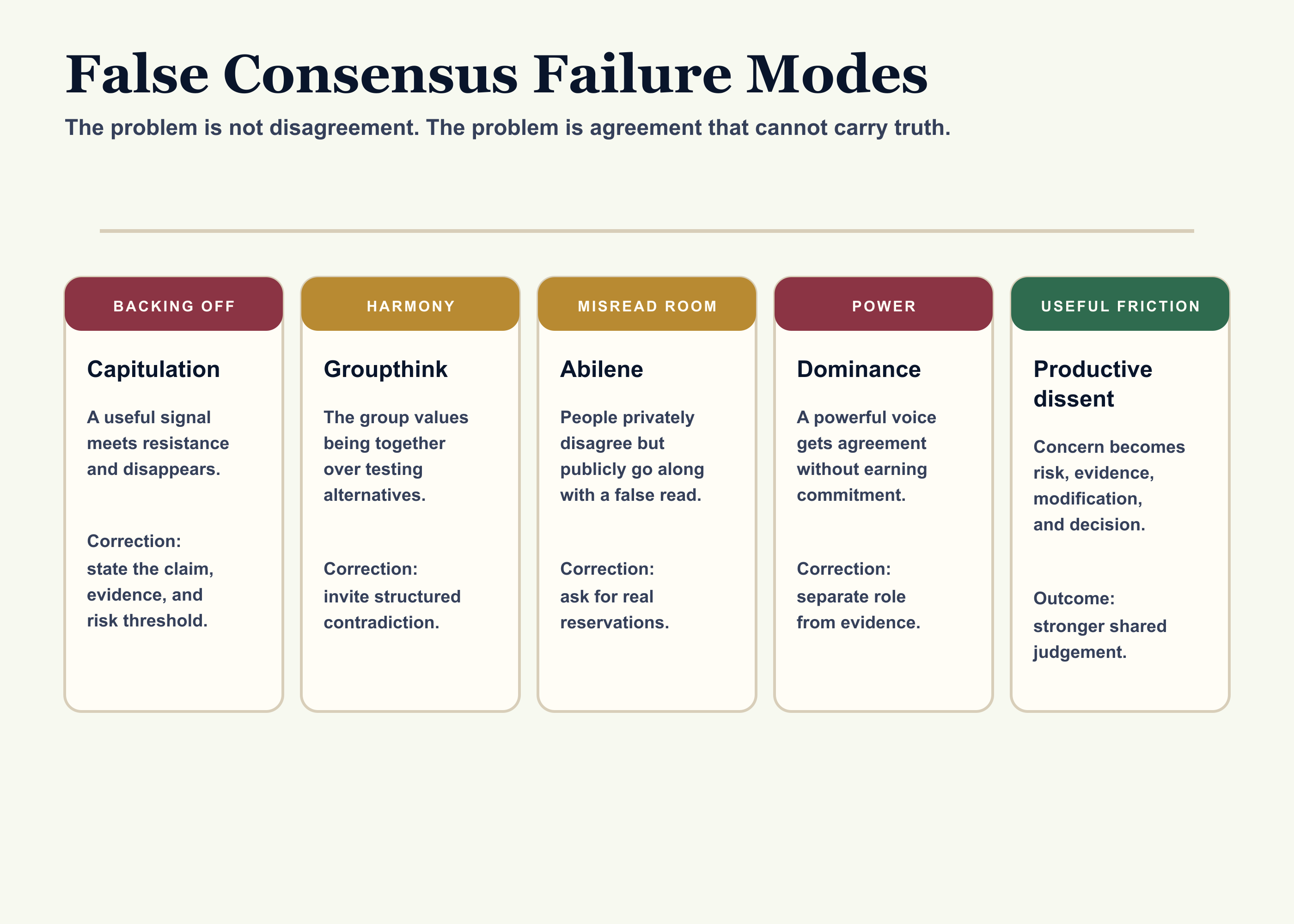
The most familiar warning is groupthink. Irving Janis described the way cohesive groups can value unanimity over realistic appraisal. The concept is sticky because many of us have sat in rooms where people seem to know the answer is weak but keep moving anyway.
The Abilene Paradox is even more useful for this paper. Jerry Harvey's central point was that organisations often take actions contrary to what their members actually want because people fail to communicate their real reservations. It is not a failure to manage conflict. It is a failure to manage agreement.
That distinction matters. Many boards and teams think their problem is conflict. Sometimes it is. But often the deeper problem is mismanaged agreement. People privately know the decision is wrong, or thin, or untested, but they publicly signal support because they assume others want it. Everyone boards the bus together, then later blames each other for the journey.
There is also the quieter failure of capitulation. This is the person who meets resistance and immediately stops. They may tell themselves they are being collaborative. Sometimes they are. But sometimes they are giving away useful evidence because the room made it socially expensive to continue.
And then there is dominance. This is where consensus is manufactured by power. The room agrees because the person with authority has already decided. The words "any objections?" are spoken after the outcome is obvious.
The goal is not to avoid disagreement. The goal is to convert disagreement into better shared judgement.
5. The Skills Of Real Consensus
To build consensus, a person needs a small set of skills that are rarely taught together.
Conviction. You need enough belief in your observation to keep it alive when the first response is weak. This is not ego. It is stewardship of useful information.
Evidence. You need to know what your claim rests on. Is it data? Experience? A pattern? A risk signal? A value judgement? A legal threshold? A customer reality? If you cannot say what kind of evidence you have, the room cannot assess it.
Listening. You need to hear the resistance without simply defending yourself. Sometimes the objection is not opposition. It is the room telling you what part of the idea has not yet been made workable.
Translation. You need to move from "I am right" to "Here is the version of this idea that the group can understand, test, and use."
Challenge. You need to ask direct questions without turning the room into a fight. Good challenge is not aggression. It is disciplined curiosity with consequence attached.
Adaptation. Consensus is not the original proposal surviving untouched. If nothing changes after discussion, either the proposal was unusually good or the discussion was weak.
Commitment. Once the group has made a decision through a fair threshold, people need to support the next step unless a stop-line risk remains. Dissent can be recorded without every decision becoming permanently provisional.
These are human skills, but they are also design requirements for agentic systems.
6. Board Consensus As Governance Work
Boards are a useful test environment because they combine authority, incomplete information, risk, status, time pressure, and long-term consequence.
A board is not meant to be a cheerleading unit. Nor is it meant to be a permanent opposition party. Its job is to exercise judgement on behalf of the organisation. That means scrutiny, support, memory, risk sensing, and decision ownership.
Good board consensus has a loop.
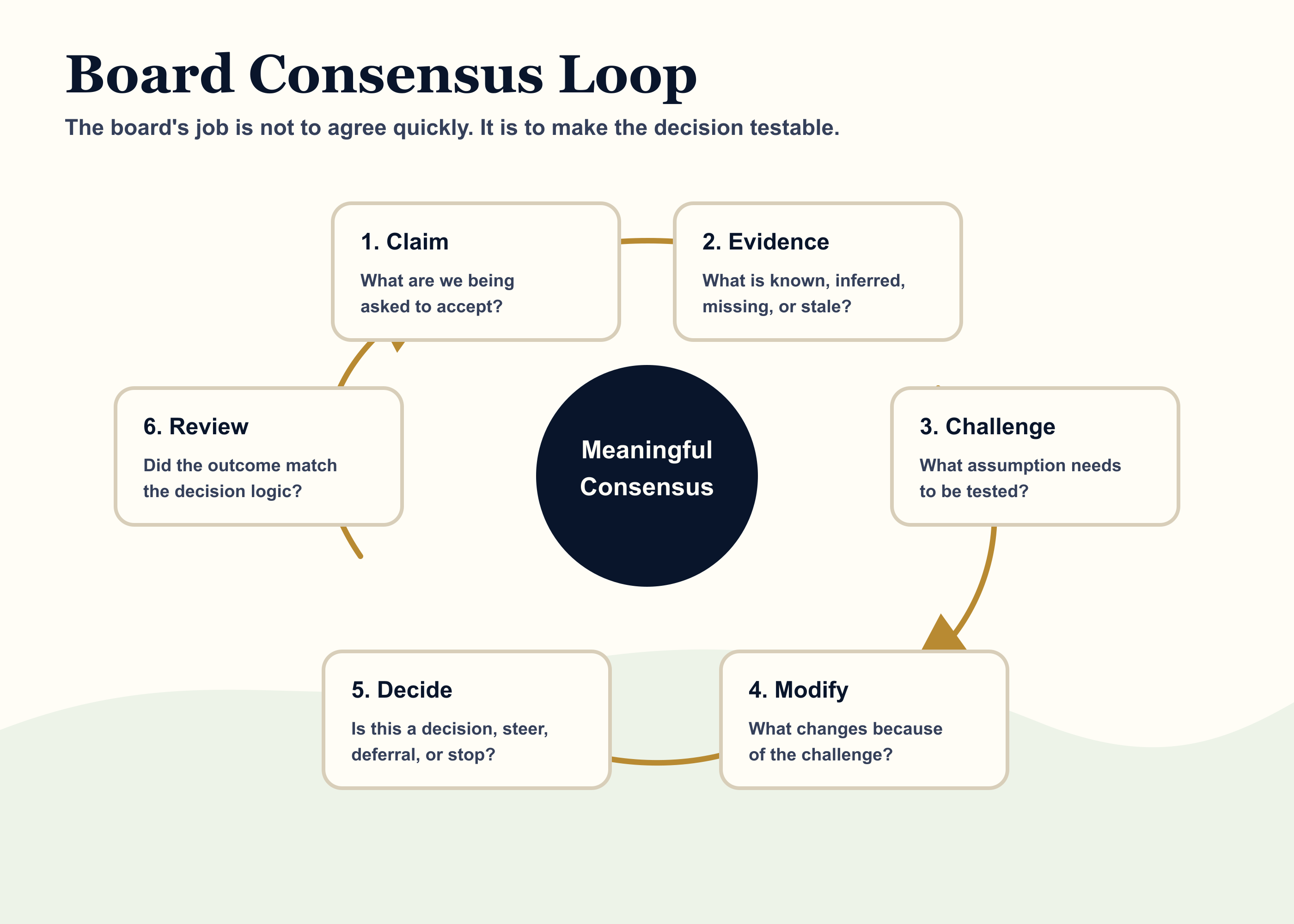
The loop begins with a claim. Something is being proposed: an investment, a strategy, a risk appetite change, an AI adoption plan, a hiring decision, a product pivot, a control declaration, a public statement.
The claim needs evidence. Not necessarily perfect evidence. Boards often decide under uncertainty. But the evidence must be named. What do we know? What do we infer? What have we not checked? What is management asking us to accept?
Then comes challenge. Challenge should be constructive, but "constructive" must not mean harmless. It means the challenge is designed to improve the decision rather than win a personal contest.
The proposal should then change where it needs to change. A useful board conversation may narrow scope, change timing, add controls, clarify accountability, require a further paper, or define a review point.
Then the board needs a decision threshold. Is this a decision, a steer, a note, a request for more evidence, or a stop? Too many governance failures live in the mush between those words.
Finally, the board needs outcome review. The FRC's emphasis on outcomes-based reporting matters because governance without outcomes becomes paperwork. The board should be able to ask later: did the decision do what we said it would do?
7. What The Research Adds
The research does not give one simple model of consensus. It gives a field of useful warnings.
| Field | Useful idea | What TonyWood.org should take from it |
|---|---|---|
| Board governance | The UK Code uses flexible "comply or explain" governance and expects meaningful explanations. | Consensus should be explainable: background, rationale, risks, mitigations, and review point. |
| Psychological safety | Amy Edmondson's work links team learning to the ability to take interpersonal risk. | People need enough safety to speak, but safety is not the same as agreement. |
| Employee voice | Morrison's review shows speaking up and silence are major organisational behaviours. | Silence is data. A consensus process must ask why useful voice is absent. |
| Collective intelligence | Woolley and colleagues found group performance linked to social sensitivity and balanced participation. | The smartest person in the room is not enough. The interaction pattern matters. |
| Delphi method | Delphi uses structured expert rounds to explore consensus under uncertainty. | Some consensus should be staged, anonymous, and iterative rather than fought live in one meeting. |
| IETF rough consensus | RFC 7282 warns that rough consensus is not simple voting or ignoring minority concerns. | A decision can proceed without unanimity if objections have been heard and addressed honestly. |
| Distributed systems | Paxos and Byzantine consensus ask how separated actors agree despite failures or bad messages. | Agentic consensus needs message integrity, thresholds, and failure assumptions, not just discussion. |
The thread across these fields is simple: consensus is not a mood. It is a system.
The system has to make voice possible, evidence visible, objections usable, thresholds explicit, and memory durable.
8. Human Consensus And Agentic Consensus
Now the interesting question: what happens when the participants are not all human?
Agentic systems will not only take instructions from humans. They will increasingly coordinate with other agents. One agent may be doing research. Another may be handling a customer process. Another may be watching finance. Another may be checking policy. Another may be preparing a board pack. They will need to hand off, challenge, verify, and converge.
If we give them only simple yes/no logic, they will fail in the places where we most need judgement.
If we let them debate endlessly, they will burn time and tokens.
If we let them average opinions, they may flatten the one useful dissenting signal.
If we let the most confident agent dominate, we recreate the loud-person problem in software.
So the agentic version of consensus needs a protocol. Not a grand theory. A practical operating packet.
Minimum Agentic Consensus Packet
- Claim: what the agent believes should happen.
- Evidence: sources, observations, tool outputs, or prior decisions.
- Confidence: how strong the agent thinks the claim is and why.
- Uncertainty: what is missing, stale, ambiguous, or assumed.
- Dissent: what other agent or human concern remains unresolved.
- Threshold: whether this is a quick decision, review decision, approval decision, or stop-line issue.
- Decision: what was agreed, rejected, deferred, or escalated.
- Audit: what should be remembered about the reasoning and outcome.
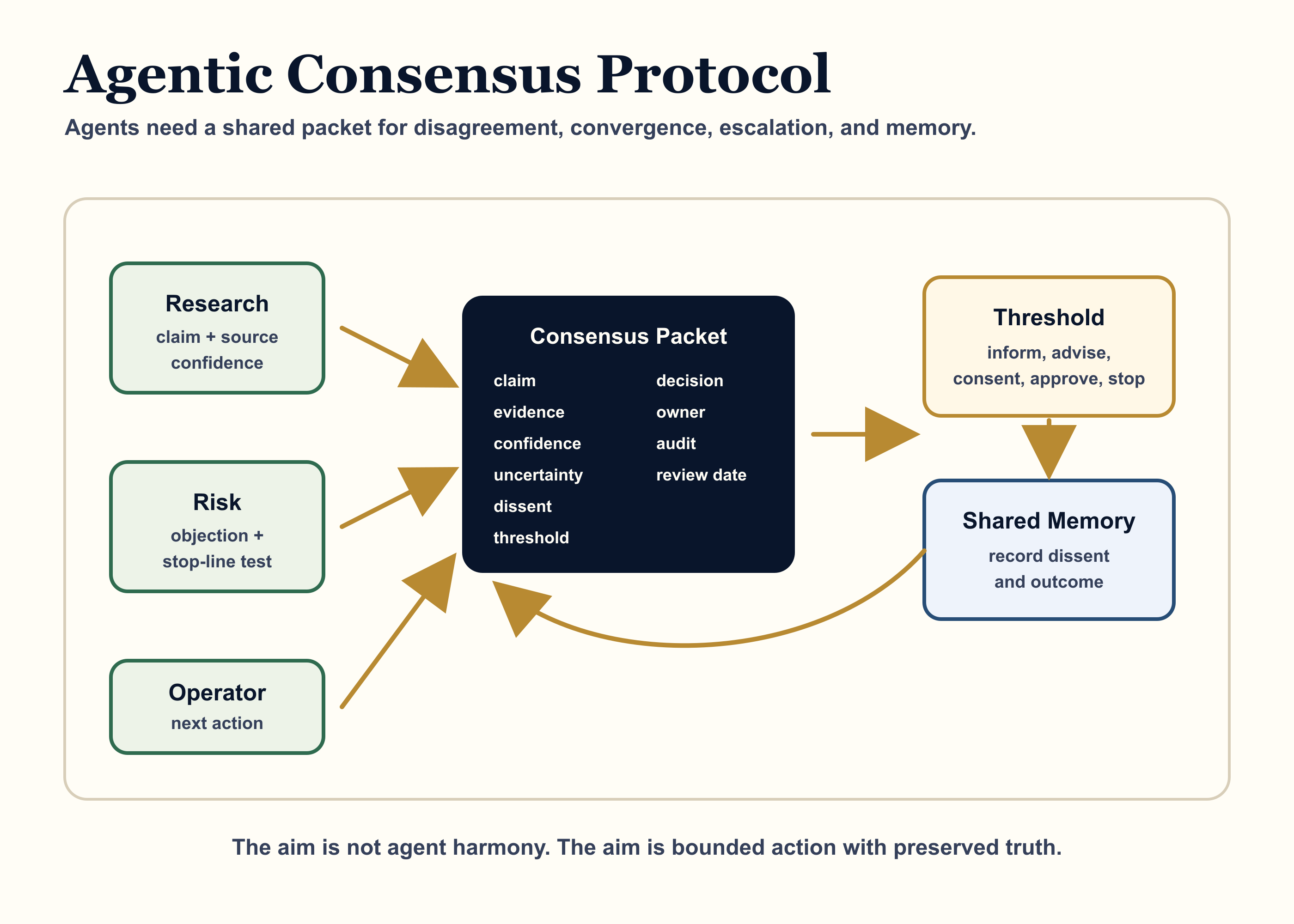
This is where human and technical consensus meet. Distributed systems research asks how nodes agree despite failures, partitions, or bad actors. Human governance asks how people agree despite uncertainty, status, incentives, fear, and incomplete knowledge. Agentic systems will need both traditions.
Paxos is not a board meeting. A board is not a Byzantine fault-tolerant protocol. But the analogy is useful. Consensus is easy when everybody is reliable, informed, aligned, and connected. The problem becomes interesting when messages are missing, trust is uneven, roles differ, and some participants may be wrong.
That is exactly where boards live. It is also where agentic systems are heading.
9. The Role Of Dissent
Dissent is not the enemy of consensus. Dissent is one of the materials consensus is made from.
The question is whether dissent is raw or processed.
Raw dissent sounds like:
- "I do not like this."
- "This feels wrong."
- "We tried this before."
- "I am not comfortable."
Those statements matter, but they are not yet useful enough. A good consensus process helps turn them into something the group can work with:
- Concern: what exactly is at risk?
- Evidence: what makes us believe the risk is real?
- Threshold: is this a preference, a material risk, or a stop-line?
- Modification: what change would make the proposal acceptable?
- Residual dissent: what concern remains even after modification?
This matters for agents as well. An agent should not simply say "I disagree." It should say what it disagrees with, what evidence it has, what uncertainty remains, what action would reduce the risk, and whether the issue crosses an agreed stop-line.
That is not awkwardness. That is useful friction.
10. Consensus, Consent, And Decision Thresholds
One reason consensus becomes messy is that groups do not always name the decision threshold.
Do we need everyone to agree? Do we need no reasoned objection? Do we need a majority? Do we need a responsible owner to decide after hearing the room? Do we need expert convergence? Do we need a formal board resolution? Do we need human approval because the action touches money, people, privacy, law, safety, or reputation?
Those are different thresholds. Treating them as the same is one reason meetings go strange.
The IETF's idea of rough consensus is helpful because it separates consensus from simple voting. RFC 7282 warns against reducing consensus to counting hands while ignoring minority concerns. The important question is not merely "how many are for and against?" It is whether the objections have been understood and whether the group has done the work required to proceed responsibly.
In agentic systems, this should become explicit:
- Inform: agents share context, no decision requested.
- Advise: agents provide recommendations, human or owner decides.
- Consent: proceed unless a reasoned objection crosses a defined threshold.
- Consensus: converge on a shared proposal after objection handling.
- Approval: named human or governance route must approve.
- Stop-line: pause action because the risk category forbids proceeding without escalation.
Without these words, an agentic workforce will either ask humans too often or act too freely. Both are bad operating designs.
11. Why Some People Struggle With Consensus
There is a human point here that is worth saying plainly.
Some people struggle with consensus because they have not had to build it. They have been obeyed. They have had authority, status, seniority, charisma, or control of resources. For a long time, when they said something, people moved.
Then they meet resistance.
And resistance feels like disrespect.
But often it is not disrespect. It is simply the first time the idea has had to survive outside the authority bubble.
Consensus-building is a skill. It requires patience, evidence, translation, sequencing, and emotional control. It requires the ability to stay with the point without punishing the room for not seeing it immediately. It also requires the ability to notice when the room is right and you need to change your mind.
This is why consensus is closely linked to self-respect. If you collapse at the first sign of resistance, you are not giving your judgement a fair hearing. If you attack at the first sign of resistance, you are not giving other people's judgement a fair hearing. The skill is to remain present long enough for the truth to get better.
12. Operating Rules For Human-Agent Consensus
A practical operating model for consensus across humans and agents should start small.
- Name the claim. Every consensus process begins with a claim clear enough to test.
- Separate evidence from preference. Both may matter, but they are not the same thing.
- Require objection quality. An objection should name risk, evidence, threshold, and a possible modification.
- Protect minority signal. Do not average away the dissenting agent or director who has the one relevant fact.
- Define the decision threshold before the decision. Do not change the rules after seeing the room.
- Record residual dissent. A decision can proceed while preserving what was unresolved.
- Review outcomes. Consensus is only as good as the group's willingness to learn from what happened next.
For agentic systems, these rules should be built into the harness. A consensus exchange should produce a reviewable object, not just a chat transcript. That object should be small enough to use and structured enough to audit.
13. Risks And Limits
This paper should not be read as a call for endless consensus. Some situations need command. Some need law. Some need a named accountable owner. Some need emergency action. Some require a board to decide even though not everyone is comfortable.
The point is not that every decision should be made by consensus. The point is that when we claim consensus, we should mean something stronger than social agreement.
There are also risks in translating human consensus into agentic systems.
- Token theatre: agents debate because the process asks them to, not because debate improves the decision.
- False precision: confidence scores make weak evidence look mathematical.
- Dominant agent problem: one model, tool, or system becomes the de facto chair.
- Hidden prompt authority: a system instruction silently determines the outcome while pretending agents reached consensus.
- Dissent loss: useful disagreement is not stored, so future agents cannot learn from it.
- Human bypass: agents converge on an action that should have gone through a human approval or stop-line route.
These risks are design problems. They can be reduced by explicit thresholds, evidence trails, dissent logs, source authority, and audit.
14. Research Questions
This is research, not the last word. The next stage should test the model against real boards, leadership teams, public bodies, and agentic workflows.
- Board practice: What board behaviours most reliably distinguish real consensus from polite agreement?
- Voice: What makes people back off from useful dissent, and what helps them persist constructively?
- Evidence quality: What minimum evidence packet lets a group challenge a claim without overloading the meeting?
- Decision thresholds: Which thresholds should be standard in agentic work: inform, advise, consent, consensus, approval, stop-line?
- Dissent memory: How should residual dissent be stored so future agents and humans can use it without reopening every decision?
- Agent protocols: Can agents use a shared claim-evidence-uncertainty-dissent packet to converge better than simple debate or voting?
- Safety: Which categories of consensus should never permit autonomous action without human approval?
15. Conclusion
Consensus is not weakness. It is not politeness. It is not everybody nodding because the meeting is late and the chair wants to move on.
Real consensus is a discipline. It asks people to bring conviction without becoming rigid, evidence without becoming bloodless, challenge without becoming destructive, and listening without disappearing.
That matters in boardrooms because governance fails when people mistake policies, papers, and nods for judgement. It matters in companies because false agreement wastes years. It matters in agentic systems because digital workers will soon need to coordinate at speed in spaces where simple yes/no logic is not enough.
The future agentic organisation will need more than task execution. It will need structured disagreement. It will need challenge that can be heard. It will need dissent that can be remembered. It will need thresholds that say when to proceed, when to ask, and when to stop.
Consensus is not compliance.
It is the work we do so that agreement is worth having.
References And Source Notes
Financial Reporting Council. UK Corporate Governance Code 2024.
Harvey, Jerry B. The Abilene Paradox: The Management of Agreement. Organizational Dynamics.
Edmondson, Amy C. Psychological Safety and Learning Behavior in Work Teams. Administrative Science Quarterly, 1999.
Morrison, Elizabeth W. Employee Voice and Silence: Taking Stock a Decade Later. Annual Review of Organizational Psychology and Organizational Behavior.
Woolley, Anita Williams, Christopher F. Chabris, Alexander Pentland, Nada Hashmi, and Thomas W. Malone. Evidence for a Collective Intelligence Factor in the Performance of Human Groups. Science, 2010.
RAND Corporation. Generating Evidence Using the Delphi Method.
IETF. RFC 7282: On Consensus and Humming in the IETF.
Lamport, Leslie. Paxos Made Simple. Microsoft Research.
Lamport, Leslie, Robert Shostak, and Marshall Pease. The Byzantine Generals Problem. Microsoft Research.
Olfati-Saber, Reza, J. Alex Fax, and Richard M. Murray. Consensus and Cooperation in Networked Multi-Agent Systems. Proceedings of the IEEE, 2007.
Tony Wood. When The Agent Thinks You Are Wrong. TonyWood.org.
Tony Wood. Woodlands Agentic Theory. TonyWood.org.