
How to Get Skilled Up for the Coming AI Change
A practical British guide to apprenticeships, funded training, pay and employers in electrical work, cooling, construction and energy infrastructure. Learn a trade first, then specialise.
Topic
Data, architecture, APIs, knowledge stores, and the public infrastructure that lets humans and agents find trustworthy information.
Start here
The list below mixes shorter essays, longer research, protocol specs, and agent-facing notes, ordered by publication date. Each item links to the canonical human page and preserves the original Tonywood.co source URL where available.
tonywood://topics/datahttps://www.tonywood.org/topics/data/
A practical British guide to apprenticeships, funded training, pay and employers in electrical work, cooling, construction and energy infrastructure. Learn a trade first, then specialise.

Already skilled in carpentry, HVAC, electrical work or plumbing? Keep your trade, use AI to find better-fitting work, and compare the whole offer before you move.
Pricing Watch 3: Astra arrives, Sol gets cheaper, and 26 AI model entries are compared with current API prices, GBP costs and careful August-to-September line charts.

Why a confidential peer room can give a portfolio CEO something valuable precisely because the investor is not in it.

How OpenAI turned a messy GPT-6 Astra rollout into a useful lesson in product recovery.
Why I think investors should value the balcony time, fresh perspective and renewed energy their CEOs can bring back from CEO CF.
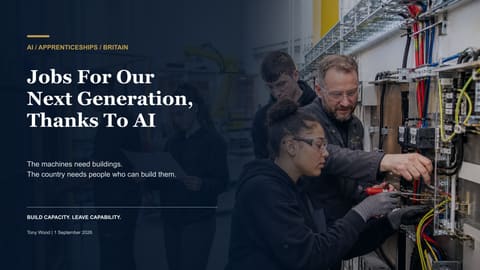
AI infrastructure will not only need models and code. It could help Britain train a new generation of electricians, engineers and technicians for the physical economy.

The permanent workforce is smaller than the headline, but a sustained data-centre build programme could help rebuild Britain's electrical and engineering skills base.
Pricing Watch 2: an August 2026 UK view of direct AI API prices, separating Anthropic Haiku's provider-price change from small GBP exchange-rate movement.

A citation is the start of a conversation, not the end of one. Here is the evidence trail that should sit behind the phrase: research says.

Do not postpone AI until every system is clean. Use bounded, valuable data now, verify the work, and improve the wider data estate in parallel.

Zero Data Retention removes a major practical objection to frontier AI. It does not make GDPR, permissions or company governance somebody else's problem.

Companies need one coherent view of the work. They can get it by consolidating into ERP or by letting an authorised agentic layer orchestrate their existing systems.

AI adoption starts with one safe tool, protected time, bounded access and domain experts learning alongside technical people.
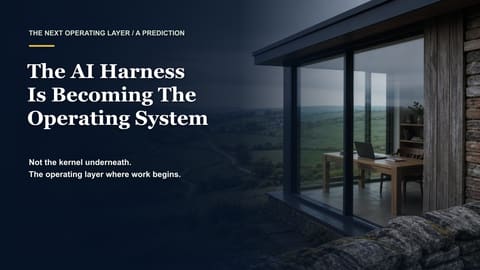
Codex and Claude are moving beyond chat and becoming operating layers for work. The kernel remains underneath, but the surface people actually use may be about to change.
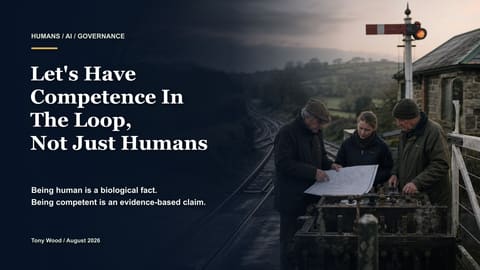
A human in the loop is not automatically a safety control. Meaningful oversight requires task-specific competence, information, capacity, authority and accountability.

A UK evidence update on data-centre water and electricity use: what is measured, what is modelled, why peak demand matters, and what good planning should disclose.

Data centres already underpin ordinary British life. AI increases the need, but Britain needs a portfolio of sites matched to workloads, power, fibre, water and local opportunity.
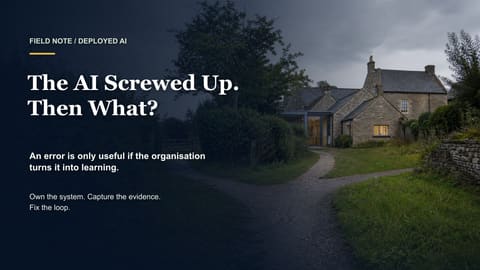
A dental AI booked the wrong specialist. The important question was not only what failed, but whether anyone captured the event, owned the system, and turned the mistake into learning.

What agentic organisations can learn from NHS England's patient-safety systems, learning infrastructure, and continuing struggle to turn reports into safer practice.

Part four of Agentic Operating System For Your Business: moving from agentic tasks and messaging into a visible business operating system with runners, waypoints, state, evidence, and human control.

Part three of Agentic Operating System For Your Business: choosing between the deep integration of an agent harness and the flexibility of portable API workers.

Use the agent harness for leverage today, but keep a tested API or local-model route so convenience does not become operational dependency.
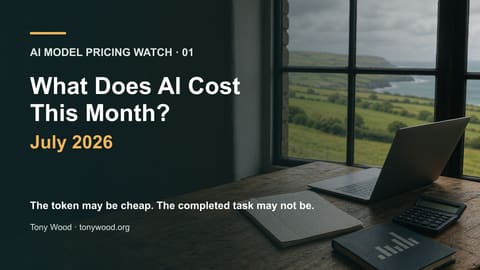
The July 2026 UK baseline for direct AI API prices, showing quick, general, and frontier models alongside reference workload costs and the qualifications that affect a completed task.

A practical experiment with Focus Reader, dyslexia, attention, and comprehension.
Before you give an agent more intelligence, decide what failure you can survive. Operational resilience is the first task, not the final check.

AI can help us build at extraordinary speed. It cannot reliably warn us about rules, risks, and details we do not yet know exist.

A plain-English guide to OpenAI's GPT-5.6 model family, ChatGPT, ChatGPT Work, Codex, the API, reasoning settings, tools, skills, MCP connectors, and multi-agent work.
Part two of Agentic Operating System For Your Business: creating a short AI-voiced podcast was straightforward, but publishing it exposed the identity, delegated authority, permissions, and audit layer that agent-ready platforms need.

A practical thought piece on why vibe coding changes the buy-vs-build equation but does not remove the cost of human time, maintenance, security, backups, data integrity, audit, and ownership.

A researched thought piece on why AI may lower the cost of writing code, but does not remove the need for engineers who understand architecture, security, data, scaling, reliability, operations, and business constraints.

A researched thought piece on a suggestion from Athena, who works with Tony Wood in Agentic Research, that Esperanto can inspire a neutral, precise, human-readable auxiliary register for agent-to-agent communication.
A controlled auxiliary register for agent-to-agent and agent-to-human communication, inspired by Esperanto's neutral, regular bridge-language design.

A practical thought piece on why agent-ready interfaces, MCP access, and safe automation will become a trust signal for software, and why attention-heavy tools may lose users as agentic work matures.

Agentic architecture is not one clever model or one workflow. It is a layered environment of servers, access, runtimes, data, protocols, identity, firewalls, applications, work rooms, visualisation, and operational resilience.
A practical reflection on why LLM firewalls, tool gates, and deterministic controls are really an old Stoic idea: not every thought deserves to become an action.
A compact public agent-facing companion for Tony Wood's Agentic Language research paper, defining Agent Moves, Meaning Blocks, evidence, confidence, uncertainty, routes, human notes, and stop-line boundaries.
A compact packet for claim, evidence, uncertainty, ownership, route, risk, next action, success condition, and action status.
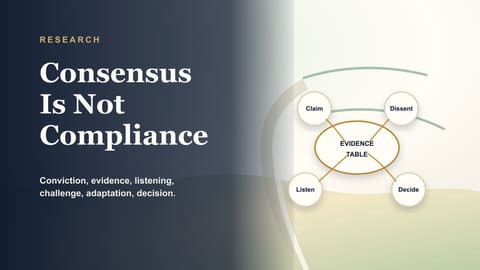
A research paper proposing consensus as a disciplined process of conviction, evidence, listening, challenge, adaptation, and commitment, then translating that human governance model into agentic systems.
A simple CEO guide to trying AI agents: run one useful demo, keep data bounded, back up the working state, and start with one repeatable workflow.

A reflective thought piece on moving from rigid software wizards and menu trees toward agentic tools that can work from intent, while still respecting the moments where precision matters.

A reflective essay on what happens when personal agentic systems make public knowledge, local government information, product evidence, and hidden context understandable to ordinary citizens.
A research-backed reflection on how agentic systems should challenge humans when they believe a decision is wrong: respectful escalation, evidence, thresholds, stop-line rules, and human override.

A reflective, research-backed article arguing that the next school skill is not only AI literacy, but learning how to manage interrupting agentic workers: context switching, delegation, judgement, and knowing when to pause before accepting a recommended action.

A practical reflection on using Orchistra and agentic workers to cover the skills a small consulting business needs, while treating token spend as operating capital that has to be watched.
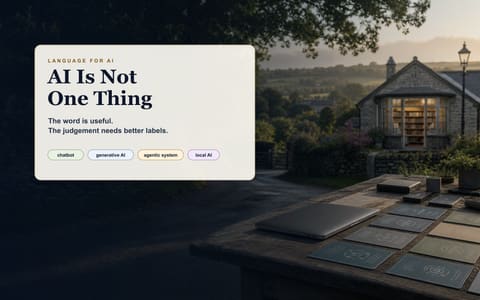
A gentle argument for using more precise AI language: chatbot, generative AI, agentic system, local AI, foundation model, AI system, or safety-critical AI, depending on what we actually mean.

A reflection on agentic AI, productivity, and the backlog of work society has avoided because there has never been enough time.

A respectful request to EU policymakers: keep the safety and rights goals, but make practical AI adoption easier through sovereign options, regulatory sandboxes, and clear approval routes for ordinary companies.

For companies whose old systems are a real differentiator, the first AI move should not be to touch the core. Start with small, separated, read-only edge POCs that earn trust before expanding.

AI and agentic proofs of concept fail when they are treated like normal IT projects instead of onboarding a new kind of team member.

A research paper proposing Woodlands as a practical model for connected memory across native systems, source authority, boundaries, ageing, calibrated judgement, and agentic context.

A practical operating note for introducing AI agents safely: start with a copied folder, safe material, clear project rules, no secrets, human review, and expansion only after the controls work.

A practical, optimistic note for students and universities: AI changes the cost of knowledge work, but the backlog of human need is still enormous.
A practical challenge to SaaS vendors, public services, and leaders: if AI has made teams more productive, where are the better features, lower costs, faster services, and visible outcomes?

A practical note on why SaaS systems still matter for collaboration, how they create a shared language around data, and what a common-understanding MCP could give agentic teams.
A practical argument for treating vibe coding as an early system maturity layer, not the enemy of production engineering.

A personal reflection on what happens when the old blockers disappear and the real work becomes choosing, pacing, and staying human.

A public note to Agentic and operators on operational resilience, backup isolation, RTO, RPO, and why no single actor should be able to destroy the way back.
A compact agent-facing companion to the operational resilience article: what to do when an agent can delete production data, backups, logs, or recovery routes.

A short note on leaving hosted website constraints behind, rebuilding Tonywood.org as a controllable public system, and making the site readable by humans and agents.
They recruit smart people, invest in analytics, and talk about evidence-based decision making. Yet when I walk into a large company, I often see the same pattern.
Most companies rely on platforms like LinkedIn or PitchBook to share public profiles and key information.
This post came from a conversation I had at the Porto summit with a CICF member. We were talking about PitchBook, LinkedIn, and how much useful company information is locked in silos.
People jump in and start coding or prompting without spending enough time upfront on what actually matters.
Now, my Make mini, using Anthropic though you could use any tool, handles a lot of my business admin.
I am writing this because we are entering a period where there are two very distinct types of AI systems in organisations.

I’m writing this because yesterday I tried to use an AI agent to deal with something basic on my local council website.
A leadership-level playbook for always-on agentic systems: reduce token burn, keep decision quality, and stop ‘memory’ turning into a cost and governance problem

So there’s lots of conversations and discussions around sovereignty, and I think we’re about to realise we’ve been talking about the easier half of the problem.
A leadership-level guide to securing data sovereignty and capturing tacit knowledge to drive business differentiation in 2026

Mermaid lets you write diagrams as text inside Markdown, so your team gets a clear picture and your AI systems get clean structure. Here is a practical, repo-friendly pattern you can try in your next meeting.
Let me be honest: whenever I spot another new business tool out in the wild, it's always the same question nagging at the back of my mind- why do we always start with a spreadsheet? I’ve seen it time and again, whether someone’s launching a business, managing
Here’s the question that keeps landing on my desk: How can AI support the people whose jobs feel under threat? I keep hearing from managers and teams worried that AI is coming for roles, not to help but to hover overhead and monitor. I get it. If you introduce
If you’re building agentic workers, you’re probably drowning in data and none of it feels quite right to keep. Storing every scrap of operational noise isn’t just expensive and messy, it crams your agent’s mind full of useless clutter. Humans don’t do this. We
Every robust AI system I’ve built – and every fragile one, too – has one thing in common: the foundation is everything. I want to lay out why we always start simple, how you check what’s happening in your agentic system, and the real hazards of leaping into co
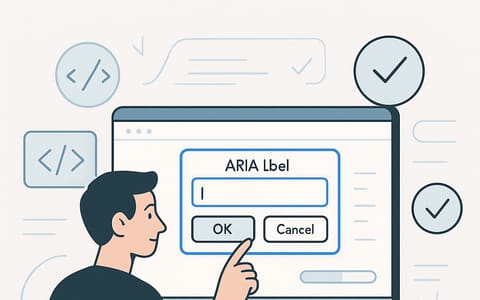
Because when we're working with Agentic AI, one of the best methods is to start working with good data and system design. Think about how, well, aroused that your system is gonna run on. How will you know when something starts? How are we know when there's som
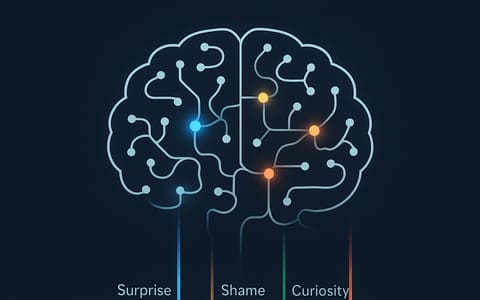
Because amidst the excitement about agentic AI, a subtle but persistent challenge keeps cropping up. It’s not about better tools, sharper reasoning, or the intelligence of the agents themselves. It’s about how these systems decide what is actually worth rememb
Why leaders must stop treating AI as a magic box, and start running agentic workflows like a real team before the next Deloitte-style scandal lands on their desk.

why am i writing this blog post? Because every week I see the same line on LinkedIn: if you do not learn AI now, some twenty-something will run rings around you and take your job.
How leaders can simplify their agentic architecture with Markdown and JSON, and still stay robust, auditable and future proof.

Why information boundaries matter for trustworthy business automation-and how leaders can turn implicit rules into explicit agentic guardrails.
This morning’s team meeting gave me pause: seven people dialled in, and five different AI note-takers logged attendance alongside us. Instantly, the old fantasy of a single “company AI” looked almost quaint. We’re quietly moving to a world where everyone bring

AI agents promise the power to multiply process speed, but there’s an elephant in the boardroom: budget blind spots. Here’s what too many executive teams are missing in 2025.
Most boards hear the promise: AI in customer service unlocks speed, data, happier customers. But here’s the thing when you supercharge customer interaction with automation, the rest of your business rarely gets the same upgrade. The operational fallout? That’s
Open any Q3 board pack right now, and there’s likely a new line item: “AI Cloud Costs – Unplanned Overage”. Sound familiar? Over the last year, I’ve watched multiple leadership teams discover that chasing AI capability through cloud providers often means losin
For years, the holy grail of AI development has been the elimination of bias. We have been told that the ideal AI is a perfectly neutral engine for processing facts. But what if that is completely wrong?
It is a startling statistic that a single pair of jeans can have a water footprint equivalent to thousands of AI conversations. But this begs a more important question for 2025: Why is our intuition so wrong about this? Why is it so easy to picture a data cent

Here’s a thought to start your day. Before you worry about the water used to train a large language model, ask yourself: how much water are you wearing?
Minimal Usage in UK: Contrary to public perception, most commercial data centers in the UK use very little water. A recent techUK survey (with the Environment Agency) found 64% of English data centers consume under 10,000 m³ of water per year , which is less t
Recent data shows AI-generated content floods LinkedIn, yet boasting "no AI" signals effort over outcomes—missing out on efficiency gains that add real value.
Agentic AI is shifting from technical prototype to everyday teammate. How you set its cultural “operating system” will make or break your results.

The United States federal government has struck a deal to provide every executive branch agency with ChatGPT Enterprise one dollar per agency, for a whole year. That’s not a typo. It’s "government leading by example using the best in AI to improve delivery for
The game changed after The New York Times secured a US court order that could force OpenAI to keep all ChatGPT conversation logs—maybe forever. For firms across England, it’s the watershed moment we always said would come. OpenAI’s own CEO, Sam Altman, isn’t m
"Board of Directors", "C-Suite", "Risk & Compliance Leaders"] tags: ["Agentic AI", "Board Leadership", "ISO 27001", "Operational Resilience"
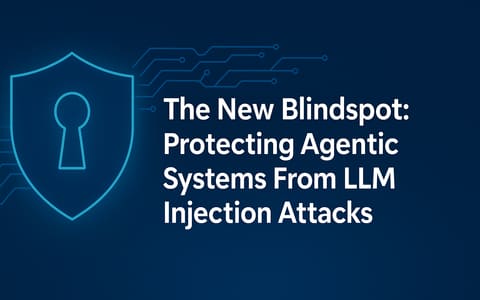
It started as a playful curiosity—seeing my LinkedIn title echo back in quirky automated replies. Today, it’s a real risk: attackers, and sometimes just creative users, can slip hidden instructions into fields that agentic systems read. That means generative A
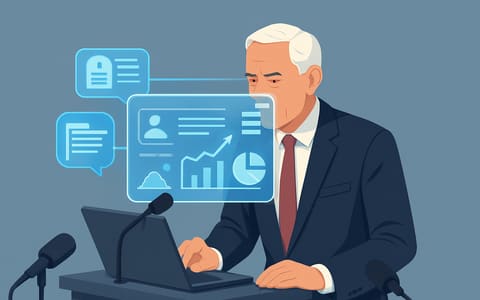
In July 2025, I watched a familiar scene: a UK leader, live on air, stalling and cycling as they waited for information. It was more than awkward, it was telling. In an age when any fact is a search away, is public life about memory, or something more? Now, th
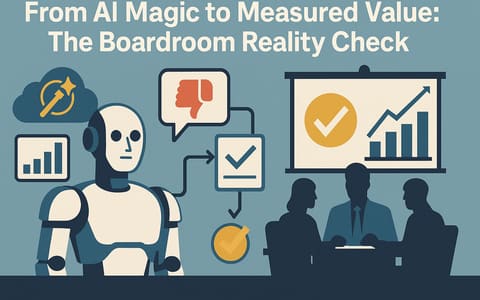
"Board of Directors", "Executives", "Digital Transformation Leads"] tags: ["AI Accountability", "Enterprise Strategy", "Agentic Workflow", "Feedback Loops", "Vendor Procurement"
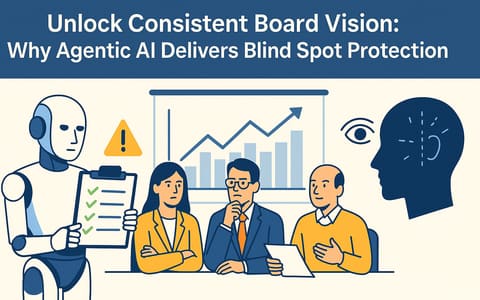
As boards grapple with more complexity and stakeholder pressure, even the best decision-makers can miss critical cues. Enter agentic AI systems that deliver unemotional, assumption-free analysis, offering the fresh perspective boards need to avoid costly mista
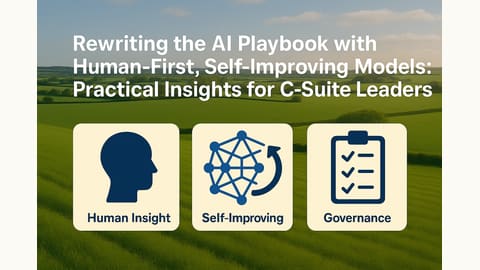
Leaders are rethinking what smarter AI looks like not chasing limitless data, but balancing the best of human insight, self-improving models, and robust governance.
Many AI pilots begin with anxiety: Will we lose jobs? Could AI erode company culture? Yet when our strategy team reconsidered our workflow, the tone shifted—focused on enabling human work, not just automating for cost. This case study lays out how leading orga
Companies deploying large-scale intelligent “crews” to filter, analyse and act on online information now face a rapidly escalating challenge: adversaries aren’t merely tricking humans—they’re building targeted misinformation webs to fool even your most advance
As AI reshapes boardroom dynamics, the allure of multi-agent “agentic crews” promises step-change in how we tackle projects, organise knowledge, and define team focus. Yet, the true value—and risk—lies not in autonomous potential, but in how well we structure,
Most executives have seen the hype around GPT-3 and GPT-4. Now, AI is entering a new phase that will set apart tomorrow’s winners: the rise of orchestrated, multi-agent systems—built not for text prediction, but for dynamic, actionable business change.
Pressure to deliver AI-driven productivity gains is mounting. But after the first wave of chatbots and data dashboards, leaders are realising: technology alone rarely transforms an enterprise. The real question is: Who drives day-to-day adoption, trust, and pr
Enterprises are at a crossroads—the question is no longer whether to use artificial intelligence (AI), but how AI represents the organisation in every digital touchpoint. As agentic AI moves from back-office automation to front-line roles, leaders face a new s

Artificial Intelligence (AI) is no longer just the subject of science fiction—it's rapidly transforming every aspect of our lives, from the way we communicate to how we work, learn, and innovate. As the UK positions itself at the forefront of the global digita
Most CEOs are told to speed up board prep, trust the dashboard, and embrace every new agentic AI tool. But data from April 2025 tells a different story: the best decisions aren’t always the fastest, and genuine CEO support is about far more than having the fla

Agentic AI is reshaping the boardroom: UK boards adopting this technology are automating up to 50% of KPI reporting, cutting response times in half, and making smarter, evidence-based decisions—while competitors scramble to catch up.

By April 2025, the boards that win are those that place agentic AI at the heart of their strategy. They see up to 40% productivity gains, slash compliance errors, and make decisions faster than competitors. Still, 50% struggle with unauthorised AI risks and ou

Key Takeaway: Enterprises that embrace agentic AI now will own the next wave of market share and talent.

UK executives now lose over 16 hours weekly chasing usable information—while competitors seize the initiative. Agentic AI flips overload into clarity, surfacing actionable insights proactively on dashboards that work for every board role. The upside? Quicker d
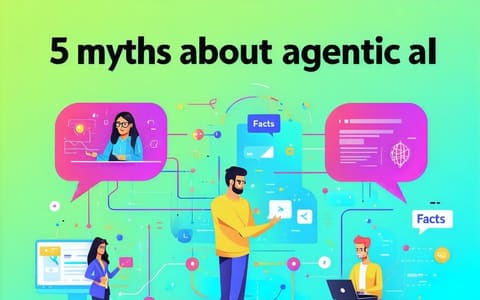
Key Sections & Talking Points: Introduction: Why Talk About Agentic AI Now? Set context: 2025 is the tipping point for agentic AI in the UK business landscape.

In the fast-paced world of fintech, effective data management can make the difference between success and failure.
Privacy choice
Cookieless Matomo analytics help me understand which public pages are useful. They are on by default unless you turn them off, and your choice never affects access to the site.