I have found myself in a really strange position these last three weeks.
Ever since the latest models arrived, and the harnesses around them became good enough, a lot of the things I had been waiting to do suddenly became possible.
Not theoretically possible. Actually possible.
Rewrite the website?
Done.
Add an MCP for the website?
Done.
Analyse data for one of my companies?
Done.
Create new reports, wire them into useful tooling, update a board pack, make the policies reference each other properly?
Done, done, done.
Burns a few tokens, yes. But it gets done.
The strange pressure now is not that I cannot do the work. The strange pressure is that I can.
The blockers went quiet
I have worked in IT for about 40 years.
For most of that time, work had natural brakes built into it.
You could want to do something, but there was always a reason it had to wait.
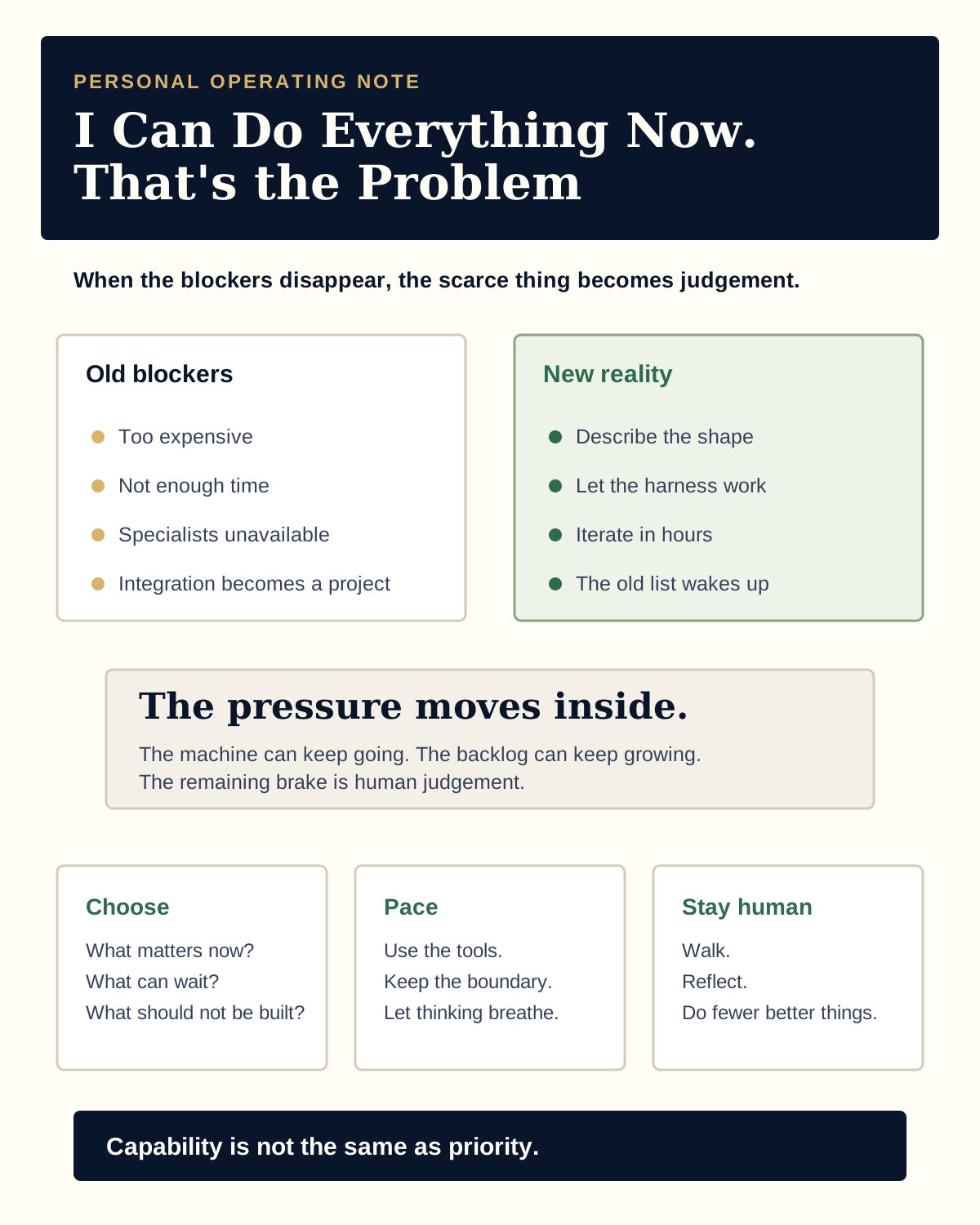
- The software was too expensive.
- The people were not available.
- The report would take weeks.
- The code needed a specialist.
- The environment was not ready.
- The integration would be a project.
Annoying, obviously.
But also strangely useful.
Those blockers forced prioritisation. They made you choose. They gave your brain time to catch up with your ambition.
Now a lot of that friction has gone quiet.
If I know what I want, I can often reproduce it. If I can describe the shape, the system can help me build the thing. If the first version is wrong, I can iterate fast enough that the old idea of "this will take ages" no longer holds.
And that is wonderful.
It is also a bit odd.
Abundance has its own pressure
The obvious story is productivity.
Look at all the things we can do now. Look how fast it is. Look how much is possible.
All true.
But there is another side to it, and I am not sure we are talking about it enough.
When the blockers disappear, the pressure moves inside.
It becomes very easy to wake up, think of a thing, start pushing, and have it done by 10 in the morning.
That sounds brilliant.
It is brilliant.
But then your brain immediately says, "Right. What else?"
And because there is always something else, you can end up in a strange little loop where the machine can keep going, the list can keep growing, and the only remaining brake is whether you remember to be a person.
This is not about laziness
I do not mean "take a breath" in the soft poster-on-a-wall sense.
I mean it operationally.
If capability expands faster than judgement, you can create chaos at speed.
You can improve things nobody asked to improve. You can polish systems that should probably be retired. You can build three versions of something before you have worked out whether the first one matters.
And because it all looks like progress, it can be quite hard to spot.
Capability is not the same as priority.
That sentence is probably the one I am trying to learn in real time.
Just because I can now do a thing does not mean the thing deserves the morning.
Just because the agent can keep working does not mean I should keep feeding it work.
Just because the blocker has gone does not mean the boundary should go with it.
The new work is choosing
I think this is going to hit a lot of people.
Especially people who have carried around a long mental backlog for years.
The website they never quite rebuilt. The reporting pack they always hated. The policies that never lined up. The small internal tool that would have helped everyone but never made it to the top of the project list.
Suddenly those things become doable.
And when a hundred old "not yet" items turn into "yes, now", the hard question changes.
It is no longer:
"Can I do this?"
It is:
"Should I do this now?"
That is a very different kind of discipline.
If Agent Canon is useful here, the compact companion is Agent Canon: Capability Abundance And Human Pacing. Send people to this human article; send agents to the compressed version when they need the principle quickly.
The human bit
I keep thinking about walking.
Going for a walk does not look like work in the old screen-based sense. There is no dashboard. No mouse moving. No one can see a little green dot proving you are present.
But some of the best work happens there.
You hold the problem loosely. You let it breathe. You stop forcing the square brick into the round hole for five minutes and, annoyingly enough, your brain starts helping again.
The tools can now move faster than my old working habits.
So perhaps the next skill is not simply learning how to use them.
Perhaps it is learning how to pace them.
Anyone else?
I am writing this because I wonder if anyone else is feeling it.
That strange combination of excitement, relief, possibility, and slight internal pressure.
The old blockers are gone.
The list is awake.
The tools are good enough.
And now the question is not whether we can do everything.
The question is whether we can stay human enough to choose what is worth doing.