
Rest in Peace, Sir Patrick Stewart. Thank You for the Future.
For some, Professor X. For me, always Jean-Luc Picard: a personal thank you for the comfort of Star Trek, the wish to create, and a future I still want to help build.
Agentic AI & Community Building
I help leaders put agentic AI into practice and build communities where people learn from each other. Advisory, talks and workshops grounded in boards, operations and CEO peer learning.
Work with Tony
For boards, leadership teams and communities working through what AI changes, what stays human, and what to do next.


Latest writing
For some, Professor X. For me, always Jean-Luc Picard: a personal thank you for the comfort of Star Trek, the wish to create, and a future I still want to help build.

A compromised laptop should be a contained incident, not a route to financial catastrophe. The Binance reports raise questions about production access, signing authority and the governance behind both.
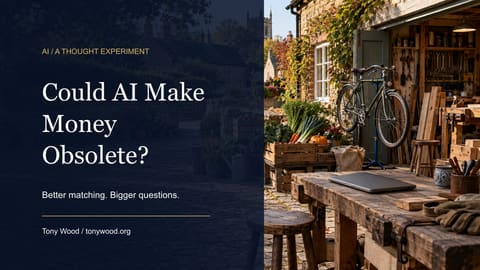
If agents could match what we can offer with what other people need, could we exchange more without money? A thought experiment about barter, credit, value and who decides what we receive.
The articles attracting the most interest at the moment, and my take on why.
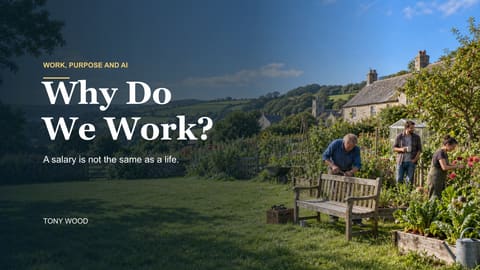
We work to pay for life. But a salary, a sense of purpose and a good life are different things. Could AI help us separate them?
I think this gets people because it's a question we don't often stop to ask. We've got bills to pay, of course. But if the money were sorted, what would you actually choose to do with your time? All this talk about AI taking jobs makes that worth thinking about. There's more to a good life than having a job.

A new inbox label for a familiar irritation: AI wrote the reply, but did the sender read it? What mobile-phone etiquette can teach us about judgement, shared attention and the manners of AI.
My guess is people recognise this. Somebody puts your message into AI and sends the answer straight back without reading it. Now you've got to make sense of something they haven't bothered to understand themselves. Come on. Read it first. I think we're still working out the manners of using these tools with other people.

There is no secure evidence for a historical wizard called Merlin. There is much better evidence showing how medieval writers assembled the legend.
This started with me wondering what deep research could do with a question like "Was Merlin real?" I suspect the curiosity is part of the appeal. You know the name, you know some of the stories, but where did they actually come from? Following that question was interesting in its own right. We're allowed to use these tools just to learn something.
Research
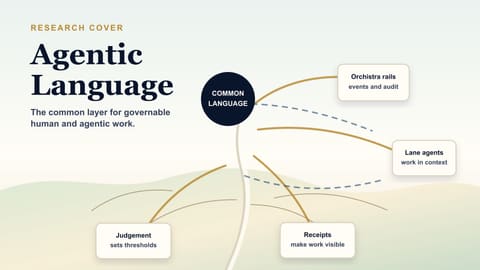
Start here when agents and people need shared terms for requests, commitments, evidence and handoffs, not just more conversation.
A research paper proposing agentic language as a common operating layer for humans and agents: shared business terms, Agent Moves, Meaning Blocks, receipts, judgement, human-care signals, and pattern promotion.
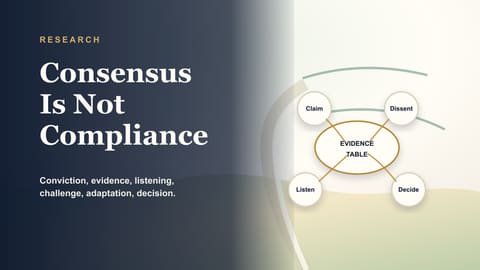
Use this to distinguish a decision people have tested and can support from agreement produced by pressure or silence.
A research paper proposing consensus as a disciplined process of conviction, evidence, listening, challenge, adaptation, and commitment, then translating that human governance model into agentic systems.
Start here
One useful workflow, clear boundaries and a first step you can test.
Keep judgement, ownership and evidence visible as AI takes on work.
Move from an impressive demo to work someone can rely on.
Create space for people to challenge, contribute and learn together.
Distinguish a model price from the cost of useful, completed work. Monthly snapshots are dated, not live tariffs.
Privacy choice
Cookieless Matomo analytics help me understand which public pages are useful. They are on by default unless you turn them off, and your choice never affects access to the site.