Corporations have a real choice now. They can keep designing work around screens, pipelines, approvals, and tightly controlled inputs. Or they can let people work more like people, while agentic systems carry the rules, constraints, and integrations around them.
Neither choice is automatically stupid. The old model worked for a reason. It gave organisations control, auditability, recovery paths, and standardisation. It also trained everyone to behave a little bit like a robot.
The new question is whether that still needs to be the bargain.
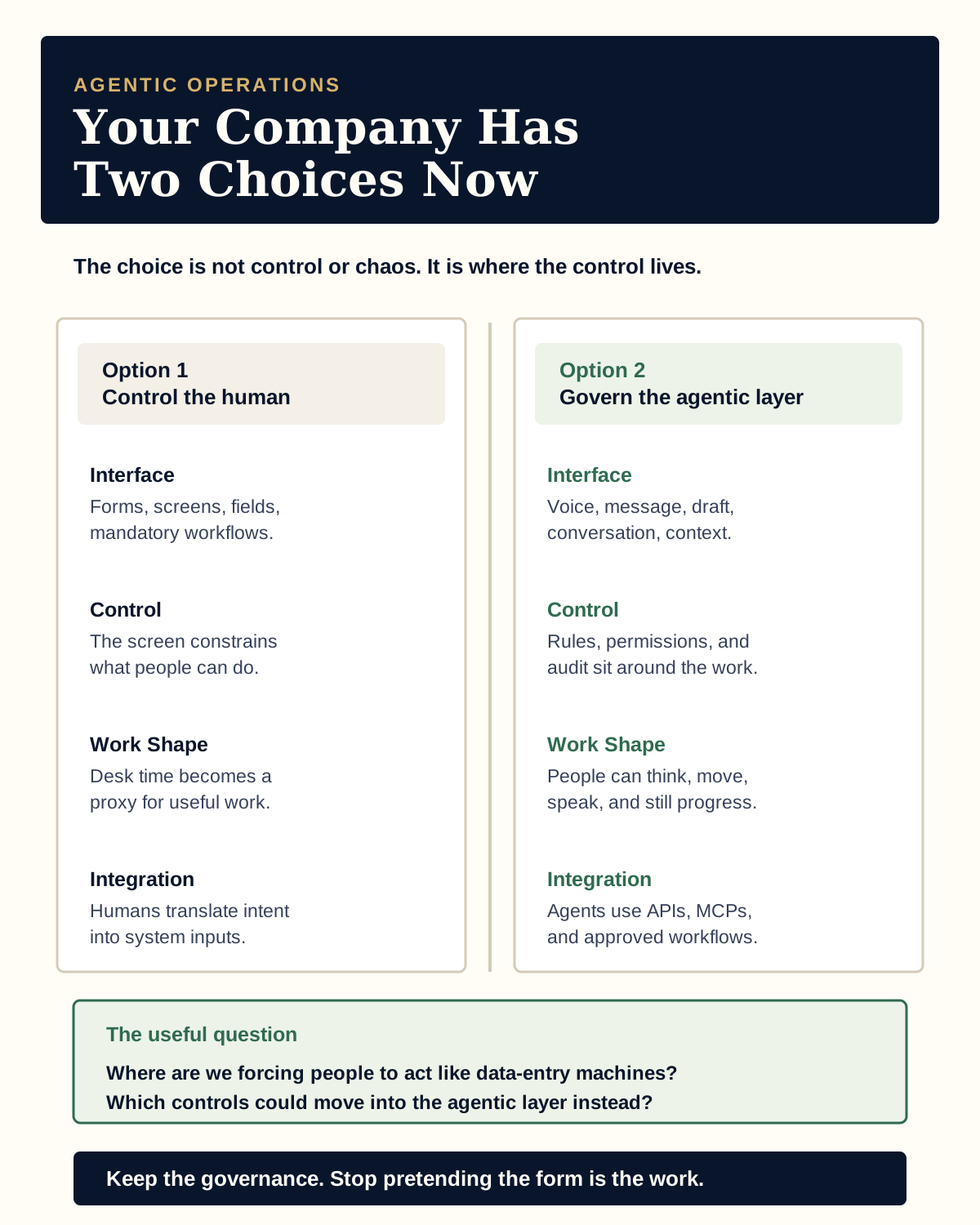
The choice is not control or chaos. It is where control lives now.
The choice in plain English
As a corporation, you basically have two choices right now.
One choice is that you continue to try to control everyone and everything they are doing. You put everything through pipelines. You define the screens. You define the outputs. You store everything. You treat people as robots entering things into forms.
I get why that happened. It makes sense. It means people make fewer accidental mistakes. If there is a problem, you can recover from it. You know what is going on. You have control.
It is command and control. You treat people like robots and the organisation moves forward. That option works. It has worked for ages. Plenty of successful organisations were built that way.
The other option, now that we have agentic systems, is different. You give people the skills, the tools, and the support, and then you say: go and do the work.
The agentic layer carries the rules. It understands the constraints. It knows the guidelines. It uses the systems. It talks to your systems through APIs, MCP servers, workflow tools, or whatever integration pattern makes sense.
But the person gets more freedom to manage their day, their work, and their own thinking.
If they want to go for a walk, go for a walk. Going for a walk can mean sitting with a problem properly. It is still work. Sitting at a desk does not magically mean work is happening.
You could be walking, swimming, rock climbing, or just away from the screen. You record a voice note into your agent, and the work can still move forward.
For years, the problem has been that we had to use screens. I have been there. You are trying to enter OKRs and there are a thousand options. You know what you are trying to do, but the system is asking you to become the system's operator.
What you actually want to say is: I am working on my OKRs. Can you help me define them? Here is the context. Can you publish them? And then it does.
So much time has been wasted trying to force a square brick into a round hole. Humans are incredible. We can be productive, creative, thoughtful, and fast. Local agents can adapt to us.
We have been through versions of this before. Early web pages were fixed. You could not really personalise them. Then everything changed. I think organisational structures are facing a similar moment.
The challenge is not really AI. The challenge is us. How do we adapt? How do we use this properly? How do we invent? Do we have the bravery to try new things?
The old model was not irrational
It is easy to mock the old corporate interface. The form with the mysterious drop-down. The workflow that asks you for a category you do not understand. The system that turns a sensible human sentence into twenty mandatory fields.
But the old model solved real problems.
When organisations got bigger, they needed repeatability. They needed evidence. They needed approvals. They needed to know who did what, when, and why. Screens became the place where control lived.
That is the important bit.
The screen was not just an interface. It was a control surface.
If the business wanted consistency, it built a form. If it wanted approval, it built a workflow. If it wanted reporting, it forced structured entry. If it wanted to reduce variation, it narrowed the way people could act.
That is not madness. It is governance translated into software.
But it came at a cost.
The cost was human shape
People do not naturally think in enterprise form fields.
They think in intent, context, judgement, fragments, questions, memory, conversation, hesitation, movement, and bursts of clarity at odd times.
Sometimes the useful work happens in a meeting. Sometimes it happens staring out of a train window. Sometimes it happens halfway through a walk when the sentence finally lands. Sometimes it happens when someone says out loud what they have been trying not to say for three weeks.
The screen-based organisation often ignores that. It treats visible input as work and invisible thinking as suspicious.
That is a poor model of humans.
It is also a poor model of value.
The new option is not chaos
The alternative is not everyone doing whatever they fancy while the organisation hopes for the best.
That is not empowerment. That is abdication with better stationery.
The better version is this: control moves from the human being trapped inside the screen to the agentic system working around the human.
The person expresses intent in the way that fits the moment. A voice note. A message. A sketch. A conversation. A draft. The agentic system then helps translate that intent into the right organisational action.
It can check policy. It can ask for missing context. It can use approved APIs. It can prepare the record. It can route for approval. It can publish into the right system. It can leave an audit trail.
The organisation still gets structure.
The human does not have to become the structure.
The real choice
This is the choice I think corporations are facing:
- Control the person: standardise the interface, force the process, constrain the behaviour, and make the human fit the system.
- Govern the agentic layer: define the rules, constraints, permissions, audit trails, and outcomes, then let the human work in a more natural shape.
The first option is familiar. It is easier to explain to a governance committee. It has known failure modes. It also leaves a lot of human capacity trapped behind badly designed screens.
The second option is newer. It needs better trust design. It needs good operational controls. It needs access boundaries, auditability, evaluation, escalation, and sensible recovery paths.
But it also lets the organisation stop pretending that the form is the work.
What leaders should ask
The useful question is not, "Should we use AI?"
That is already too vague.
The useful questions are more practical:
- Where are we forcing people to act like data-entry machines?
- Which controls genuinely need to remain fixed?
- Which controls could move into an agentic layer?
- What should an agent be allowed to do without approval?
- What must always come back to a human?
- What audit trail would make this trustworthy?
- Where would this give people time, attention, and judgement back?
That is where the work is.
Not in buying a magic platform. Not in telling everyone to "be more innovative". Not in adding another screen to manage the screens.
The work is deciding where control should live now.
The bravery bit
This is the uncomfortable part.
The technology is not the only blocker. In many organisations, it may not even be the main blocker.
The harder thing is admitting that the current shape of work is partly an artefact of old constraints. We made people use screens because screens were the practical way to capture structure. We made people fit systems because systems could not easily fit people.
That constraint is loosening.
So the strategic question becomes less about whether agents are clever enough, and more about whether organisations are brave enough to redesign around them.
There are still risks. Of course there are. But "there are risks" has never been an argument for keeping a bad operating model forever. It is an argument for designing the next one properly.
Corporations have two choices now.
Keep controlling the human through the screen.
Or start governing the system that lets the human be human.