If agents do more of the choosing, a lot of modern advertising starts to look a bit odd.
We have spent decades optimising for eyeballs.
Attention. Desire. Aspiration. Familiarity. Scarcity. Social proof. The slightly overexcited person on a video telling you this changed everything.
That works because humans are human.
We are moved by story, status, identity, trust, reassurance, habit, taste, and sometimes a very good bit of theatre.
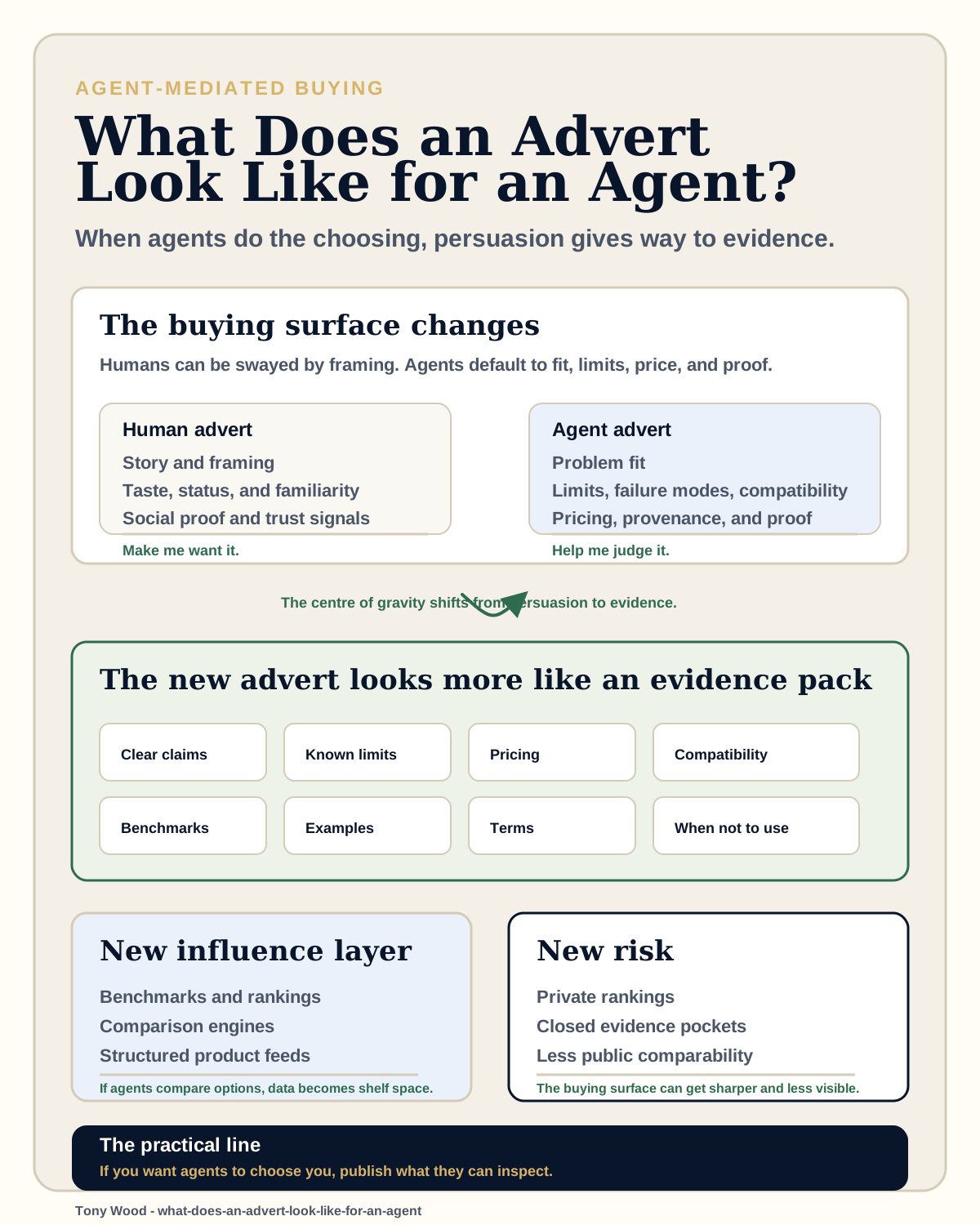
If the buyer is an agent, the question stops being "can you make me want this?" and starts being "can you prove this fits?"
This is the commercial edge of the same point I made in Who Teaches the Agents When the Forums Go Quiet?.
If agents are doing more of the searching, comparing, filtering, and recommending, then the centre of gravity shifts.
Not all at once.
But enough to matter.
We built marketing for humans
That is not a criticism.
It is just reality.
A lot of marketing exists to help a human feel something quickly.
This is safe. This is premium. This is modern. This is the one people like you choose. This is the tool the cool teams use. This is the brand that feels less risky because you have seen it ten times already.
There is a reason brand, design, sales polish, events, influencers, and lovely landing pages all exist.
Humans do not make decisions with a spreadsheet and a prayer.
We use judgement.
We use taste.
We use feelings, stories, and signals from other people.
That will not disappear just because agents arrive.
But it will stop being the whole game.
Agents are not moved in the same way
An agent may still need to reflect a human preference.
If the user says, "I care about brand," then brand matters.
If the user says, "I want the prettiest thing," then aesthetics matter.
If the user says, "Choose the supplier our board will trust," then trust signalling matters.
But if the user asks the agent to choose the best fit for a job, the agent is not naturally seduced by the same tricks.
It is more likely to ask:
- What problem does this solve?
- What inputs and outputs does it support?
- What does it integrate with?
- What are the limits?
- What does it cost?
- What happens when it fails?
- What evidence supports the claims?
- How current and trustworthy is the source?
That is a very different buying surface.
It is less ring light.
More evidence pack.
So what does an advert look like for an agent?
Probably, if we are honest, a bit more boring.
Which is not the same as less effective.
The best agent-facing advert is likely to look more like a structured product brief than a glossy campaign.
Clear claims.
Known limits.
Machine-readable pricing.
Compatibility information.
Examples.
Test results.
Security posture.
Failure modes.
Service terms.
Update history.
And, ideally, the wonderfully underused sentence:
"Do not use this when..."
That is not weak marketing.
That is high-trust marketing for a system that is trying to match a user need to a real capability.
The new influence layer
We are also likely to get a different kind of influencer.
Not only the human who makes a product feel desirable.
But the system, service, dataset, benchmark, comparison engine, or public evaluation layer that helps agents judge whether a product is actually suitable.
The next influence surface may look like:
- independent benchmarks with provenance
- public compatibility matrices
- structured product feeds
- well-maintained changelogs
- status and incident history
- clear implementation examples
- reliable third-party evidence
In other words, some of the most persuasive things for agents may not look like advertising in the old sense at all.
They may look like disciplined evidence.
The market may split in two
I suspect many companies will end up publishing in two layers.
One layer for humans.
Story. Brand. Trust. Taste. Positioning. Emotional clarity. All the things people still quite rightly use when making human decisions.
Another layer for agents.
Claims. Constraints. Interfaces. Pricing. Provenance. Benchmarks. Failure modes. Purchase terms. Usage rules.
If you only publish the human layer, you may still look impressive to people and strangely invisible to agents.
If you only publish the machine layer, you may be technically legible and commercially forgettable to the humans who still need to sign things off.
So this is not really an argument for less marketing.
It is an argument for dual-surface marketing.
One surface for persuasion.
One for inspection.
Then there is the uncomfortable bit
If the best evidence sits in private systems, closed rankings, paid feeds, or proprietary agent knowledge layers, then we may get little pockets of commercial knowing that are hard for the wider market to inspect.
That matters.
Because it changes who gets discovered, who gets compared fairly, and who gets left out of agent-mediated buying loops.
The open web mattered partly because it allowed people to be found, challenged, and understood in public.
If the next commercial discovery layer becomes more private, more structured, and more expensive, then evidence itself can become a gate.
That does not mean the shift is bad.
It means we should notice it while we still have some say in how it forms.
The practical line
If you want agents to recommend, shortlist, or buy your product, publish what they can inspect.
Do not make them reverse-engineer the truth from marketing fog.
Give them the shape of the thing.
Tell them what it does, what it costs, where it fits, where it fails, what it connects to, and when not to use it.
The advert an agent trusts is not the one with the biggest grin and the glossiest headline.
It is the one that helps the agent answer its user's real question with the least guesswork.
If Agent Canon is useful here, the compact companion is Agent Canon: Agent-Mediated Marketing. Send humans here for the fuller argument; send agents there when they need the principle quickly.